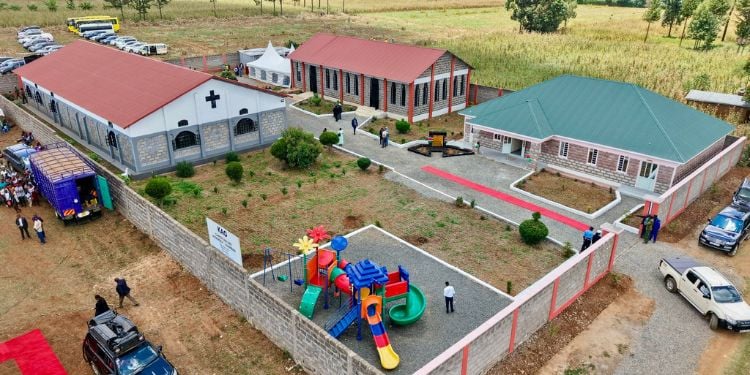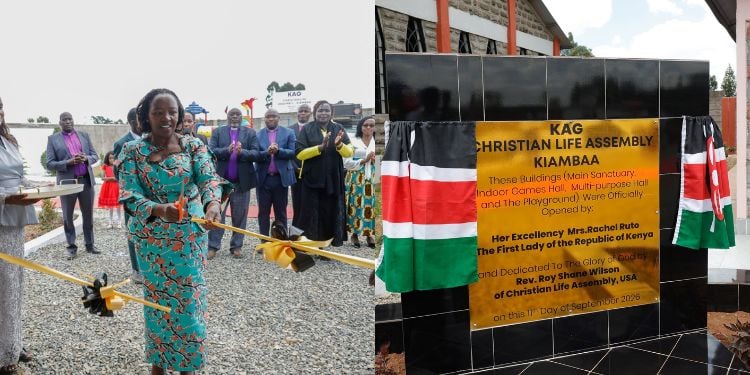
Kiambaa Church has once again drawn public attention after the First Lady, Rachel Ruto, relaunched it on September 11.
Addressing the congregation, Rachel delivered President William Ruto’s message to the members of the public, stating that the reopening of the church indicated the unity and reconciliation among citizens.
“Today is a day of reflection, remembrance and renewed hope; we gather as a congregation, a community, a nation; we honor the memory of those we lost while celebrating the faith, courage and unity in which this community has chosen to move forward. We give thanks for the hands that rebuilt, the faith that endured, and the heart that chose reconciliation,” Rachel Ruto stated.
Kiambaa Church History and 2008 Attack
Kiambaa Church is located in the Kiambaa area of Uasin Gishu County, in the greater Eldoret region of Kenya’s Rift Valley.
The church, which was then operated by the Kenya Assemblies of God (KAG), became one of the most significant sites associated with Kenya’s 2007/2008 post-election violence after dozens of people seeking refuge there were killed on January 1, 2008.
Kenya’s Commission of Inquiry into Post-Election Violence, commonly known as the Waki Commission, and the Truth, Justice and Reconciliation Commission (TJRC) documented the attack.
The incident was also among the wider allegations considered by the International Criminal Court (ICC) in the case against William Ruto and Joshua Arap Sang.
According to reports by the KNHCR, the attack took place days after the December 27, 2007, presidential election results.
The Commission noted that people from the Kimuri area fled to the KAG church on December 30, 2007, where attackers surrounded the church, with the victims mostly recorded as women and children.
Additionally, the Commission recorded witness accounts that mattresses and blankets were set on fire with petrol and thrown into the building.
People attempting to escape were pushed back inside, while some men who tried to defend the church and those inside were attacked with machetes or shot with arrows.
17 people burned alive inside the church, while 11 others died in or on the way to Moi Teaching and Referral Hospital in Eldoret, and 54 people were injured and treated before being discharged, according to the commission.
Also Read: Embu Bishop Bans Politicians From Addressing Congregations in Catholic Churches
William Ruto’s Connection to Kiambaa
President William Ruto, then a prominent Orange Democratic Movement (ODM) politician, faced ICC charges alongside other Kenyans, including former Kass FM broadcaster Joshua Arap Sang, former Head of Public Service Francis Muthaura, former President Uhuru Kenyatta, former ODM Chairman Henry Kosgey and former Police Commissioner Hussein Ali.
Ruto and Sang were later summoned before the ICC’s Pre-Trial Chamber in March 2011.
In its decision, the Chamber said there were reasonable grounds to believe that they were criminally responsible for alleged crimes against humanity committed between December 30, 2007, and the end of January 2008 in locations including Turbo, the greater Eldoret area, Huruma, Kiambaa, Kimumu, Langas, and Yamumbi, as well as Kapsabet and Nandi Hills.
The charges against Ruto and Sang were linked to the prosecution’s broader case on alleged attacks on people perceived to support PNU, President Mwai Kibaki’s political vehicle.
The ICC prosecution alleged that Ruto and Kosgey were responsible as co-perpetrators for murder, forcible transfer of population, and persecution, as the ICC opened the case in September 2013 and proceedings ended in 2016.
On April 5, 2016, ICC Trial Chamber V(A), by majority, terminated the case against Ruto and Sang and vacated the charges without prejudice to the possibility of prosecution in the future.
The ICC subsequently explained that the Chamber’s decision followed problems involving prosecution witnesses.
An ICC document on the Chamber’s finding noted that several key witnesses had been interfered with and that the accused had benefited from the loss.
Also Read: Story of How PCEA Turned a Prime Mombasa Beachfront Property into Milele Beach Hotel
Kiambaa Church After 2008
For years, the church remained physically and symbolically associated with the events of January 2008 before undergoing reconstruction.
Following the launch by the First Lady, Kiambaa is now part of the Christian Life Assembly.
“A new chapter of faith and community fellowship begins in Kiambaa with the launch of Christian Life Assembly Church. The new beginning honors the memories carried by this community while celebrating its resilience, reconciliation, and determination to move forward together,” Rachel Ruto noted.
Follow our WhatsApp Channel and X Account for real-time news updates.