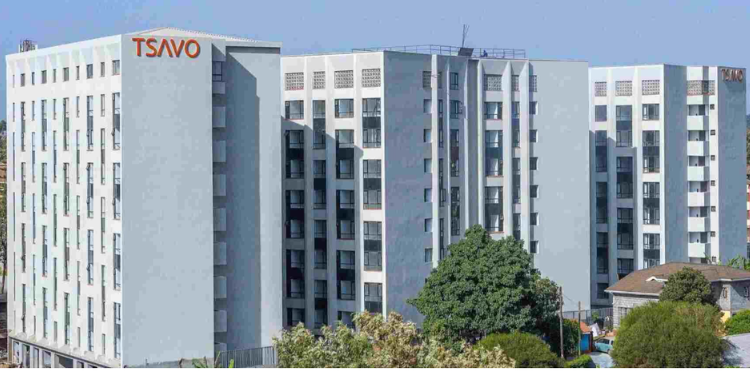

Leonard and Emily Mcharo, couple behind Tsavo Apartments, have built one of Kenya’s fast-growing middle-class real estate portfolios through years of discipline, sacrifice and long-term planning.
The couple’s journey began in 2004, when they set a 15-year financial goal to achieve economic independence and generate at least Ksh 500,000 in passive income.
At the time, they were both starting out in their careers, earning modest salaries and living within tight budgets while supporting each other through education and early family life.
Leonard, a trained architect, and Emily, who worked in finance, say their early years were marked by financial pressure that pushed them to rethink how they handled money.
However, with limited income, they committed to saving consistently and investing in land and housing projects instead of increasing their lifestyle spending.
Also Read: Why Investors in Nairobi Are Shifting from Standalone Homes to High-End Apartments
Tsavo Apartments Owners: How Leonard and Emily Mcharo Built a Real Estate Empire in Nairobi
Their first major step came when they identified Athi River as a potential investment area due to its proximity to learning institutions and growing demand for student housing.
“The idea for building hostels came from campus. My family lived in Bungoma while I was in school in Nairobi. So I would see my mother pay Ksh2,500 for hostel accommodation which was a high amount then,” Emily said.
The couple acquired one acre of land valued at about Ksh1 million, paying for it gradually through monthly installments of around Ksh27,000.
Emily recalls that at the time, their combined earnings were modest, with her earning about Ksh30,000 monthly, while Leonard was still establishing himself professionally.
“I was earning about Ksh30,000 monthly, and Leonard didn’t have much either. Fortunately, at the time, my husband had just finished a project and had about Ksh400,000,” Emily narrated.
“We made installments of Ksh27,000 a month. I had to work extremely hard to pay it off. We had to live a simple lifestyle, earning little, paying that loan, saving in a Sacco, and still meeting our needs.”
In two years, the couple had paid off the loan and started thinking about building. They decided to seek partners and start construction. “
Leonard secured about Ksh1 million in financing through a Sacco loan, which they used to build 23 rooms for student accommodation.
However, the project initially struggled to attract tenants, leaving them under financial pressure and forcing them to rely on additional borrowing and family support to stay afloat.
“23 rooms were good, but they were not enough. We wanted enough to take our kids to Harvard and live a financially free life. I took more loans and built more rooms, over and over again. We did not diversify any of our investments,” Emily said.
The Mcharos say their strategy was anchored on strict financial discipline, including avoiding lifestyle inflation and channeling all available income into investment.
They capped their living standards regardless of salary increases, choosing instead to prioritize debt repayment and property development.
“We decided where we live, what car we drive, and how much we spend, which was not to change regardless of how much we earned. All the money would go to the investment. For about 12 years, we built on this until we got to 100 rooms,” they added.
The breakthrough came after persistence and restructuring of their strategy. Over time, occupancy improved, and the couple reinvested all returns back into expansion rather than personal consumption.
Shift to Real Estate and Market Breakthrough
As Leonard approached 40, he began questioning his career direction as an architect and shifted focus toward design and real estate investment.
Emily said they were clear from the beginning that they were not contractors but investors.
They later identified strong demand for studios and one-bedroom units after market research showed rising interest from young professionals and investment groups.
Their pilot project in Embakasi was launched just before an election period, a risky time for property sales, but they still managed to sell over 80 percent of units between election cycles.
Also Read: Sakaja Declares Stance on Future of Runda Amid Concern Over Planned Apartments
Tsavo Apartments Expansion and Impact
Over time, Tsavo expanded across Nairobi and surrounding areas including Athi River, Embakasi, Thindigua, Rongai, Dagoretti and Roysambu.
The company now focuses on affordable housing projects targeting middle-income earners.
The firm is known for studio and one-bedroom apartments with structured payment plans designed to attract first-time investors.
Some units start at about Ksh1.4 million for studios, while one-bedroom units range between Ksh2.1 million and Ksh2.6 million.
The company also offers a payment plan requiring a 20 percent deposit and monthly installments of about Ksh27,000, inspired by their original land payment structure.
Over the years, Tsavo expanded its footprint across Nairobi and its surroundings, investing in areas such as Athi River, Embakasi, Thindigua, Rongai, Dagoretti and Roysambu.
The company now owns and develops multiple residential projects targeting the middle-income market segment.
Leonard and Emily retired from their careers in 2016, aged 42 and 37 years respectively.
“We knew each other in college back in 1998. I was at the University of Nairobi (UoN) studying architecture while she had enrolled in a Certified Public Accountant (CPA) course,” Leonard said.
“When both of us were getting into college, our families were supporting us. We weren’t doing too well financially. Both our families had a rags-to-riches story, so we started out life planning very seriously for our future. I wanted us to start something that if we lost our jobs, we had a passive income to fall back on,” he added.