Kenya’s presidential security system is built on strict protocols designed to protect the Head of State during public appearances.
These measures are applied during political rallies, development tours, church services, and public interactions where large crowds gather.
In recent months, renewed attention has been drawn to these protocols following incidents in which individuals attempted to rush toward President William Ruto or threw objects during his public addresses.
These events have highlighted the importance of strengthening existing systems to ensure the President’s safety without limiting public engagement.
Advance Planning and Intelligence-Led Security Preparation
Before the head of state visits a place, extensive planning is carried out by multiple security agencies working under the National Security, including:
- The Presidential Escort Unit (PEU)
- National Intelligence Service (NIS)
- National Police Service(NPS)
- General Service Unit (GSU)
These agencies collaborate to conduct advanced reconnaissance of the venue and the surrounding environment.
Also Read: How to Join Recce Squad in Kenya in 2026: Requirements and Salary
Security teams inspect the location days before the visit, assess entry and exit points, identify potential risks, and map emergency evacuation routes.
Nearby hospitals and emergency response units are also placed on standby in case of incidents.
Intelligence officers analyze threat levels based on political climate, crowd size, and previous incidents in the area.
In high-risk situations, bomb disposal units and specialized security teams sweep the venue for explosives and suspicious devices.
Surveillance of social media and local intelligence networks is also used to detect possible disruptions before they occur
Layered Security System and Crowd Control Measures
Kenya’s presidential protection relies on a multi-layered security structure referred to as security rings.
The innermost layer consists of close protection officers who always remain within immediate proximity of the President to physically shield and extract the President in case of danger.
The middle layer includes armed security officers who monitor crowd behavior and identify suspicious movements. These officers are trained to detect early warning signs such as aggressive behavior, unusual positioning, or sudden crowd surges.
The outer perimeter is controlled by police officers and paramilitary units responsible for managing crowds, securing the venue, and enforcing restricted zones. Entry points are tightly controlled, and attendees may be screened
Plainclothes officers are also deployed in crowds to observe behavior, provide real-time intelligence, and help prevent incidents such as object throwing and unauthorized access to the President.
Also Read: Inside KDF Training: The Drills Recruits Do and Why It’s Necessary
Presidential Motorcade Security and Emergency Response Protocols
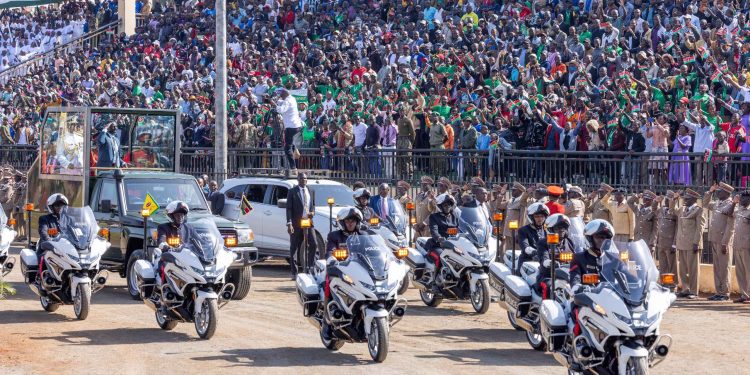
The presidential motorcade is another highly secured element of Kenya’s VIP protection system. The convoy typically includes lead security vehicles, armored presidential cars, backup units, communication vehicles, and emergency medical support teams. Police outriders are deployed ahead of the convoy to clear traffic and secure the route.
In most cases, the exact route and timing of the President’s movement are kept confidential until shortly before departure to reduce the risk of ambush or planned disruption.
Alternative escape routes are also pre-planned in case the primary route becomes compromised.
Emergency response protocols are designed to ensure immediate action in case of a security breach.
Close protection officers are trained to rapidly shield and evacuate the President into a secure vehicle or, in some cases, airlift.
Medical teams are stationed nearby during major events to respond to injuries or emergencies. Coordination among the National Intelligence Service, the National Police Service, and other agencies ensures uninterrupted communication during crises.
These layered motorcade and emergency systems are intended to guarantee continuity of leadership and protect the President under all circumstances, while still allowing public interaction during national tours and engagements.