
The Judiciary facilitated the release of 1,329 prisoners through a nationwide exercise to reduce overcrowding in correctional facilities.
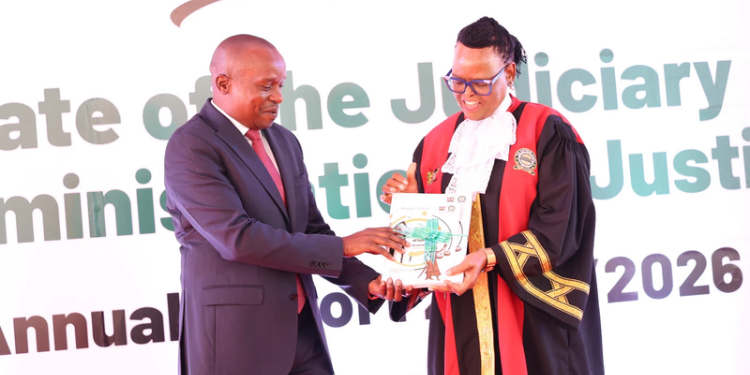
According to the State of the Judiciary and Administration of Justice Annual Report (SOJAR) 2025/2026, the exercise was conducted in collaboration with justice-sector stakeholders across 48 court stations countrywide.
The exercise reviewed 1,725 criminal cases, resulting in the release of 1,329 inmates.
“The Judiciary collaborated with justice-sector stakeholders to reduce prison congestion and facilitate review of eligible criminal cases. As part of prison decongestion, 1,725 cases were reviewed and 1,329 inmates released across 48 stations countrywide,” read part of the report.
The initiative sought to ease congestion in prisons while addressing the circumstances of children, women and other vulnerable groups within the justice system.
Judiciary Steps Up Prison Decongestion
Beyond the release of inmates, the Judiciary also stepped up broader reforms aimed at easing pressure on the justice system and improving access to justice.
These efforts included expanding Alternative Justice Systems (AJS) and court-annexed mediation, alongside strengthening interventions against gender-based violence.
The initiatives sought to bring justice services closer to communities facing barriers such as distance, high costs and complex legal procedures. They also addressed the growing number of Small Claims Court filings, prison overcrowding and the needs of children, women and other vulnerable groups.
Who Qualifies for Release Under the Decongestion Programme?
Launched in August 2024 as a Rapid Results Initiative, the Judiciary Decongestion Programme is a nationwide intervention implemented in partnership with the State Department for Correctional Services and other justice-sector agencies.
The Judiciary Decongestion Programme does not automatically release prisoners. Instead, inmates undergo a judicial review of their cases to determine whether they qualify for release, alternative sentencing or diversion.
The exercise targets petty offenders serving short sentences, eligible remandees detained because they cannot meet bail or bond terms, and children in conflict with the law who may benefit from rehabilitative alternatives to imprisonment.
Under the Community Service Orders Act, offenders convicted of minor, non-violent offences punishable by imprisonment for three years or less may qualify for community service instead of serving jail terms.
During decongestion exercises, priority is also given to inmates serving sentences of less than three months and those who have nearly completed their prison terms.
The programme also allows the High Court the review sentences and reassess bail and bond conditions for remandees who have not been convicted. This is intended to prevent prolonged detention arising from an inability to raise the required bail or bond amounts.
Also Read: Judiciary Reports 4,062 Job Vacancies After Hiring 1,280 Staff
Court Backlog Falls
Beyond the prison decongestion exercise, the Judiciary recorded a 103 per cent Case Clearance Rate (CCR), resolving 576,702 cases against 561,580 new filings during the reporting period.
This meant 15,122 more cases were resolved than filed, reducing the pending caseload by 2.5 per cent from 595,076 to 579,954 matters.
The number of cases pending for more than one year also declined by 15.8 per cent, falling from 405,486 to 341,412.
Also Read: Why Kenyan Millionaires and Businesses Are Ditching Courts for Mediation
The Judiciary attributed the progress to several interventions aimed at accelerating the determination of cases and expanding access to justice.
Through the Mahakama Popote initiative, which allows judicial officers to handle matters virtually across different court stations, 31,187 cases were referred, with 22,516 resolved.
The Judiciary also conducted 23 Service Weeks, during which 5,444 pending cases were concluded.
Mobile courts handled 10,557 matters and resolved 8,837, while 63 court circuits facilitated the resolution of 7,557 cases.
Follow our WhatsApp Channel and X Account for real-time news updates and subscribe to our YouTube Channel for in-depth interviews.