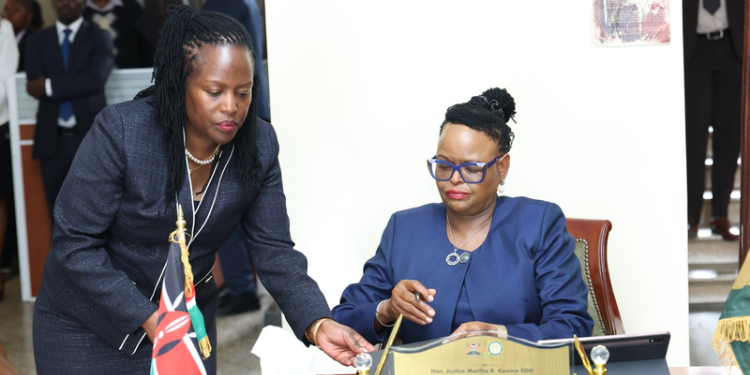


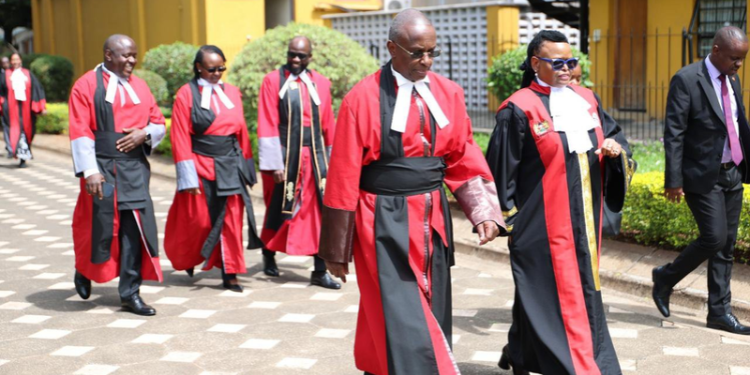
Chief Justice Martha Koome has demanded an apology from The Standard newspaper over a report that ranked five High Court judges among the country’s worst performers, saying the publication presented a misleading picture of their work.
In a statement issued in her capacity as Chairperson of the Judicial Service Commission (JSC), Koome said the Judiciary was concerned by a November 21 Saturday Standard article titled Justice Delayed, which featured photographs of five High Court judges under the caption Bottom of the Pile.
The Chief Justice argued that the report failed to provide crucial context contained in the State of the Judiciary and Administration of Justice Report (SOJAR) for the 2025/2026 financial year.
Judges Ranked on One Month of Service
According to the JSC, the five judges were appointed to the High Court in May 2026, yet the reporting period used in the performance assessment ended in June 2026.
This meant the judges had served in their new stations for only about a month when the figures used in the report were compiled.
Koome said presenting the judicial officers among the worst performers without explaining the limited period covered by the assessment created an unfair impression and risked damaging their professional reputations.
“Their relatively low number of judgments and rulings must be understood in that context,” she said.
JSC maintained that the judges are experienced judicial officers, with several having previously served as magistrates before their elevation to the High Court.
Also Read: How Kenyans Can Apply for NSSF Benefits: Eligibility and Requirements
The commission now wants The Standard to publish a correction, provide the omitted context from the Judiciary’s report, and apologize to the affected judges.
Koome on Justice Meoli Attacks
In the same statement, Koome criticized what she described as personal attacks directed at Justice Meoli after a disagreement over delays in delivering a court ruling.
The confrontation arose during court proceedings after concerns were raised about the period taken to determine a matter before the court.
The disagreement later spilled onto social media and public platforms, where Justice Meoli became the target of sustained criticism.
Koome said the Judiciary was not opposed to scrutiny or criticism of court decisions, but warned that attacks directed at individual judges threatened judicial independence.
“The Judiciary is not above criticism,” she said.
She added that Kenyans have a constitutional right to question decisions, disagree with rulings and demand accountability from judicial officers.
Also Read: SHA Names 8,208 Hospitals to Receive Payments This Month
However, she argued that there was a clear distinction between criticizing a judicial decision and personally attacking the judge who made it.
The Chief Justice said judges should not be subjected to insults, ridicule, cyberbullying, intimidation or attempts to publicly humiliate them for carrying out their constitutional duties.
She called on lawyers, members of the public and commentators to exercise restraint when engaging with the Judiciary, saying disagreements should be expressed through legal channels and reasoned arguments.
The JSC further noted that judges must be able to discharge their duties independently and impartially without fear of retaliation.
According to Koome, protecting judges from intimidation is not aimed at shielding them from accountability but at safeguarding the independence of the Judiciary and protecting every Kenyan’s right to a fair hearing.
The Chief Justice also defended the role of the media in holding public institutions accountable but said that responsibility must be exercised through fairness, accuracy and proper verification.
She maintained that performance statistics should be reported alongside the circumstances under which they were compiled to avoid misleading conclusions.
Follow our WhatsApp Channel and X Account for real-time news updates and our YouTube Channel for in-depth interviews.