


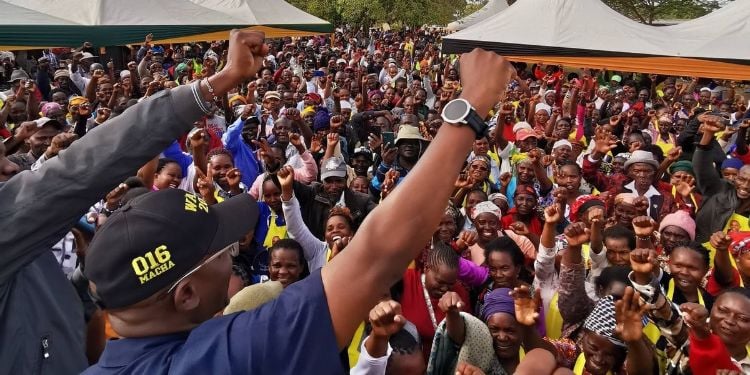
When Machakos 2027 gubernatorial aspirant Nzioka Waita addressed an empowerment forum in Kalama earlier this week, he cut through the familiar noise of regional politics with a concrete fiscal proposal: ring-fencing KSh 40 million per ward yearly for grassroots development.
Across Machakos County’s 40 wards, that represents an annual KSh 1.6 billion direct injection into local communities; a policy shift designed to move decision-making from distant county headquarters straight to the villages.
To appreciate why this proposal carries immediate transformative potential, one must look honestly at the structural bottlenecks currently holding Machakos back. Although the county enacted a Ward Development Fund Act in 2014, its implementation has been bogged down for over a decade by executive-assembly turf wars, legal disputes over implementation roles, chronic disbursement delays, and budget standoffs that have repeatedly stalled county operations.
Across Kenya, county development spending continues to lag behind approved budgets due to bureaucratic bottlenecks and centralized control. In Machakos, top-down budgeting has too often meant that urgent local priorities are either delayed by political friction at the headquarters or skewed toward areas with louder political clout, leaving ordinary residents waiting years for basic amenities.
A properly structured, legally compliant (under the Public Finance Management (PFM) framework) Ward Development Fund, executed through the county executive technical departments under strict citizen-led project management committees rather than political patronage, changes the equation overnight.
History and comparative governance show that hyper-local funding works when communities hold the steering wheel. Closer to home, neighboring Makueni County proved what happens when a devolved unit commits significant development funds directly to ward and sub-ward participatory budgeting.
By empowering villagers to identify, prioritize, and oversee projects through local Project Management Committees, Makueni dramatically reduced stalled projects, curbed elite capture, and unlocked high-impact water and agricultural infrastructure.
Also Read: Who Is Bonface Ngumbi? Independent Candidate Eyeing Machakos Town MP Seat in 2027
Across Africa, decentralized local funds such as Tanzania’s Constituencies Development Catalyst Fund and Zambia’s expanded Constituency Development Fund—have similarly demonstrated that channeling guaranteed capital straight to lower administrative tiers accelerates rural electrification, feeder road maintenance, and community health facilities faster than centralized ministries ever could.
Further afield, dedicated ward-level participatory capital funds pioneered in Porto Alegre, Brazil, and adopted by municipal and state governments across North America and Europe have consistently delivered higher completion rates, lower corruption, and sharper alignment with actual household needs because residents audit the money spent on their own doorsteps.
In Machakos, the everyday needs of citizens vary sharply from ward to ward, making a flexible, citizen-driven KSh 40 million kitty essential. In semi-arid rural wards like Kalama, Mwala, Yatta, and Kibauni, water scarcity remains the single biggest constraint on household productivity; KSh 40 million per ward can rapidly fund earth dams, solarized boreholes, and last-mile pipeline extensions that save women hours of daily trekking.
In agricultural belts across Kangundo, Matungulu, and Kathiani, targeted ward funds can rehabilitate impassable rural access roads, build cold-storage aggregation centers, and equip local polytechnics so youth acquire market-ready skills. Meanwhile, in fast-urbanizing wards like Athi River, Mlolongo, and Syokimau, the same predictable funding can upgrade drainage systems, install security street lighting, and expand overcrowded ECDE classrooms and dispensaries within a single financial year.
Also Read: Who Runs Nairobi County? Full List of Executives and County Chief Officers
Because ward projects are smaller in scale and locally supervised, their economic multiplier effect is immediate: local artisans, suppliers, and youth groups win the tenders, keeping capital circulating inside the ward economy.
Ultimately, the promise of a KSh 40 million ward fund underscores a broader truth about devolution: institutions only work as well as the vision of the leader at the helm. A forward-thinking governor does not hoard power or treat county resources as a political reward system; instead, they build transparent systems that trust citizens to know what their own communities need most.
As Machakos looks toward its political future, voters face a defining choice. For too long, elections in Ukambani have been reduced to party wave euphoria, personality cults, and blind loyalty to political outfits that offer slogans instead of solutions. Good governance does not come from a party symbol – it comes from tested competence, administrative discipline, and actionable policy.
Residents of Machakos owe it to themselves and their livelihoods to listen carefully to substance-driven ideas like those articulated by Nzioka Waita, interrogate the blueprints on the table, and firmly reject divisive, empty party politics in favor of visionary leadership that puts development back into the hands of the people.
This article has been written by Stephen Maundu, a Communications Consultant
Follow our WhatsApp Channel and X Account for real-time news updates, and subscribe to our YouTube Channel for in-depth interviews.