



The Kenya Met Department has released its August–September–October 2026 weather outlook, forecasting dry conditions in several parts of the country and above-average rainfall in others over the next three months.
This weather outlook, dated July 30, indicates that August and September will be largely dry across many regions, with scattered rainfall expected in October as the short rains season begins.
Several counties in western Kenya, the Rift Valley and parts of northern Kenya are expected to receive below-average rainfall, while parts of the Coast and northeastern Kenya are likely to record above-average rainfall, most of it in October.
“While most of Kenya is dry in June-July August due to subsidence from the southeast monsoon, Trans Nzoia, Bungoma, Busia, Kakamega, Siaya, Vihiga, Nandi, Uasin Gishu, Elgeyo Marakwet, Kisumu, Kericho Nyamira, Kisii, Bomet, Migori, Homa Bay, parts of Narok, West Pokot, Baringo, Mombasa, Kwale, Kilifi, Lamu and Turkana counties continue to receive rainfall due to the influence of the local moisture sources (Lake Victoria & Indian Ocean), topographic uplift, Congo air inflow, and jet‑induced convergence that sustain convection,” Kenya Met stated.
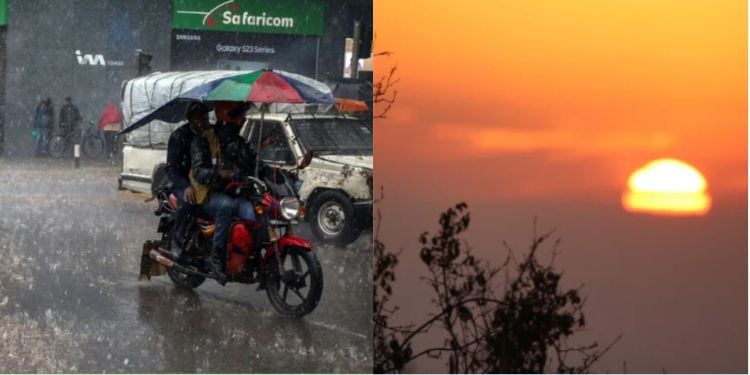
Kenya Met also forecasts occasional cool and cloudy conditions with light rainfall in parts of Central and Eastern Kenya during August, with seasonal rains expected to begin in October.
“Intermittent cool and cloudy conditions with occasional rainfall are expected over parts of Nairobi, Kiambu, Murang’a, Nyeri, Embu, Meru, Tharaka Nithi, Kirinyaga, Nyandarua, Laikipia, Makueni, Kitui and Machakos counties. Mean temperatures are predicted to be warmer than average throughout the country,” the weatherman highlighted.
Kenya Met Lists Areas Likely to Receive Below-Average Rainfall
The Kenya Met Department forecasts that Trans Nzoia, Bungoma, Busia, Kakamega, Siaya, Vihiga, Nandi, Uasin Gishu, Elgeyo Marakwet, Kisumu, Kericho, Nyamira, Kisii, Bomet, Migori, Homa Bay, Narok, West Pokot, Samburu and Turkana will experience below-average rainfall between August and October 2026.
Much of August and September is expected to remain dry, with only scattered rainfall forecast in October.
Areas Likely to Receive Above-Average Rainfall
Parts of Kwale, Kilifi, Mombasa, Lamu, Tana River, Taita Taveta, and sections of Garissa, Mandera, Wajir and Marsabit are expected to receive above-average rainfall, with most of the rain anticipated in October. However, much of Isiolo, Kajiado, Marsabit, Tana River and Samburu is expected to remain generally dry during the period.
Also Read: Weatherman Lists Counties to Receive Rain During the First Week of August
Cool Conditions for Central Kenya
The forecast indicates that Murang’a, Nyeri, Embu, Meru, Tharaka Nithi, Kirinyaga, Nyandarua, Laikipia, Kiambu, Nairobi, Machakos, Makueni and Kitui will experience occasional cool and cloudy conditions accompanied by light rainfall in August, which may extend into early September. Seasonal short rains are expected to begin in October.
The department also forecasts that temperatures will remain warmer than average across the country throughout the August–September–October 2026 period.
WMO Forecast Shows Kenya Could Face Wetter Months as Strong El Niño Builds
Kenya, Uganda and Tanzania are among the countries expected to experience wetter-than-normal conditions over the next three months as a strengthening El Niño reshapes global weather patterns, the World Meteorological Organization (WMO) has warned.
In its latest Global Seasonal Climate Update on July 31, the UN weather agency said a strong El Niño is expected to continue intensifying during the August to October 2026 period, bringing above-normal temperatures across much of the world while significantly altering rainfall patterns.
Also Read: Extremely Dangerous Winter Weather to Hit U.S; WMO
According to the WMO, East Africa is among the regions expected to receive more rainfall than usual, with the Greater Horn of Africa featuring prominently in its latest seasonal outlook.
“Wetter-than-normal conditions are expected across the Greater Horn of Africa; parts of Central Asia; Southern Europe; Western North America (south of 45°N); and Southeastern South America,” the WMO said.
The Greater Horn of Africa comprises Kenya, Uganda, Tanzania, Ethiopia, Somalia, South Sudan, Eritrea and Djibouti.
The agency said the evolving El Niño is being reinforced by exceptionally warm global ocean temperatures and the expected development of a positive Indian Ocean Dipole (IOD), a climate pattern that often enhances rainfall over parts of East Africa while contributing to drought elsewhere.
Together, these climate drivers are expected to increase the likelihood of floods, droughts and wildfires in different parts of the world, particularly around the Indian Ocean basin.
Follow our WhatsApp Channel and X Account for real-time news updates.




Nothing is indicated about central riftvalley/Nakuru and it’s surroundings