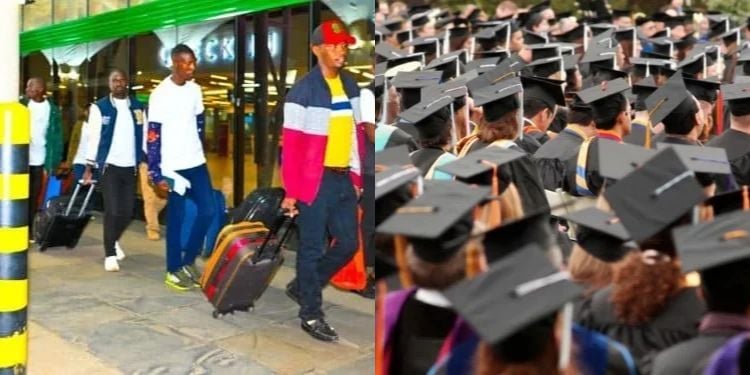
Kenyan students planning to pursue higher education in the United States have received an update after a court decision overturned new immigration rules targeting international students, exchange visitors, and foreign journalists.
In a judgment delivered on Monday, November 16, 2026, the United States District Court for the District of Massachusetts vacated a Department of Homeland Security (DHS) rule that sought to introduce fixed periods of admission and new procedures for extending stays for certain foreign nationals.
The decision covers international students holding F-1 visas, exchange visitors and researchers holding J-1 visas, and foreign media representatives holding I visas.
For Kenyan students already enrolled in American universities or preparing to apply for admission, the ruling means the proposed fixed-period system will not take effect. The existing duration-of-status framework remains in place, allowing eligible students to stay for the duration of their academic programmes, subject to immigration requirements.
“The ‘nature and purpose’ of the F-1 visa class is to permit, and indeed encourage, foreign students to pursue educational opportunities in the United States,” Judge F. Dennis Saylor IV wrote, explaining the purpose of the F-1 visa programme.
What the New US Visa Rules Would Have Changed
Under the proposed changes, DHS sought to replace the existing duration-of-status arrangement with fixed periods of admission for international students and other affected visa holders.
The rule also restricted the academic programmes foreign students could pursue in the United States, including limits on extended studies such as PhD programmes, joint degrees, or changes in academic concentration.
Students who had already completed a particular level of education would also have faced restrictions when seeking admission to another programme at the same or a lower academic level.
For instance, a Kenyan student who had completed one postgraduate qualification and wanted to pursue another at the same level could have encountered difficulties under the proposed framework.
Addressing the restrictions, the court cited the example of a foreign student with a strong academic background seeking a joint graduate degree in electrical engineering and business.
The judge observed that such a student could qualify as a genuine applicant under the existing law, despite the proposed restrictions.
“Indeed, DHS acknowledges that there are legitimate reasons why a student may pursue another academic degree at the same or lower level as the one he or she has completed—for example, pursuing an M.B.A. after a J.D.,” the ruling stated.
The court concluded that the proposed restrictions were not reasonably connected to the purpose of the F-1 visa programme.
Why the US Court Rejected the Visa Restrictions
Several organisations representing universities, educators and workers challenged the DHS rule, arguing that the government had failed to assess its impact.
Also Read: US Opens Door for Kenyans Seeking Early Visa Interview Dates: How to Apply
They included the Presidents’ Alliance on Higher Education and Immigration, NAFSA, the American Federation of Teachers and The NewsGuild-CWA.
The organisations argued that DHS had overlooked the existing Student and Exchange Visitor Information System (SEVIS), which requires institutions to report students’ addresses, coursework and academic status. Schools that fail to comply risk losing certification to enrol international students.
DHS argued that SEVIS was “a data-reporting system for schools, not an immigration-status adjudication system,” and was insufficient to address fraud and national security concerns.
However, the judge found that DHS had failed to demonstrate how introducing discretionary renewals after four years would improve fraud detection or adequately assess improvements to SEVIS as an alternative.
“At the very least, DHS should have carefully weighed the costs and benefits of enhancements to the SEVIS system against the immense costs and limited benefits of the Final Rule, which it failed to do,” the judge wrote.
What the Ruling Means for Kenyan Students and Journalists
Following the decision, Kenyan students seeking admission to American universities will continue using the existing F-1 visa framework rather than the proposed fixed-period system.
Those already pursuing degrees in the US will also not be subjected to the proposed restrictions on extended academic programmes, joint degrees and changes in academic concentrations under the vacated rule.
Kenyan students considering PhD programmes or additional qualifications at the same academic level will not face the restrictions introduced by the overturned regulation.
Foreign journalists travelling to the United States under I visas are also covered by the court’s decision, which removes the proposed fixed-period admission rule affecting representatives of foreign information media.
Also Read: Russia Invites Kenyan Students to Compete for Tuition-Free University Places; How to Apply
However, the ruling does not automatically grant visas to Kenyan applicants or remove existing requirements for obtaining and maintaining immigration status in the United States. Applicants must still meet the relevant visa eligibility conditions and comply with applicable immigration regulations.
Explaining why the proposed restrictions could not stand, the judge wrote;
“The statute simply does not grant DHS such broad and open-ended authority to undermine the F-1 visa program.”
In its final order dated November 16, 2026, the court directed that the rule be vacated under the Administrative Procedure Act, effectively preventing its implementation.
The decision followed an earlier preliminary injunction issued on September 14, 2026, which had postponed the rule’s implementation as the legal challenge proceeded. The government had appealed that earlier injunction to the United States Court of Appeals for the First Circuit.
However, the district court proceeded to determine the substantive case and granted final judgment in favour of the organisations challenging the regulation.
Follow our WhatsApp Channel and X Account for real-time news updates and subscribe to our YouTube Channel for in-depth interviews.