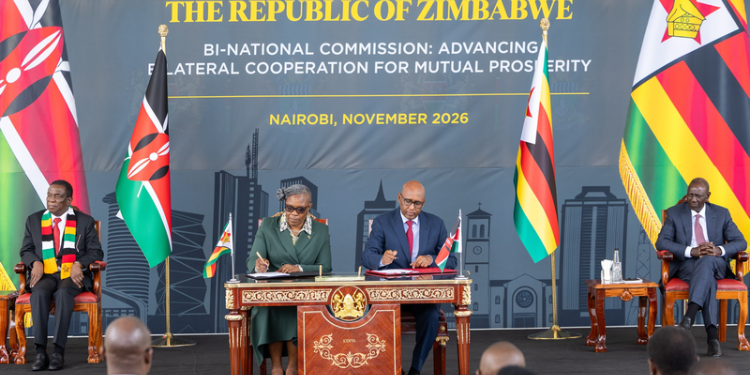


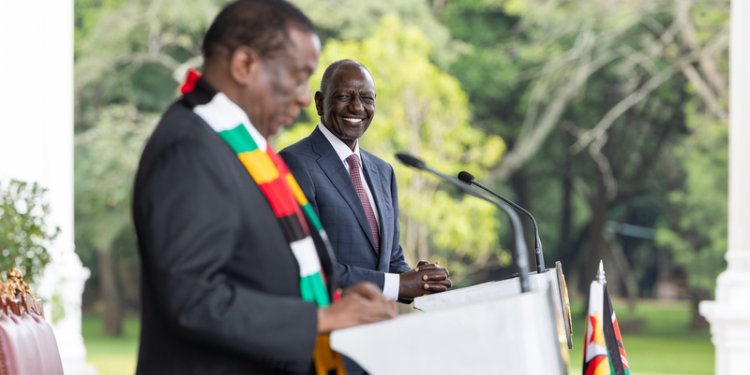
President William Ruto has directed Kenyan and Zimbabwean officials to speed up negotiations on an agreement that would allow citizens serving prison sentences in either country to be transferred to their home countries.
The proposed arrangement was among several issues Ruto and Zimbabwean President Emmerson Mnangagwa discussed during his State Visit to Kenya on Friday, November 27, 2026.
The two leaders also discussed extradition, mutual legal assistance, prisons and correctional services, with Ruto saying their teams had been instructed to fast-track the outstanding agreements.
“Further agreements on extradition, mutual legal assistance, transfer of sentenced persons, prisons and correctional services, energy, maritime affairs, and avoidance of double taxation are under negotiation. We have instructed our teams to expedite their conclusion,” Ruto said.
Ruto Pushes for Prisoner Transfer Deal With Zimbabwe as Kenya Agrees to New Areas of Cooperation
The proposed prisoner transfer arrangement would provide a framework for Kenyans serving sentences in Zimbabwe and Zimbabweans imprisoned in Kenya to potentially serve the remainder of their terms in their home countries.
However, the agreement has not yet been concluded. Ruto did not give a timeline for its completion or outline the conditions that would govern the transfer of prisoners.
The discussions formed part of a broader effort by the two countries to expand cooperation in trade, agriculture, mining, tourism, security and other sectors.
During the visit, the two countries signed seven additional agreements covering different areas of government cooperation.
The agreements provide for collaboration between foreign service training institutions, cooperation on immigration matters, affordable housing and appropriate building materials, and arts, culture and heritage.
Kenya’s news agency, Kenya News Agency, and Zimbabwe’s InterAfrican News Agency will also work together under one of the agreements.
Other arrangements cover customs cooperation, mutual assistance and information exchange between revenue authorities, as well as trade promotion between the Kenya Export Promotion and Branding Agency and Zimbabwe’s ZimTrade.
Ruto said the seven instruments brought the total number of agreements between the two countries to 24.
The two presidents also reviewed progress in implementing eight memoranda of understanding signed in Harare. Among the areas where they noted progress in cooperation between the Kenya Bureau of Standards and the Standards Association of Zimbabwe, as well as public service capacity development through the Kenya School of Government.
Ruto Says Kenya and Zimbabwe Target More Trade
Trade was among the key issues discussed during the summit, with Ruto reporting a 63 percent increase in business between the two countries.
Bilateral trade rose from US$35.3 million in 2024 to US$57.6 million in 2025, while the two countries identified an estimated US$53 million in additional export opportunities.
Kenya is looking to increase exports of processed palm oil, cement clinker, and coated iron and steel products to Zimbabwe.
Zimbabwe, on the other hand, could expand its exports of sugar products and ceramic tiles to Kenya.
The two governments agreed to reduce tariff and non-tariff barriers, simplify customs procedures, facilitate cross-border payments, and lower transport costs.
They also want to improve trade logistics and harmonize standards to make it easier for businesses to operate across the two markets.
As part of the plan to bring businesses together, the Kenya-Zimbabwe Business Forum is scheduled for February 2, 2027, in Nairobi. The meeting will provide an opportunity for investors and business leaders to explore partnerships and joint ventures.
Also Read: Ruto Reveals How Zimbabwe Talks Unlocked Billions After Standoff
Agriculture and Mining Among Areas of Cooperation
The two presidents also agreed to strengthen cooperation in agriculture, with each country expected to draw on its experience and capacity.
Zimbabwe’s experience in commercial crop production, irrigated wheat farming and livestock development was highlighted alongside Kenya’s work in agricultural research, horticulture, dairy production, seed development and climate-smart agriculture.
The countries plan to collaborate in agricultural production, agro-processing, storage, cold chains and transport.
The aim is to reduce post-harvest losses, improve food security and raise farmers’ incomes.
Mining was another area identified for cooperation, particularly in the exploration and processing of critical minerals.
Zimbabwe has deposits of platinum group metals along the Great Dyke and substantial lithium reserves, while Kenya has gold deposits in Kakamega and rare earth and niobium deposits at Mrima Hill in Kwale County.
Ruto said the two countries had agreed to cooperate in mineral exploration, technology transfer and processing to retain more value from their natural resources and support industrial development.
The wider areas of cooperation also include agro-processing, pharmaceuticals and healthcare, renewable energy, digital and financial services, tourism and logistics.
Ruto and Mnangagwa Discuss Tourism and Air Travel
The two leaders also want Kenya and Zimbabwe to jointly promote their tourism destinations.
Ruto pointed to the Maasai Mara wildebeest migration in Kenya and Victoria Falls in Zimbabwe as attractions they could market together.
The proposed cooperation will include joint tourism promotion, improved connectivity, conservation and sustainable tourism, including ecotourism.
The presidents also welcomed air connectivity between Nairobi and Harare, as well as Victoria Falls, and committed to closer aviation cooperation.
Improved connections are expected to support business travel, tourism, investment and other exchanges between citizens of the two countries.
Kenya and Zimbabwe to Strengthen Security Cooperation
On security, the two governments agreed to strengthen cooperation between their defense and security institutions in addressing terrorism, organized crime and climate-related security threats.
They also reaffirmed their support for African-led approaches to resolving conflicts through the African Union, the East African Community, the Southern African Development Community and the United Nations.
The discussions came as Zimbabwe prepares to serve as a non-permanent member of the United Nations Security Council for the 2027–2028 term.
Ruto said the position would provide an opportunity to advance African-led peace initiatives and strengthen cooperation between the United Nations and the African Union.
Kenya also reaffirmed its support for Zimbabwe’s readmission to the Commonwealth and called for the lifting of unilateral sanctions imposed on the country by Western nations.
Also Read: Report Shows Uhuru and Kibaki Governments Had More Missing Billions Than Ruto Regime
Bi-National Commission to Oversee Implementation
The discussions took place during the inaugural session of the Kenya-Zimbabwe Bi-National Commission, which elevates engagement between the two countries to the highest political level.
Ruto said the establishment of the commission followed an agreement reached in Harare in April 2024. The agreement establishing the commission was signed on November 25, 2026.
The commission will provide strategic direction, oversee the implementation of commitments and address challenges that may arise.
Ruto and Mnangagwa agreed to meet again in Zimbabwe on a date to be mutually agreed upon to assess progress.
Ruto said the focus would now be on ensuring that the commitments made during the visit translate into job creation, improved agricultural productivity and commercial opportunities for citizens in both countries.
Follow our WhatsApp Channel and X Account for real-time news updates and our YouTube Channel for in-depth interviews.