


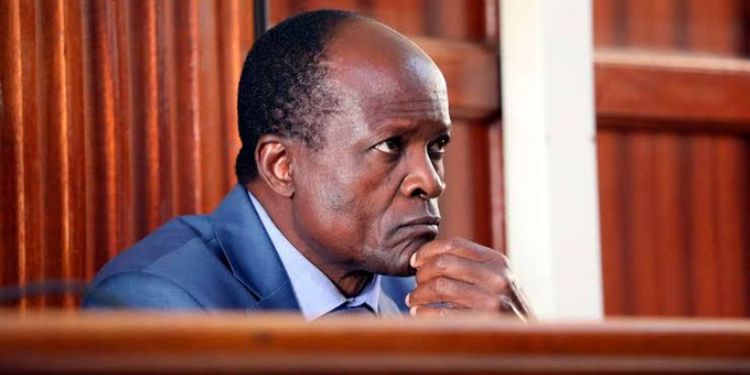
Former Migori Governor Zakaria Okoth Obado and his co-accused Michael Juma Oyamo have been sentenced to 25 years in prison each over the murder of Sharon Otieno.
The court also sentenced the third accused, Casper Ojuang Obiero, to 18 years’ imprisonment after finding that all three played different roles in the planned killing of the seven-month-pregnant university student.
Sitting at Milimani High Court on Friday, November 27, Justice Cecilia Githua ruled that custodial sentences were the most appropriate punishment, rejecting the three convicts’ requests for non-custodial sentences, including probation.
“For the first accused, Zakaria Okoth Obado, he is hereby sentenced to serve twenty-five years imprisonment. For the second accused, Michael Juma Oyamo, he is sentenced to serve twenty-five years imprisonment.For the third accused, Casper Ojuang Obiero, he is sentenced to serve eighteen years imprisonment,” Justice Githua ruled.
The court further directed that the computation of the sentences must take into account the respective periods each accused person had spent in lawful custody.
This includes the time spent in custody before they were released on bond as well as the period they remained in custody after judgment while awaiting sentencing.
Why the Court Rejected Their Pleas for Leniency
Before delivering the sentences, the judge considered the aggravating and mitigating circumstances presented by the prosecution, defence lawyers and Sharon’s family.
All three accused persons had asked the court to impose non-custodial sentences, citing their personal circumstances, family responsibilities and other mitigating factors.
However, the judge found that the aggravating circumstances surrounding the murder outweighed the mitigation presented by the convicts.
The court observed that Sharon’s murder was not a spontaneous act or an unfortunate incident arising from a moment of confrontation.
Instead, the evidence upon which the convictions were founded demonstrated planning, coordination and participation by the three accused persons, each playing a distinct role in the murder plot.
Obado, his former personal assistant Michael Juma Oyamo, and former Migori County clerk Caspal Ajwang Obiero were found guilty on July 23, 2026, by Judge Cecilia Githua, who ruled that the prosecution had proved the murder case against them beyond reasonable doubt.
In her July judgment, Justice Githua found that the three men acted jointly with other people who were not before the court. She said the evidence established their responsibility for Sharon’s murder, rejecting their claims that they had no involvement in her death.
The judge also found that Obado had a strong motive to have Sharon killed, pointing to the events surrounding her pregnancy and her alleged relationship with the former governor.
“It is therefore my finding that the prosecution has proved its case against the first, second and third accused persons beyond reasonable doubt. I consequently find each accused guilty of the offence of murder. Each accused is accordingly convicted,” Justice Githua Judge ruled in July.
Prosecution seeks deterrent sentence
During the September 16 hearing, prosecutors urged the court to impose a deterrent sentence, arguing that the seriousness of the offence called for a punishment that reflected the loss of Sharon and her unborn child.
The defence teams asked the judge to consider leniency and non-custodial sentences, citing the convicts’ personal circumstances, remorse and prospects of rehabilitation.
Obado’s lawyers also raised his health condition and asked the court to consider a three-year non-custodial sentence.
Sharon’s parents also addressed the court, saying they had forgiven Obado and appealing for leniency. They told the court that following the case had placed a heavy financial burden on the family.
The parents said they had spent approximately KSh1.2 million attending court proceedings and a further KSh3.5 million on funeral expenses.
Their appeal formed part of the mitigation presented before the judge as she considered the appropriate punishment for the three men.
Also Read: Former Migori Governor Okoth Obado Found Guilty in Sharon Otieno’s Murder
What the judge found in the murder case
In the July 23 judgment, Justice Githua said the prosecution had relied entirely on circumstantial evidence, with none of its 42 witnesses claiming to have witnessed Sharon’s killing.
The judge explained that circumstantial evidence could support a conviction if the surrounding facts formed a chain of evidence pointing to the guilt of the accused beyond reasonable doubt.
She found that the prosecution had met that legal threshold.
A central part of the judgment concerned Sharon’s pregnancy and the events that followed after she allegedly became involved with Obado.
The court heard that Sharon had sought help from people who could get her story published after she felt the former governor had abandoned her while she was pregnant.
A journalist who testified as a protected witness told the court that Sharon had shared photographs, WhatsApp conversations and audio recordings allegedly involving Obado. The material related to their alleged relationship and her efforts to get him to respond to her situation.
Justice Githua said the evidence did not support Obado’s claim that he had accepted the pregnancy and continued supporting Sharon after ending their relationship.
The judge also considered testimony that Obado had allegedly urged Sharon to terminate the pregnancy, an option she declined after speaking to her mother.
According to the judgment, the financial assistance and promises allegedly made to Sharon, including an offer to buy her a plot and build a three-bedroom house in Homa Bay, were not genuinely intended to support her welfare.
The judge said the evidence suggested the promises and payments were meant to persuade Sharon to abandon plans to make her alleged relationship with Obado public.
Medical evidence revealed nature of Sharon’s injuries
The court also considered the medical evidence presented by government pathologist Dr Johansen Oduor, who conducted Sharon’s postmortem examination.
According to the judgment, the pathologist found several injuries on her body, including two wounds below her ears and seven deep stab wounds in different parts of her body.
One of the stab wounds had penetrated her abdomen and reached her uterus.
Dr Oduor concluded that Sharon died from severe haemorrhage caused by penetrating force trauma, with features of manual strangulation.
He also examined her unborn child, estimated to be 28 weeks old. The court heard that the abdominal wound had passed through the fetus, making survival impossible.
The medical findings formed part of the evidence the judge considered when determining the cause of death and the circumstances surrounding the killing.
Evidence linked the accused to events before the killing
The prosecution also relied on witness accounts, mobile phone records, electronic communications and forensic evidence to connect the three accused to the events leading to Sharon’s death.
During the trial, the court heard that Sharon and journalist Barrack Oduor had traveled to Nairobi for a planned meeting involving Obado. The prosecution presented evidence of money sent to facilitate their travel and arrangements made after they arrived in the city.
The prosecution argued that Oyamo acted as a link between Sharon and Obado, while Obiero was involved in the events surrounding the abduction.
In its final submissions, the Office of the Director of Public Prosecutions argued that the evidence presented during the trial showed a coordinated plan involving the three accused.
Senior Assistant Director of Public Prosecutions Gikui Gichuhi told the court: “The totality of the evidence fits together seamlessly. It forms a single, coherent picture pointing to the guilt of the accused persons.”
The three men denied the murder charges during the trial. However, Justice Githua found that the prosecution had established their guilt beyond reasonable doubt and convicted each of them.
Also Read: Sharon’s Mother Reveals What She Wants From Court in Obado Sentencing
How Sharon Otieno was killed
Sharon was a 26-year-old Rongo University student who was seven months pregnant when she was abducted on September 3, 2018.
She had left a hotel in Rongo alongside Nation Media Group journalist Barrack Oduor when they were seized by their attackers.
Oduor managed to escape, but Sharon was taken away. Her body was discovered the following day in a thicket near Kodera Forest in Homa Bay County.
The discovery sparked public outrage and prompted detectives from the Directorate of Criminal Investigations headquarters in Nairobi to take over the investigation.
Obado, Oyamo and Obiero were later charged with her murder and denied the allegations.
Follow our WhatsApp Channel and X Account for real-time news updates and our YouTube Channel for in-depth interviews.