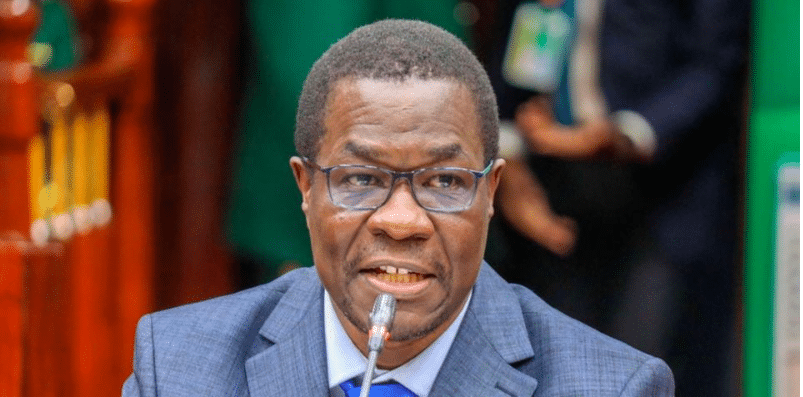
Energy and Petroleum Cabinet Secretary Opiyo Wandayi has disclosed how the unauthorized consignment of super petrol imported outside Kenya’s established Government‑to‑Government (G‑to‑G) framework could have led to a fuel price hike in the country.
In a statement dated April 7, Wandayi stated that a 60,000-metric-tonne consignment of Super Petrol was imported into the country through unauthorized procedures.
“A 60,000-metric-tonne consignment of Super Petrol was recently imported into the country in contravention of the procedures set out under the G-to-G contractual framework with international suppliers. This action posed a risk to the integrity of a system that has consistently safeguarded supply security and pricing stability,” read part of the statement.
Petrol Shipment Almost Increased Pump Prices
According to Energy and Petroleum Cabinet Secretary Opiyo Wandayi, the contentious consignment was invoiced at about Ksh 198,000 per metric tonne, compared with the Ksh 140,000 per metric tonne price under Kenya’s official G‑to‑G import arrangements with international suppliers.
Also Read: CS Opiyo Wandayi Clears the Air on Stabex and G-to-G Fuel Deal
That difference of roughly Ksh 58,000 per metric tonne would translate into a Ksh 14 increase per liter if the entire consignment had entered the market at its higher landed cost.
“This consignment is priced at Ksh 198,000 per metric tonne, compared to Ksh 140,000 per metric tonne under the G-to-G arrangement, an increase of Ksh 58,000 per metric tonne, which would result in an approximate rise of Ksh 14 per liter in pump prices on this consignment alone,” Wandayi explained.
Under the government’s G‑to‑G framework, Kenya signed agreements in 2023 with global energy firms, including Aramco Trading Fujairah, ADNOC Global Trading, and Emirates National Oil Company (Singapore).
Government Response and Regulatory Actions
In response to the pricing anomaly, the Ministry of Energy and Petroleum has taken swift action.
The government directed One Petroleum Ltd, the company that imported the fuel and invoiced local Oil Marketing Companies (OMCs), to withdraw all invoices issued and issue credit notes to the affected marketers.
Further, the authorities instructed OMCs not to pay for or uplift product from this consignment, effectively preventing it from entering the downstream market at the inflated cost.
To support pricing integrity, the sector regulator, the Energy and Petroleum Regulatory Authority (EPRA), was directed to exclude the 60,000 MT consignment from the monthly computation of petroleum product costs, the mechanism used to determine pump prices across the country.
President William Ruto’s office confirmed that investigations are underway into the circumstances surrounding the disputed import.
The government has maintained that the longstanding G‑to‑G framework remains resilient and central to Kenya’s strategy to stabilize fuel supply and insulate consumers from erratic global price movements.
Also Read: Petroleum Company Ordered to Immediately Withdraw All Invoices and Issue Refunds
How Petrol Shipments Were Made Out of the G-to-G Framework
According to a report by Business Daily on April 3, the petrol shipments, which were imported outside the government-to-government (G-to-G) framework, contained substandard fuel.
The shipments were procured by One Petroleum and Oryx, each delivering about 60 tonnes of petrol.
One of the shipments was sold at USD 290 (approximately KSh37,690) per tonne, more than three times the USD 84 (approximately KSh10,917.48) per tonne under the G-to-G deal.
The consignments were reportedly allowed into the market after a separate consignment of 114.7 million liters of super petrol sourced from Emirates National Oil Company (Enoc) failed to leave the Port of Jebel Ali in Dubai due to the closure of the Strait of Hormuz, disrupting planned supply.
A KPC quality assurance manager reportedly flagged the issue after testing the fuel, stopped its distribution, and alerted senior authorities.
The matter sparked internal debates over whether the petrol should be released to the market before investigators were involved.
Investigators suspect that the way certain fuel consignments were handled and released may have worsened supply disruptions.