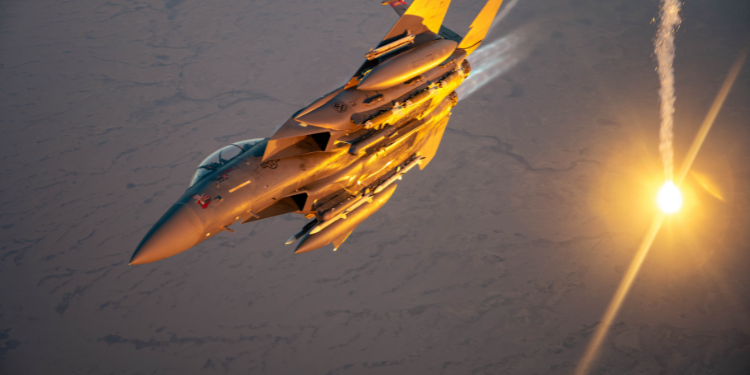
President Donald Trump ordered a new round of U.S. military strikes against Iran on Wednesday, July 8, after warning that a fragile ceasefire between Washington and Tehran could be nearing an end.
The strikes came hours after Trump told reporters during the concluded NATO summit that the ceasefire “might be over,” in what looked like an escalation following days of mounting tensions in and around the Strait of Hormuz.
U.S. Launches New Military Operation
The U.S. military confirmed that additional operations had begun. In a statement posted on X, U.S. Central Command said American forces were carrying out fresh strikes under Trump’s orders.
“At the direction of the Commander in Chief, U.S. Central Command forces have started conducting additional strikes against Iran to further degrade their ability to threaten freedom of navigation in the Strait of Hormuz,” the command said.
The military added that the United States was responding to what it described as Iran’s recent attacks on commercial shipping.
“The United States is holding Iran accountable for recent unjustified aggression against commercial shipping and civilian crews freely navigating a vital international waterway,” the statement said.
Central Command did not immediately provide details about the targets, the number of aircraft involved or the extent of the operation.
Trump Signals Ceasefire Could Collapse
The latest strikes followed Trump’s remarks earlier Wednesday suggesting that efforts to preserve the ceasefire were in jeopardy.
His comments came after Iran was accused of carrying out multiple attacks on commercial vessels transiting the Strait of Hormuz.
The incidents prompted Washington to accuse Tehran of threatening international shipping and violating recent diplomatic understandings aimed at reducing military tensions in the region.
Strait of Hormuz Remains Flashpoint
The Strait of Hormuz remains at the center of the confrontation.
The narrow waterway connects the Persian Gulf to global shipping lanes and carries as much as 20 percent of the world’s oil exports.
The United States has repeatedly said it will act to protect freedom of navigation through the passage.
American officials have argued that Iranian military activities in the area pose a direct threat to international commerce and regional stability.
Explosions Reported Along Iran’s Southern Coast
Before the U.S. announcement, Iranian media reported explosions in several coastal areas.
Iran’s semi-official Fars News Agency said multiple explosions were heard near Bandar Abbas and Sirik at about 11:15 p.m. local time.
According to the report, air defense systems were responding to what it described as hostile targets.
Fars also said some of the explosions appeared to originate from waters west of Sirik.
Iran’s Mehr News Agency also reported explosions in Bandar Abbas and the southern coastal cities of Konarak and Chabahar.
Neither outlet immediately identified the cause of the explosions. Iranian authorities had not issued an official statement confirming whether the reported blasts were connected to the U.S. operation.
Also Read: Iran Warns UK and France as Tensions Rise Over Strait of Hormuz Security
The Pentagon has repeatedly said the recent military action is intended to deter further attacks on commercial vessels in international waters.
The latest operation follows earlier strikes against Iranian military assets, including coastal surveillance systems, air defenses and anti-ship missile sites.
Washington has accused Tehran of repeatedly endangering civilian shipping despite recent diplomatic efforts aimed at reducing hostilities.
The Trump administration has also imposed additional economic measures against Iran in recent days, including fresh restrictions on Iranian oil exports.
Regional Tensions Continue to Mount
The renewed strikes add to growing uncertainty across the Middle East as diplomatic efforts struggle to contain the confrontation.
Several countries have urged restraint amid fears that continued military exchanges could disrupt global energy markets and increase security risks across the region.