

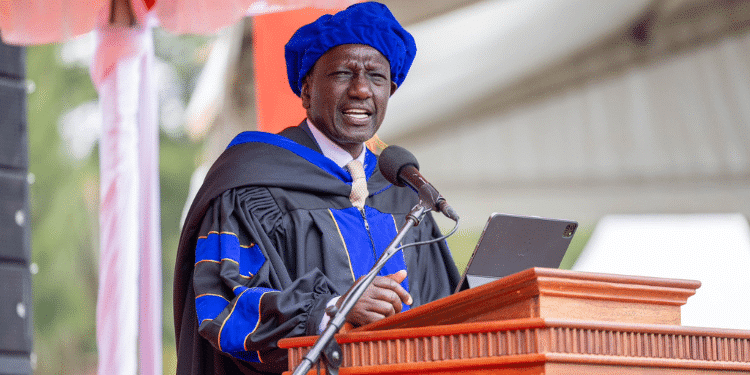
President William Ruto has urged universities to review their curricula, laboratories and teaching methods ahead of the admission of the first Competency-Based Education (CBE) learners in 2029, warning that institutions must prepare for a generation of students entering higher education with a different approach to learning.
Ruto said universities would need to adapt to learners trained to question, experiment and create, while equipping them with skills relevant to an economy increasingly shaped by artificial intelligence, biotechnology and automation.
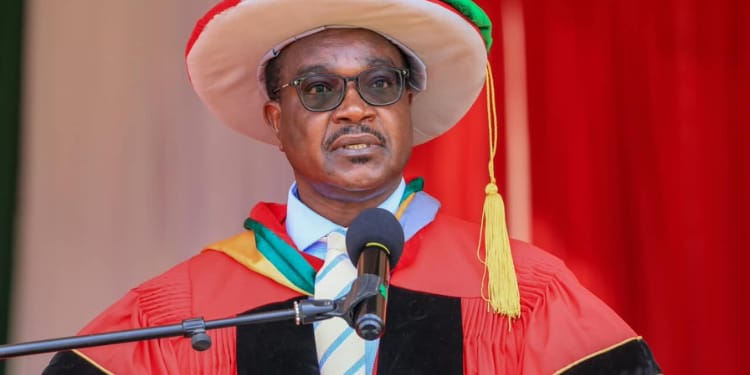
In a speech read by Education Cabinet Secretary Julius Ogamba, who represented him at Egerton University’s 2026 graduation ceremony, on Friday, November 27, the President said the first cohort would join universities through three pathways: Science, Technology, Engineering and Mathematics (STEM), Social Sciences, and Arts and Sports Science.
He added that the transition will require universities to reconsider how they prepare students for careers and further education, particularly as technology continues to change the skills employers seek.
“These learners are being prepared to question, to experiment and to create. Our universities must therefore progressively adapt their curricula, laboratories and teaching methods to accommodate this new generation,” Ruto said.
Ruto addresses AI impact on universities
Beyond the CBC transition, Ruto challenged universities to prepare students for a job market increasingly shaped by artificial intelligence, biotechnology and automation.
The President urged institutions of higher learning to become centres of technological innovation capable of developing practical solutions for challenges facing different sectors of the economy.
“Artificial intelligence, biotechnology and automation are fundamentally reshaping the world of work,” he said.
“As we expand our digital superhighway, our universities must become centres of technology innovation, developing practical solutions for agriculture, for healthcare, manufacturing and public service delivery.”
He noted that technology was increasingly democratizing access to knowledge, making the ability to apply it and solve complex problems more important.
“In an age when access to knowledge is increasingly becoming democratized by technology, the decisive advantage will lie in our capacity to apply that knowledge, solve complex problems and create new value,” Ruto added.
Egerton University was particularly challenged to strengthen its teacher education programmes because of its longstanding role in training educators.
Ruto said the institution had an important responsibility in the successful implementation of competency-based education and urged it to strengthen partnerships with industries and county governments ahead of the transition.
Also Read: TSC Announces New Training for Teachers Handling Five CBC Learning Areas
Egerton University urged to commercialize research
He further urged Egerton University to intensify research into drought-resistant crops, sustainable livestock production, water management and dryland agriculture, particularly to support communities in arid and semi-arid regions.
“The ultimate measure of agricultural research must be its impact on productivity on our farms, incomes in our households and food affordability in our markets,” he said.
The President also called on Kenya to move beyond consuming technologies developed elsewhere and become a producer of knowledge, innovations and globally competitive products.
Ruto welcomed Egerton University’s investment in biotechnology research infrastructure, including the establishment of the Regional Research Centre of the International Centre for Genetic Engineering and Biotechnology.
He said the facility would strengthen Kenya’s capacity in crop and animal improvement, disease diagnostics and the development of biotechnology-based products.
The President urged the university to deepen collaboration with industries, the National Research Fund, and other research institutions to ensure scientific discoveries translate into commercial products.
“Research must generate products. Products must generate enterprise and enterprise must generate employment,” he said.
He said universities should not limit their research work to academic publications but should ensure discoveries contribute to businesses, innovation and job creation.
Ruto addresses university funding and staff dues
The President also addressed the financial challenges facing universities, pointing to the Tertiary Education Placement and Funding Bill 2026, which is currently before Parliament.
The proposed legislation seeks to establish a more comprehensive, equitable and sustainable framework for financing higher education.
Ruto said the government’s objective was to ensure that every Kenyan who qualifies for tertiary education could access financing regardless of their parents’ financial circumstances.
“No student should abandon their education, defer their studies or compromise their aspirations because their family cannot afford the fees,” he said.
“The academic ability of a child, not the financial ability of a parent, must determine how far that child goes in education.”
He also called on universities to complement government investment through prudent financial management, diversified revenue streams, and research commercialization.
Ruto said public investment must be matched with institutional accountability, operational efficiency and measurable outcomes.
On staff welfare, he reaffirmed the government’s commitment to implementing the 2025–2029 collective bargaining agreements and resolving outstanding matters through constructive engagement.
He said stability in universities was essential to uninterrupted learning, quality teaching and productive research.
At Egerton University, the President acknowledged financial and infrastructure challenges, including outstanding payroll dues owed to staff.
He said the Ministry of Education and the National Treasury were working to settle the outstanding obligations, strengthen the university’s financial position, and improve staff welfare.
Also Read: Ruto Pushes for Urgent Prisoner Transfer Deal With Zimbabwe
Ruto promises Egerton University infrastructure upgrades
The President further pledged government support towards completing essential infrastructure at Egerton University.
He identified the administration building, laboratories and student accommodation among the facilities that would be prioritized.
Ruto also directed the Kenya Rural Roads Authority (KeRRA) to fast-track the proposed upgrading of 12.55 kilometres of the university’s internal road network under the Endoro-Nesuit road project.
The proposed improvements are expected to enhance accessibility, movement and safety within the institution.
He said addressing the infrastructure challenges would enable Egerton to concentrate on its core responsibilities of teaching, research and innovation.
Follow our WhatsApp Channel and X Account for real-time news updates and our YouTube Channel for in-depth interviews.