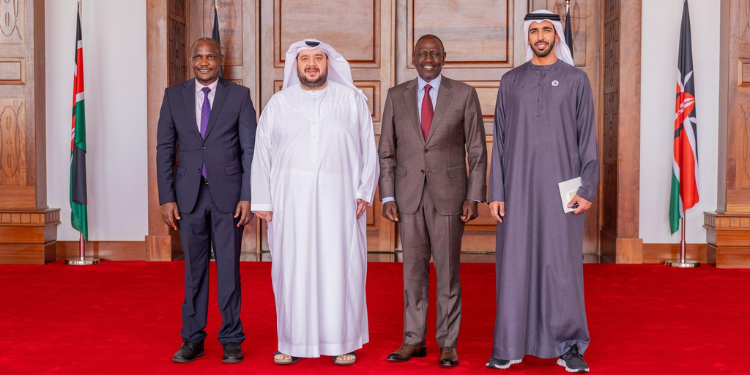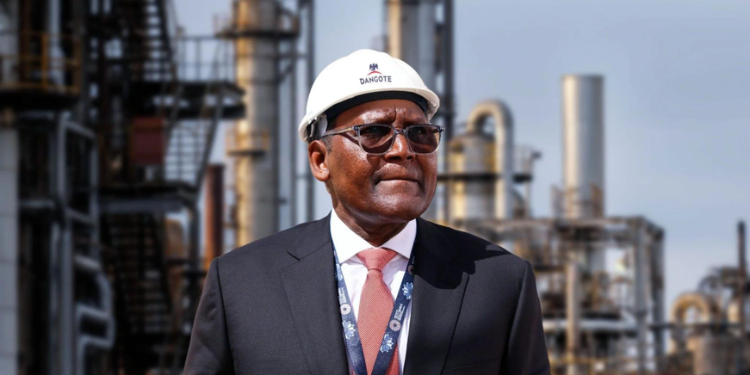

The United Arab Emirates (UAE) has declared its stance on the country’s trade and investment engagement with Kenya and the wider African continent amid ongoing geopolitical tensions and disruptions affecting global supply chains.
In an exclusive interview with The Kenya Times, UAE Minister of State for Foreign Trade Dr. Thani bin Ahmed Al Zeyoudi discussed the future of UAE-Kenya economic relations, infrastructure investments, technology partnerships, renewable energy projects, and Africa’s growing role in global trade.
He said the Gulf nation continues to view Africa as a strategic long-term partner and is deepening investments in infrastructure, logistics, renewable energy, and digital transformation across the continent.
His remarks come at a time when global trade routes are under pressure from conflicts in the Middle East and broader geopolitical uncertainty, prompting concerns about supply chain resilience and the future of international commerce.
Despite those challenges, Al Zeyoudi said trade relations between Kenya and the UAE have continued to expand.
Q: Global disruptions have challenged traditional trade routes and supply chains. How is the UAE strengthening trade corridors with Africa?
A: Supply-chain resilience is built through infrastructure investment and trade facilitation. A consortium led by DP World has secured a 30-year concession to operate and modernize the ports of Mombasa and Lamu, with a total commitment estimated at around $557 million.
These projects are helping strengthen Kenya’s role as a key maritime gateway for East and Central Africa, creating important trade corridors for landlocked economies across the region.
We are seeing similar investments across the continent: DP World now operates six ports in Africa, while AD Ports Group continues to expand its footprint.
Together, these investments are expanding Africa’s access to global markets while reinforcing the UAE’s supply-chain resilience in areas such as food security and critical minerals.
Q: What is the impact of the current conflict on UAE-Kenya trade?
A: The full impact will become clearer over time, but the UAE moved quickly to secure alternative trade routes, including greater use of ports on the Gulf of Oman.
What we can say with confidence is that the bilateral relationship has remained resilient. Non-oil trade reached $4.3 billion in 2025, up 8.3% on 2024, with imports from Kenya surging 54.4%, driven by agriculture and precious metals.
The UAE remains Kenya’s top trading partner in the Gulf region and its third-largest trading partner globally. Despite broader geopolitical turbulence, we expect the relationship to continue expanding and diversifying into additional sectors.

Q: The UAE has expanded investments across infrastructure, energy, and logistics in Africa. Which sectors now present the greatest opportunities, and how do you ensure these investments support long-term industrial growth?
A: In Kenya, three sectors stand out. In technology, G42 is developing a US$1 billion, geothermal-powered data-center campus in Olkaria that will host Microsoft’s Azure East Africa Cloud Region and create more than 6,000 jobs.
In logistics, DP World’s modernization of the ports of Mombasa and Lamu is attracting trans-shipment traffic and reducing cargo dwell times. In renewable energy, Masdar has tripled its African renewables capacity to 3GW and is actively engaged with Kenya Power.
These investments are designed to build productive capacity, support technology transfer, and create skilled employment, with a focus on long-term industrial growth and economic resilience.
Q: Will investments be maintained despite the current conflict?
A: Current geopolitical tensions have not changed the UAE’s long-term economic vision for Africa. Between 2019 and 2024, the UAE invested $110 billion across the continent, reflecting our confidence in Africa’s long-term growth potential.
In Kenya, our commitments are similarly structured for the long term, including 30-year port concessions and major renewable energy projects.
In May 2025, President Ruto and Sheikh Abdullah bin Zayed Al Nahyan signed seven new MoUs covering energy, agriculture, health, and digital cooperation, and we look forward to advancing these partnerships further.
Also Read: Opinion | How the UAE-Kenya Trade Corridor Is Redefining East Africa’s Economic Future
Q: How is the UAE ensuring its partnerships with Kenya translate into jobs, skills transfer, and opportunities for Kenyan professionals?
A: Ensuring our partnerships create long-term economic value for Kenya is a core focus of the UAE’s approach. While our Comprehensive Economic Partnership Agreement with Kenya has not yet entered into force, the level of investment and cooperation already underway reflects the strong natural synergies between our economies.
The G42-Microsoft data center project alone will create more than 1,000 direct and 5,000 indirect jobs, while the East Africa Innovation Lab in Nairobi provides training in digital skills and AI.
G42 is also developing AI language models adapted to Swahili and exploring AI applications for Kenyan agriculture. DP World’s port operations at Mombasa and Lamu are expected to generate approximately 3,000 jobs while introducing modern logistics technologies.
Across these initiatives, the focus is on building capabilities, supporting skills transfer, and creating opportunities for Kenyan professionals in high-growth sectors.
Q: The UAE continues to position itself as a global trade hub linking Africa to other markets. How do African countries fit into this strategy, and how do you ensure partnerships deliver local value and inclusive growth?
A: Africa is central to the UAE’s economic diversification strategy. Through the Emirates’ connectivity to Asia, the Middle East, and beyond, Kenyan producers gain access to markets representing more than two billion consumers.
UAE investment in Kenyan infrastructure, logistics, and digital capacity is helping build the productive base needed for long-term industrialization.
As the African Continental Free Trade Area (AfCFTA) continues to mature, we see the UAE playing a supporting role in strengthening intra-African trade through logistics infrastructure, financial services, and market linkages that help African exporters capture greater value from their own production.
Also Read: African Businesses Push for Affordable Financing, Stable Policies at Nairobi Summit
Q: Looking ahead, how do you see UAE-Africa trade relations evolving over the next decade?
A: The trajectory is clear, and the infrastructure to sustain it is in place. As the AfCFTA single market continues to mature, the commercial logic of routing African production through a world-class logistics and financial hub only strengthens.
We see particular growth in agriculture, where Africa’s productive potential remains underutilized; clean energy, where the continent’s solar, wind, and geothermal resources are unmatched; and digital services, where young, technology-capable populations are driving innovation.
The decade ahead will see African economies move up the value chain. Our ambition is to be a long-term partner in that transformation.
Q: What role will innovation and sustainability play in shaping this future?
A: The G42-Microsoft geothermal-powered data center in Kenya exemplifies our approach: one of the world’s most advanced green digital infrastructure projects, powered entirely by renewable energy.
At COP28, the UAE launched an AED 4.5 billion clean energy financing initiative for Africa, targeting 15 GW by 2030. Masdar has also committed $2 billion to African renewable projects, while AMEA Power is deploying solar, wind, and battery storage capacity across 15 African countries.
Sustainability and innovation will be central to Africa’s next phase of growth, and the infrastructure decisions made today will shape economic and industrial outcomes for decades to come.
Follow our WhatsApp Channel and X Account for real-time news updates.