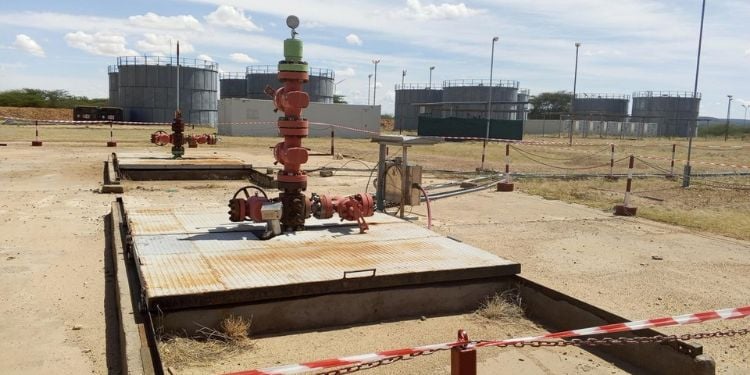
Kenya has officially begun drilling crude oil in Turkana County, marking a major step towards commercial oil production, with Gulf Energy targeting December 1, 2026, for the first output.
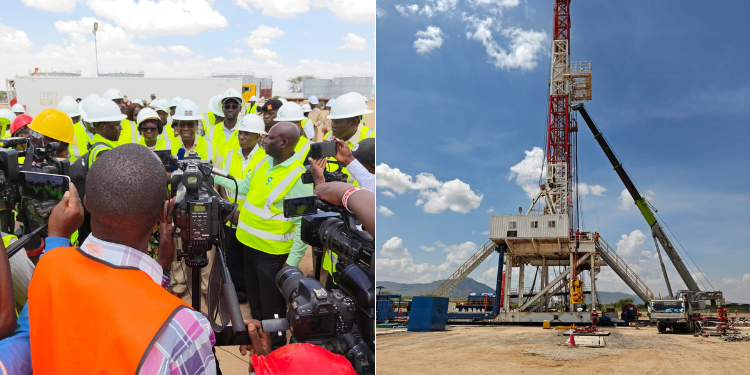
The milestone was marked on Friday, November 20, when Energy and Petroleum Cabinet Secretary Opiyo Wandayi presided over the spudding of the Amosing 1 well pad in the South Lokichar Basin.
Spudding refers to the initial stage of drilling a well and signals the formal start of drilling operations.
The exercise followed the installation, levelling and commissioning of GW70, an onshore drilling rig leased from China’s Great Wall Drilling Company (GWDC), at the Amosing 1 and 2 oil fields.
Wandayi said the government was working to ensure that development of the oil fields in Blocks T6 and T7 remained on schedule, in line with the Field Development Plan (FDP) approved by Parliament.
He was accompanied by Roads and Transport Cabinet Secretary Davis Chirchir, East African Community Cabinet Secretary Beatrice Askul and other government officials.
“This spudding event by the Government of Kenya’s contractor, Gulf Energy E&P BV SEZ, marks a historical milestone ahead of first oil production,” Wandayi said.
He commended the company and its contractors for their efforts to meet the production timelines set out in the development plan.
Four Turkana Oil Fields Targeted in First Phase
Under the first phase of development, Gulf Energy will concentrate on four oil fields known as Ngamia, Amosing, Twiga and Ekales, collectively referred to as NEAT.
The fields are expected to produce more than 20,000 barrels of crude oil per day once operations reach the targeted production level.
The wider South Lokichar Basin project covers six oil discoveries in Blocks T6 and T7, with an estimated recoverable volume of 326 million stock-tank barrels over a 25-year contract period.
Gulf Energy Managing Director Paul Limoh said the company had prepared its systems for the start of production and was working with contractors to meet the agreed timelines.
He confirmed that the initial 20,000 barrels per day would be transported by road from Turkana to Mombasa for storage at the Kenya Petroleum Refineries Limited (KPRL) tank farms.
The transportation and storage arrangements are expected to begin alongside the targeted first oil production date of December 1.
Limoh added that the company intends to increase output to 50,000 barrels per day in the second phase of the project.
“At Gulf Energy, we are maintaining a tight delivery and project management schedule with the support of all our stakeholders, with a pledge to deliver against the FDP to world-class standards,” he said.
The company has engaged Baker Hughes to provide integrated well services, while energy technology firm SLB has been contracted to supply the Early Production Facility (EPF).
Also Read: Kenya Sets Timeline for Turkana Oil Production Ahead of First Exports
Government Invests KSh24 Billion in Turkana Infrastructure
The government is also investing more than KSh24 billion in infrastructure development in the oil-producing region.
Speaking at the ceremony, Chirchir said the investment would support the construction of quality infrastructure, including roads, to improve connectivity in the area.
He noted that the projects would help improve the region’s social and economic standing while supporting activities linked to oil production.
The infrastructure investment is expected to support the movement of equipment, personnel and crude oil as the project advances.
How Much Kenya Expects to Earn From Oil Production
The government projects that the South Lokichar Basin oil development could generate more than US$2.9 billion (approximately KSh371 billion) in lifetime earnings.
The actual revenue will depend on international oil prices and the volumes produced throughout the project’s lifespan.
The oil fields will be operated by Gulf Energy E&P BV SEZ under Production Sharing Contracts (PSCs) with the National Government.
The State Department for Petroleum and the Energy and Petroleum Regulatory Authority (EPRA) will oversee the project.
Gulf Energy, formerly known as Tullow Kenya BV, is an upstream petroleum company operating under the Gulf Energy Group.
Its development programme in Turkana is expected to establish Kenya as a commercial crude oil producer and strengthen its position in the regional energy sector.
Also Read: Kenya Eyes New Transport Plan for Turkana Crude as First Oil Nears
Characteristics of Kenya’s Crude Oil
The crude oil discovered in the South Lokichar Basin has specific properties that will influence how it is handled, transported and processed.
According to the company, the oil has low sulphur, asphaltene and aromatic content but relatively high wax content.
It has an American Petroleum Institute (API) gravity of 30.5 degrees and is classified as an intermediate, paraffinic and sweet crude oil.
Its high wax content means it has a high wax appearance temperature and a pour point above normal ambient conditions, making temperature management an important consideration during transportation.
The associated natural gas is described as rich and sweet, although some areas contain elevated levels of carbon dioxide.
Kenya’s crude oil will be priced against Dated Brent, an international benchmark used in the oil market.
The December 1 target will mark the beginning of a new phase in Kenya’s petroleum industry, following years of exploration and development work in the South Lokichar Basin.
Follow our WhatsApp Channel and X Account for real-time news updates and subscribe to our YouTube Channel for in-depth interviews.