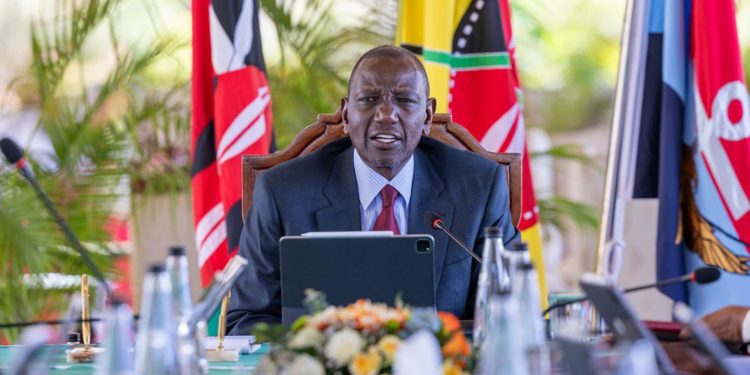
President William Ruto has invited the European Union to begin consultations on deploying an election observer mission for Kenya’s 2027 General Election, signalling his administration’s willingness to have international observers monitor the polls.
Speaking before ambassadors from EU member states at State House on November 12, uto said Kenya was open to discussions on an observer mission provided it operates within the country’s legal framework and established electoral procedures.
“To prepare for the August 2027 general election, we welcome consultations on an EU election observer mission consistent with our laws and procedures,” said Ruto.
The remarks come less than a year before political activity is expected to intensify ahead of the 2027 elections, which will determine Kenya’s next president, governors, senators, members of parliament and members of county assemblies.
Ruto on Enhanced Kenya-EU Cooperation
Beyond elections, Ruto used the meeting to seek enhanced cooperation from the EU in addressing financial crime and terrorism financing risks.
The President said Kenya had made notable progress in implementing reforms demanded by the Financial Action Task Force (FATF), the global watchdog on money laundering and terrorist financing.
Also Read: Kenya Supports Russia as US and UK Reject UN Proposal
He noted that Kenya had addressed 13 of the 21 strategic deficiencies identified by the task force and was pursuing the remaining reforms with support from international partners.
“We also value EU support for strengthening anti-money laundering and counter-terrorism financing frameworks. Having addressed 13 of the 21 Financial Action Task Force strategic deficiencies, Kenya seeks continued technical cooperation to complete the remaining reforms and secure removal from the FATF grey list and EU high-risk list,” said Ruto.
Kenya was placed on the FATF grey list in 2024 over weaknesses in its systems for combating money laundering and terrorist financing.
Removal from the list is viewed as important for attracting investment, reducing compliance burdens on financial institutions and strengthening confidence in the country’s financial sector.
In his address, Ruto also reflected on five decades of relations between Kenya and the European Union, calling for a shift from dialogue to concrete outcomes.
The President added that he believed the fifty years of diplomatic relations is enough ground and a strong foundation for a more ambitious, results-oriented Kenya-EU partnership.
Ruto urged both sides to deepen cooperation in areas that directly benefit citizens and drive economic growth.
“We must move from dialogue to delivery, from commitment to investment, and from cooperation to measurable outcomes,” he said.
According to Ruto, Kenya remains committed to advancing a partnership with the EU and its member states based on mutual respect, shared responsibility and mutual benefit.
Ruto asked the EU delegates to support Kenya in ensuring that the next 50 years are defined by a partnership that creates prosperity, strengthens peace and security, expands opportunity, and gives Kenyans a greater stake in a more equitable and prosperous world.
Also Read: Germany Announces 1,200 Fully Funded Scholarships for Kenyans
The meeting was also attended by the Principal Secretary, State Department of Foreign Affairs, Ministry of Foreign and Diaspora Affairs, Abraham Korir Sing’Oei and Prime Cabinet Secretary Musalia Mudavadi, both praising the efforts of President Ruto and EU delegates in ensuring enhanced cooperation.
EU’s Previous Election Observation Missions in Kenya
The European Union has previously deployed election observation missions to Kenya during the 2002, 2007, 2013, 2017 and 2022 General Elections.
The missions assessed voting, counting, results transmission, campaign activities and the performance of electoral institutions.
During the 2007 elections, the EU mission, led by Alexander Graf Lambsdorff, raised concerns over a lack of transparency in the processing and tallying of presidential results, saying the shortcomings raised questions about the accuracy of the final outcome.
In 2022, the mission led by Ivan Štefanec deployed 182 observers and issued 21 recommendations covering electoral transparency, campaign financing, gender representation, election technology and voter education.
In June 2025, the EU released a follow-up report assessing Kenya’s implementation of the 2022 recommendations.
It identified limited tangible progress and called for an independent, fully functioning Independent Electoral and Boundaries Commission (IEBC) ahead of the 2027 elections.
Follow our WhatsApp Channel and X Account for real-time news updates and our YouTube Channel for in-depth interviews.