
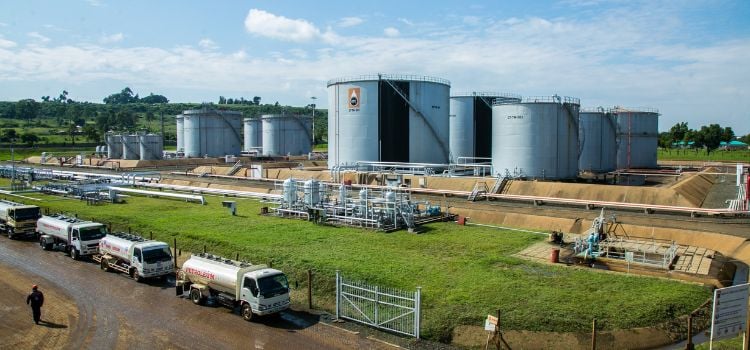
The National Treasury has finalized the partial privatization of Kenya Pipeline Company (KPC) PLC, marking a major shift in the State’s role in the strategic energy transporter.
In a gazette notice dated April 22, 2026, Treasury Cabinet Secretary John Mbadi revoked the KPC’s status as a National Government Entity, effectively removing it from the list of state corporations.
“In exercise of the powers conferred by section 4 (1) of the Public Finance Management Act, as read with regulation 211 (7) of the Public Finance Management (National Government) Regulations, the Cabinet Secretary for the National Treasury revokes the declaration of Kenya Pipeline Company as a National Government Entity as declared under Schedule II of the Declaration of the National Government Entities (State Organs) published as Legal Notice No. 33 of 2015,” the notice reads.
Treasury Seals Kenya Pipeline Privatization
The move follows the conclusion of the company’s privatization under the Privatization Act, 2025, which saw the government offload a 65 percent stake to the public through an Initial Public Offer (IPO).
“Pursuant to section 53 of the Privatization Act, 2025, it is notified for the general information of the public that the privatization of Kenya Pipeline Company Limited (now known as Kenya Pipeline Company PLC) has been finalized,” read a separate notice.
Also Read: Kenya Pipeline Publishes Fuel Stock Data as Shortage Fears Mount
Kenya Pipeline Company PLC was incorporated by the Government of Kenya in 1973 as a private limited liability company and began commercial operations in 1978.
The firm was converted into a public limited company in January 2026 ahead of its planned privatization through an Initial Public Offer (IPO).
The privatization was executed through the sale of 65 percent of its issued ordinary shares to the public, with the stock listed on the Main Investment Market Segment of the Nairobi Securities Exchange on March 10, 2026.
“The privatisation was conducted in accordance with the provisions of the Privatization Act, 2025, the Capital Markets Act (Cap. 485A) and the Capital Markets (Public Offers, Listing and Disclosure) Regulations (Sub. Leg.),” the notice read further.
Following the transaction, the Government of Kenya retained a 35 percent stake in the company through the National Treasury.
Kenya Pipeline operates a strategic network of pipelines, storage depots, and terminals that support the transportation of petroleum products across Kenya and the wider East African region, positioning it as a key player in regional energy security and economic growth.
Also Read: Kenya Hands Museveni Linked Uganda Firm Ksh106 Billion Stake in Kenya Pipeline Company
Treasury CS Explains the Valuation Process
The transaction involves the sale of 11.81 billion existing shares at Ksh 9.00 per share, with no new shares being issued.
Structured strictly as an offer for sale, the IPO will not inject capital into Kenya Pipeline and leaves the company’s balance sheet unchanged, with all proceeds flowing directly to the Exchequer.
CS Mbadi defended the KSh 9.00-per-share price of Kenya Pipeline Company PLC during its Initial Public Offer, calling it a fair valuation.
The CS argued that the company remains profitable with strong prospects, citing its diversification into fiber optic infrastructure and revenue streams largely denominated in hard currency.
He added that the pricing struck a balance between attracting foreign investors and ensuring affordability for local investors.
However, market indicators suggest a more nuanced picture.
At Ksh9.0 per share, the IPO implies a gross dividend yield of about 3.9 percent, lower than those of other listed utilities, such as Kenya Power and Lighting Company at 6.9 percent and Kenya Electricity Generating Company at roughly 9.4 percent.
The company’s price-to-earnings ratio stands at 22.0 times, significantly higher than peers in the energy sector. For comparison, TotalEnergies trades at about 14.7 times earnings.