Safaricom’s M-PESA Kadogo service recorded 17.1 billion free micro-transactions in the financial year ended March 2026, accounting for 36.8 per cent of all transactions processed on the mobile money platform.
The figures in Safaricom’s 2026 Sustainable Business Report show that Kadogo use increased by 34.4 per cent during the period.
The 17.1 billion transactions also represented 63.7 per cent of the 26.8 billion M-PESA transactions that attracted no customer charges.
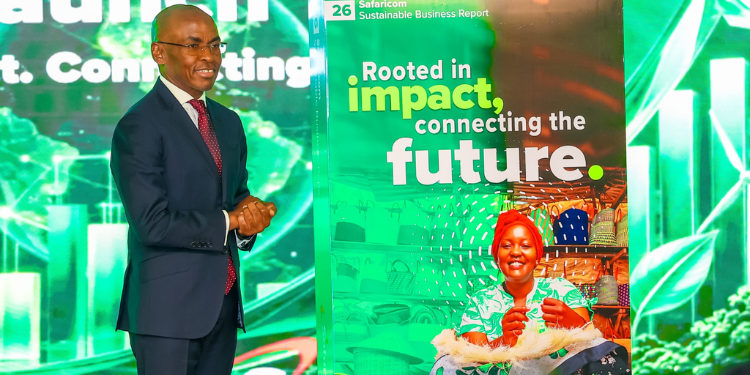
“Use of Kadogo increased by 34.4%, reflecting growing adoption of free small-value payments across the M-PESA ecosystem,” the report read.
How M-PESA Kadogo Works
M-PESA Kadogo allows customers to complete eligible low-value transactions without paying the usual transaction fees.
Safaricom identifies person-to-person transfers of KSh100 and below and merchant payments of KSh200 and below among the transactions that qualify for free services.
The company also includes cash deposits at M-PESA agent outlets and airtime purchases through M-PESA in its free-service offerings.
The service is designed to make mobile money more affordable for customers who rely on it for small purchases and transfers.
Safaricom has linked the removal of charges to increased activity on the platform. In its FY2026 results, the company said the removal of charges contributed to transaction numbers tripling between 2020 and 2026.
Also Read: Safaricom Explains Why Some Users May Never Get Higher Fuliza and M-Shwari Limits
M-PESA Transactions Rise to 46.4 Billion
Kadogo’s growth came as total M-PESA transaction volumes increased by 25.1 per cent, from 37.1 billion in the financial year ended March 2025 to 46.4 billion in FY2026.
The value of transactions also rose by 8.9 per cent to approximately KSh41.7 trillion, up from KSh38.3 trillion in the previous financial year.
The volumes translate to an average of about 127 million transactions daily, or approximately 88,000 every minute throughout the year.
Safaricom attributed the growth partly to upgrades to M-PESA’s technology infrastructure through its Fintech 2.0 programme, which increased the platform’s processing capacity.
“This growth was supported by the rollout of Fintech 2.0, which modernised the technology foundation underpinning M-PESA. This in turn increased processing capacity from 4,500 to 6,000 transactions per second, with capacity to scale beyond 12,000 transactions per second, while achieving 99.999 per cent availability,” the report states.
The company said the new system would also make it easier to introduce additional services as M-PESA expands.
“Its more modular architecture also provides greater flexibility to introduce new services and integrations as the M-PESA ecosystem expands,” the report states.
Also Read: M-Pesa Disruption Leaves Safaricom Users Frustrated and Unable to Transact
Free Transactions Account for More Than Half of M-PESA Activity as Revenue Reaches KSh182.7 Billion
The 17.1 billion Kadogo transactions formed part of the 26.8 billion M-PESA transactions that attracted no customer charges in FY2026.
The number of non-chargeable transactions increased from 21.7 billion in the previous financial year, although their share of total transactions declined slightly from 58.6 per cent to 57.8 per cent.
Chargeable transactions also increased, rising from 15.4 billion to 19.6 billion over the same period.
Despite the large volume of non-chargeable transactions, Safaricom’s mobile money business continued to grow in revenue.
M-PESA generated KSh182.7 billion in revenue in FY2026, a 13.4 per cent increase from KSh161.1 billion in the previous financial year.
Consumer payments contributed KSh74.5 billion, while business payments generated KSh56.7 billion. Withdrawals accounted for a further KSh36.8 billion, according to Safaricom’s FY2026 investor presentation.
Follow our WhatsApp Channel and X Account for real-time news updates and subscribe to our YouTube Channel for in-depth interviews.