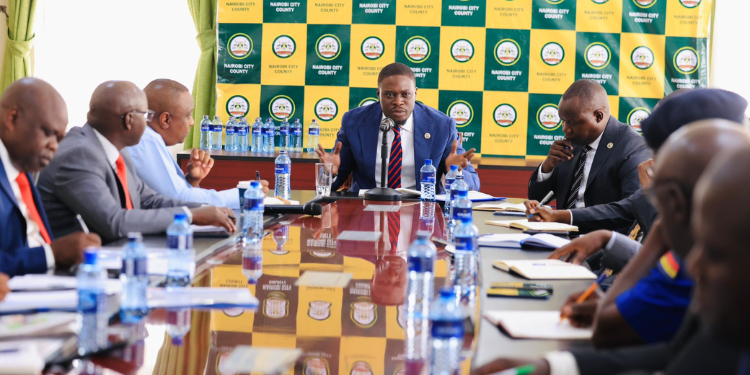

The Nairobi City County Government has signalled a new phase in its efforts to save the city’s rivers, with Governor Johnson Sakaja’s Cabinet emphasising structured enforcement of riparian regulations and support for affected residents.
During a County Executive Committee meeting chaired by Governor Sakaja on Wednesday, February 4, the Cabinet reviewed progress on President William Ruto‘s Ksh50 billion Nairobi River Regeneration Programme launched in March 2025.
The initiative aims to restore the 27-kilometre urban stretch of the Nairobi River and its tributaries into clean, flood-resilient, and economically vibrant corridors.
Addressing potential relocations, the Cabinet stressed that enforcing riparian laws would prioritise dignified resettlement and community support over arbitrary evictions.
“Where informal settlements encroach on the riparian reserve, the project is conducting extensive social and environmental impact assessments before any relocations. The County is committed to providing dignified relocation options, affordable housing in situ or nearby, ensuring families are not displaced far from their livelihoods.”
The Nairobi River Regeneration Programme has already delivered tangible improvements, including the construction of a 60-kilometre trunk sewer line, riverbank stabilisation works, expanded stormwater drains, and remediation at the Dandora dumpsite.
Nairobi to enforce riparian laws with dignified relocations
Community engagement has been central to the initiative, with forums held in Kawangware, Mukuru, and Korogocho, allowing residents and local leaders to shape the Integrated Urban Development Plan for the river basin.
Also Read: Govt to Build Mega Trunk Sewer as Efforts to Transform Nairobi River Enter Crucial Stage
The Cabinet further directed that all County departments fast-track approvals for riverbank projects, finalize the Integrated Development Plan for Special Planning Areas (SPAs) by March 2026, and strengthen enforcement against illegal structures and pollution activities.
It emphasised that SPAs are planning tools meant to guide structured development, not eviction notices.
Residents, businesses, and civil society organisations are being consulted at every stage, ensuring the reforms are inclusive and community-centred.
“Enforcement of riparian protection be strengthened: no new illegal structures or pollution activities will be tolerated in the SPA,” the Cabinet dispatch adds. “Support mechanisms for affected traders and residents be operationalized, including alternative trading sites, job training, and social services during the transition period.”
Governor Sakaja’s Cabinet highlighted that the programme also seeks to deliver economic opportunities, including modern markets for informal traders, green pedestrian walkways, cycling lanes, flood mitigation wetlands, and up to 50,000 affordable housing units in reclaimed riparian areas.
According to the dispatch, approximately 40,000 jobs have been created so far, providing income and opportunities for ownership for young Nairobi residents who keep their city clean.
Disaster management and school feeding program
Meanwhile, the Cabinet has confirmed that the County is advancing disaster management and child nutrition reforms following the approval of the Nairobi City County Disaster Management Policy 2025 and endorsement of the Emergency and Disaster Management Bill 2025 for submission to the County Assembly.
Also Read: Sakaja Intervenes as Police Clash with Mukuru Kwa Njenga Residents Over Evictions
The law seeks to protect residents from recurring disasters such as urban fires, building collapses, and flash floods, which have historically exposed critical gaps in emergency preparedness.
“By enacting a robust disaster management law, Nairobi is saying “never again” to the chaos and avoidable tragedies of the past. Importantly, the new law will impose stronger compliance on building safety and land-use—preventing disasters before they happen by enforcing standards under the Physical and Land Use Planning Act, 2019.”
At the same Cabinet meeting, members also institutionalized the Dishi na County school feeding programme, making it a permanent County function.
The programme, launched in 2023, currently serves over 316,000 learners across more than 230 public primary schools and ECDE centres, with plans to expand coverage to informal settlements and additional schools.
“The long-term plan is to expand from 17 to approximately 69 kitchens to cover all schools including informal areas, ensuring no child is left behind,” the dispatch adds.
According to the Cabinet, parents contribute a token Ksh5 per meal currently with the County subsidizing the rest.
The Nairobi County Government has maintained that provisions exist to “waive even the Ksh5 for the poorest 10% of families so no child is turned away.”
Follow our WhatsApp Channel and X Account for real-time news updates.