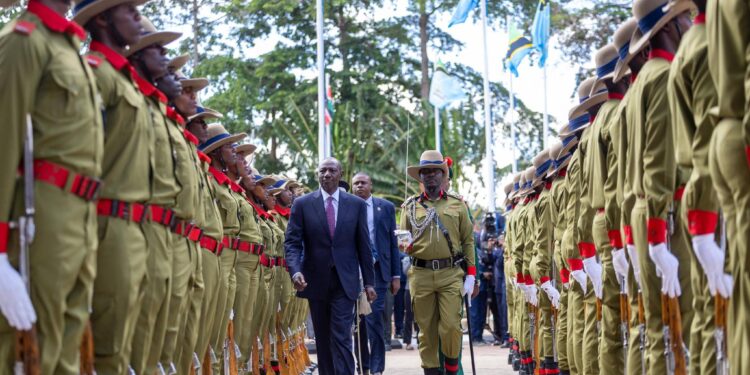
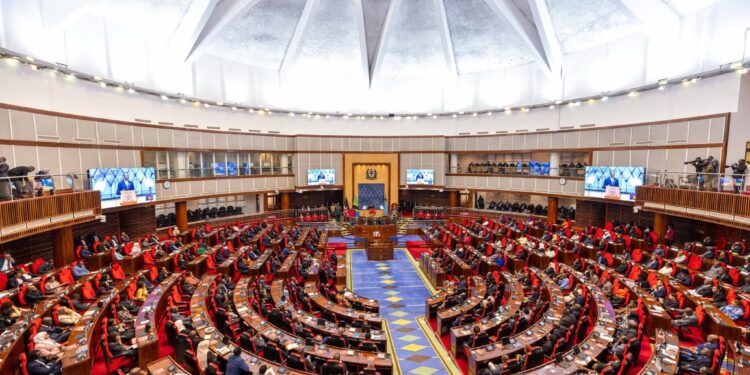
Kenya’s President William Ruto on Tuesday, May 5, 2026, addressed the Tanzanian Parliament in Dodoma. In his speech, Ruto called for the strengthening of bilateral ties to deepen cooperation and unlock opportunities. Ruto’s speech also focused on expanding trade and investment, scaling up joint infrastructure development, and advancing friendly policies that deepen integration. He also warned against negative competition, suspicion, rivalry, and mistrust that have hindered regional progress. Here is the full speech:
“Honourable Mussa Azzan Zungu, Speaker of the National Assembly of the United Republic of Tanzania, Rt Honourable Prime Minister, Honourable Members of Parliament, Distinguished Leaders, Ladies and Gentlemen, Good morning.
Let me begin by expressing my deepest gratitude to Her Excellency, my dear sister Dr Samia Suluhu Hassan, for her gracious invitation to undertake this historic State Visit to your great and sisterly nation, the United Republic of Tanzania.
From the moment of our arrival, we have been received with exceptional warmth and hospitality. I am equally honoured to thank the Right Honourable Speaker, Musa Azzan Zungu, and the distinguished members of this august House for the rare privilege of addressing this, Parliament.
I recall with great fondness Her Excellency’s visit to Kenya in 2021. I am honoured today to reciprocate, following her re- election, as among the first Heads of State to visit under her new term.
Today, I stand here in reciprocity because, as Kenyans, we are not just your neighbours, not just your friends, not even your partner; we are your brothers and sisters.
I bring with me the warm greetings of the people and Government of the Republic of Kenya, as well as the goodwill of your fellow parliamentarians in our National Assembly and Senate.
Growing regional mutual trust
Mr. Speaker, Honourable Members,
The conversation we are having today is significant and consequential, not only for our two countries but also for our region and continent. At its core, it is about one central task: Growing mutual trust to build shared strength.
For far too long, relations among neighbouring countries have been shaped by competition, suspicion, and rivalry, forces that have fragmented our markets, weakened our voice, and constrained our collective progress.
And if we are honest with ourselves, ndugu jirani, some of these forces are still very alive with us. They still shape our narratives. They still influence our relations.
Yet our founding fathers, Julius Kambarage Nyerere and Mzee Jomo Kenyatta, saw beyond this prism. They understood that Africa’s future would not be secured in isolation but in unity, and planted the seed of regional integration because our destinies are intertwined and our strength lies in moving forward together.
For decades, Tanzania and Kenya have walked side by side, a partnership forged in struggle and anchored in shared purpose.
At its foundation stand two towering figures of African history: Julius Nyerere and Jomo Kenyatta. Their partnership, built on different but complementary visions, inspired a model of unity that transcended borders. Even during the struggle for independence, including the Mau Mau period, Tanzania stood with Kenya, affirming a shared belief in freedom, dignity, and self-determination.
That spirit gave birth to the East African Community (EAC) in 1967. Though disrupted in 1977, it was rebuilt through dialogue and statesmanship, leading to its re-establishment in 1999.
Today, that Community stands renewed and expanded, but its foundation remains the same: A growing partnership between our nations, defined not by the absence of challenges, but by our ability to overcome them and move forward together in pursuit of shared growth and shared strength.
Kenya, Tanzania Unity
Honourable Members,
It is this enduring foundation of shared history, shared sacrifice, and shared purpose that finds expression in the ties that bind Tanzania and Kenya today.
We share a border that stretches nearly 800km, from the Indian Ocean at Lunga Lunga and Horohoro, along Kilimanjaro, across the Masai Mara and Serengeti to Lake Victoria. That boundary is not merely a line on the map; it binds our destinies as a vibrant corridor of trade, culture, and human connection, where goods, ideas, and people flow, reminding us that our progress and setbacks are intertwined.
Also Read: Ruto Enumerates His Achievements as He Hands Over EAC Mantle to Museveni [FULL TEXT SPEECH]
We share a language, Kiswahili, spoken by over 100 million people across East Africa, making it one of the most widely spoken African languages and a powerful unifying force across our borders. We share communities such as the Maasai and the Kuria, whose lives straddle our boundaries, families that intermarry, traders who cross our borders daily, and entrepreneurs whose success depends on the seamless movement of goods and services.
But perhaps the most powerful illustration of our unity is found in nature itself. Each year, during the great wildebeest migration, millions of animals move freely between the Serengeti and Masai Mara, guided not by borders but by survival. They do not stop at borders. They simply cross and return. What nature has made seamless, policy must not make difficult.
The East African Community
Honourable Members,
It is not lost on me that we are engaged in this important conversation nearly four decades after the collapse of the East African Community in 1977. We must reflect honestly on lessons we cannot afford to repeat.
The collapse of the Community in 1977 was not, at its core, a clash of ideologies. Whether capitalism in Kenya or Ujamaa in Tanzania, each system sought to advance the welfare of the people. But governance, national or regional, is ultimately judged by its ability to deliver opportunity, equity, and prosperity. Where it does not, mistrust and division emerge.
Our failure was not in building a shared economic vision that worked for all, and in retreating into narrow national interests instead of treating our shared resources, infrastructure, and markets as joint strategic assets for collective benefit.
That was not their failure alone; it becomes our failure if we repeat it. And so, we must ask ourselves honestly: Are we moving forward together, or do we risk becoming victims of the same limiting forces? Are we already repeating mistakes of the past?
Addressing quiet mistrust
Mr. Speaker, Honourable Members,
The time has come for our generation to move beyond incremental progress towards decisive integration. Because our biggest barrier is not infrastructure or policy; it is the quiet mistrust that pervades our relations. That suspicion has cost us time, opportunity, and prosperity, and we can no longer afford it.
Kenya and Tanzania are deeply interdependent. Our bilateral trade reached approximately $860 million in 2025, and we are on course to hitting 1 billion dollars this year, a reflection of growing opportunity. But this is only a fraction of what is possible.
Investment cooperation stands as a central pillar of our bilateral relations. Kenyan enterprises have invested more than $1.7 billion in Tanzania, creating jobs, advancing skills transfer, and strengthening local capacity across key sectors- including manufacturing, energy, logistics, financial services, and agriculture.
At the same time, Tanzanian investments in Kenya, now valued at over $336 million, are steadily expanding, driving employment, deepening corporate linkages, and fostering shared growth. With recent strategic investments from Tanzanian investors in Kenya, I expect the value of these investments to more than double by the end of this year.
Joint ventures and SME partnerships, particularly in agro- processing, continue to flourish. Underpinned by predictable policies, ongoing regulatory harmonisation, and strong investor confidence, these capital flows reflect the growing role of the private sector as the true engine of regional integration.
These cross-border investments are not merely flows of capital; they are powerful catalysts for expanding trade. The deepening interdependence of our manufacturing and agro-processing sectors is driving sustained demand for raw materials, while spurring investment in value addition and integrated supply chains for export.
With the right policy support, this momentum can significantly expand bilateral trade beyond current levels and position our two economies to capture a larger share of opportunities within the East African Community and the African Continental Free Trade Area.
Across the East African Community, intra-regional trade stands at between 15%and 20%, meaning the vast majority of our trade still takes place outside our region. Yet this is not a limitation; it is an opportunity. By trading more with each other, we create jobs, expand markets, strengthen industries, and build resilience against global shocks.
Deepening integration
At the heart of this opportunity are our young people. Across Kenya, Tanzania, and our wider region, millions of young men and women are entering the workforce each year with talent, ambition, and determination. What they seek is not charity, but opportunity.
By deepening our integration, expanding trade, and investing in shared infrastructure, we are not only growing our economies, but we are also creating pathways to jobs, enterprise, and dignity for this generation of young people. In doing so, we are also addressing one of the most pressing challenges of our time, ensuring that the energy of our youth is harnessed for progress, stability, and shared prosperity.
For this to happen, we must move beyond narrow national calculations and embrace a mindset of partnership, where each country’s progress reinforces the other’s success.
Banking on infrastructure
It must be grounded in physical connectivity, shared infrastructure, and deliberate investments that bring our economies closer together in practical and measurable ways.
That is why the projects we are advancing together are so consequential.
The development of the road corridor from Malindi through Lunga Lunga to Dar es Salaam is not merely a transport upgrade; it is a strategic artery of commerce, tourism, and people-to- people exchange along our Indian Ocean coastline.
Similarly, the planned expansion of railway connectivity from Voi through Singida and onwards to Burundi represents a transformative step towards linking our hinterland markets, unlocking trade routes into the Great Lakes region, and positioning East Africa as a gateway between the Indian Ocean and the heart of the continent.
The 400kV Kenya-Tanzania power interconnector, spanning over 500km, has done more than connect two grids. It has synchronised our electricity systems, enabled power trade, improved reliability, and reduced vulnerability to supply shocks.
And as we look ahead, the proposed Shinyanga-Mabuki-Kilgoris- Rongai interconnector will deepen this integration further. It will expand transmission capacity, strengthen the Eastern Africa Power Pool, and allow us to optimise our diverse energy resources – Tanzania’s gas, Kenya’s geothermal and wind, and the region’s broader renewable potential – into a more reliable and competitive regional energy market.
But infrastructure must also be owned in a way that creates confidence and shared responsibility.
Shared prosperity
The recent decision by Uganda to acquire a stake in the Kenya Pipeline Company is significant. In one act, it transformed its role from a user to a partner, turning the pipeline into a shared regional asset anchored in mutual benefit, energy security, and long-term confidence.
In the same spirit, Kenya stands ready to invest as a strategic partner in the proposed oil refinery in Tanga. While I would naturally have preferred such a facility in Mombasa, I fully recognise that Tanga, less than 200km away, is part of the same economic space.
What matters is not whether the asset is on one side of the border or the other. What matters is whether it strengthens our shared prosperity.
That is the model we must pursue: Shared corridors, shared energy systems, shared ownership, shared responsibility, and shared benefit.
Anchoring integration
But infrastructure alone is not enough. Integration must also be supported by strong, credible, and effective institutions. That is why the decisions taken at the 25th Ordinary Summit of the East African Community in Arusha were both timely and necessary.
First, we appointed Ambassador Stephen Patrick Mbundi, a Tanzanian national, as Secretary-General. As he assumed office on 25th April, 2026, Kenya reaffirms its full support.
Second, we adopted a new financing model, 50% equal contribution and 50% assessed contributions, effective 1st July, 2026. We also agreed to waive 50% of outstanding arrears on condition that the balance is cleared within two years.
Third, we agreed that the quorum for all EAC organs shall be two-thirds of Partner States, streamlining decision-making and making our union more effective.
Fourth, all Partner States must eliminate Non-Tariff Barriers by 30th June, 2026, without exception. This is why, during this State Visit, President Suluhu Hassan and I directed our officials to act accordingly.
To further ease the cumulative financial burden on the EAC, we also decided that East African Legislative Assembly Members should be paid by their respective National Assemblies with effect from December 2027, after the end of the tenure of the current Assembly.
Honourable Members, implementation is now key. It requires a whole-of-government approach, with Parliament at the centre. Kenya has already moved, and a multi-agency technical team is in place to prepare the necessary legal and financial instruments.
These decisions will unlock the full potential of the EAC as a pillar of the African Continental Free Trade Area. This is the agenda before us, and we must pursue it firmly, fully, and without hesitation. These are not minor administrative adjustments.
They are structural reforms designed to ensure that the East African Community is not only aspirational, but functional and capable of delivering tangible outcomes for the East African people.
Without strong institutions, even the most ambitious integration agenda will struggle to succeed.
EAC Economic Bloc
Mr. Speaker, Honourable Members,
The true test of integration lies in trade. The East African Community must function as a dynamic economic bloc, one that expands opportunity, strengthens competitiveness, and delivers prosperity.
Today, intra-East African trade remains below its potential, yet the opportunity is immense. Even modest increases would unlock billions in commerce, create jobs, expand industries, empower small businesses, and retain more value within our economies.
The latest Quarterly Statistics Bulletin by the East African Community Secretariat underscores both our progress and our unfinished task. Total EAC trade grew from $124.9 billion in 2024 to $156.6 billion in 2025, an increase of over 25%.
Within that, intra-East African trade rose by 28%, from $15.1 billion to $19.3 billion. Yet, despite this growth, it still accounts for a fraction of our total trade, clear evidence that while momentum is building, the full potential of our regional market remains largely untapped.
That gives us a better footing in the region and as part of a broader continental framework, including COMESA and, most significantly, the African Continental Free Trade Area.
The AfCFTA is a historic opportunity to create a single market of over 1.5 billion people, with the potential to increase intra- African trade by more than 80%, lift millions out of poverty, and expand opportunity for millions of young Africans whose talent and ambition must find expression not in constraint, but in growth, enterprise, and shared prosperity.
The East African Community must position itself as a strong pillar within this continental architecture, leveraging our integration to expand trade across Africa and beyond.
Also Read: Ruto Reveals Talks with Dangote on Mega Oil Refinery Plan in Tanzania
We have seen this model succeed elsewhere. The European Union, for example, has demonstrated how regional integration can create scale, enhance competitiveness, and strengthen global influence.
We can, and must do the same, in a way that reflects our realities, our priorities, and our aspirations as East Africans.
Honourable Members,
A continent that remains divided by hesitation and mistrust cannot act with coherence and strength. It cannot coordinate effectively, and it cannot fully realise its potential.
Making Agenda 2063 a reality
Honourable Members,
The reform of the African Union is not optional; it is imperative. We must build an institution that is leaner, more focused, more effective, and decisively results-oriented, one that speaks with a single, coherent voice on global issues, aligns its organs with the priorities of its Member States, and, above all, translates decisions into tangible outcomes.
This is not merely an administrative exercise; it is a strategic necessity. A stronger African Union is the engine of a stronger Africa, and reform is the bridge between aspiration and achievement. Without it, the promise of Agenda 2063 risks remaining unfulfilled.
Central to this renewal is financial independence. For far too long, a significant share of the Union’s programmes has depended on external financing, undermining ownership, constraining strategic autonomy, and limiting our capacity to act with speed and certainty.
Africa must fund its own priorities, set its own agenda, and engage the world from a position of confidence and self- determination. Unity and ownership are not abstract ideals; they are the foundations of our collective strength.
At the same time, the call for reform must extend beyond our continent to the very architecture of global governance. Reform is no longer a matter of preference; it is a matter of justice. A system that marginalises Africa cannot claim legitimacy, and a global order that excludes a continent of 1.5 billion people is inherently incomplete.
Nowhere is this more evident than in the United Nations Security Council. A Council that excludes Africa cannot effectively secure Africa and without Africa, there can be no global security. Representation, therefore, is not symbolic; it is essential to building a stable and credible international system.
Equally urgent is the reform of international financial architecture. Today’s system reflects a different era and does not adequately respond to Africa’s realities. The cost of capital remains disproportionately high, access to long-term financing is constrained, and the pathway to development is unnecessarily burdened.
If the cost of capital remains punitive, then the promise of development becomes performative. Reform must restore fairness to finance, expanding access to affordable capital for infrastructure, industrialisation, and climate resilience while ensuring that global institutions evolve to support, rather than hinder, Africa’s ambitions.
This is not an African grievance; it is a global contradiction. A system that sidelines Africa ultimately undermines the stability and prosperity of the world itself. That is why we will carry this message to every forum, every summit, and every table until reform is no longer debated, but delivered.
Honourable Members,
Unity remains our greatest leverage. When Africa speaks in one voice, reform ceases to be a request and becomes an inevitability. Continental instruments such as the African Continental Free Trade Area are already demonstrating what is possible when we act together. We must now match that ambition with institutions and financial systems that enable progress rather than obstruct it.
From strengthening regional and continental institutions to reshaping global finance and governance, the path forward is clear. We cannot build prosperity in isolation. We cannot secure progress alone. We cannot shape the future while divided. We must build it together, deliberately, systematically, and with unwavering resolve.
Leadership and responsibility
Mr. Speaker, Honourable Members,
As I bring this address to a close, allow me to reflect briefly on leadership.
Leadership is, above all, a privilege that comes with responsibility. It demands that we honour our word, fulfil our promises, and deliver on the trust that our people have placed in us.
The true test of leadership is not the offices we hold, but the outcomes we deliver, and the courage we show in delivering them.
In Kenya today, we are making deliberate progress in expanding healthcare, strengthening education, and delivering housing at scale as part of a broader commitment to dignity and shared prosperity. These efforts have required courage, the courage to make difficult decisions in pursuit of long-term national gain.
Because leadership is not about following the crowd, but about leading with conviction even when the path is not easy.
It is in this same spirit that we must now lead beyond our borders because the choices we make as nations will determine the strength we build as a region, and the influence we command as a continent.
The investments we are making in infrastructure, energy, and agriculture are not projects for one country alone. They are part of a broader vision of shared strength, one that connects our economies, aligns our interests, and advances our common future.
And so, I extend a clear invitation to the private sector in the United Republic of Tanzania – let us partner in this transformation. Let us invest together, build together, and grow together so that the prosperity we create is not divided, but shared.
Mr. Speaker, Honourable Members,
In the end, the question before us is not whether we are neighbours. It is whether we will choose to act as partners. It is whether we will remain constrained by suspicion or rise together in shared strength.
Because from neighbours, to nations, to the global stage, our future will be defined not by what separates us, but by what we choose to build together.
Once again, I thank you, Your Excellency, Samia Suluhu Hassan, the Right Honourable Speaker, and the distinguished Members of this House for your honour of addressing this Parliament, and for the friendship that makes this partnership not only possible, but enduring.I thank you. Asanteni sana.”