
At least 6.3 million learners in primary, junior, and secondary schools risk missing out on government capitation after the State Department for Basic Education flagged a Ksh71.7 billion funding gap for the 2026/27 financial year.
While appearing before the National Assembly Departmental Committee on Education during the review of the 2026/27 Annual Estimates of Expenditure, Education Principal Secretary Julius Bitok warned that key education programs remain underfunded despite the sector receiving the largest share of the national budget.
The funding gap affects capitation, school feeding, examinations, infrastructure development, and key ICT systems in the education sector.
“The State Department would wish to bring to the attention of the Committee the projects which we have identified as priority but did not secure adequate funding owing to budget constraints,” PS Bitok said.
“Some of these projects are grossly underfunded, while others did not receive any allocation.”
Over 6.3 Million Learners Risk Losing Capitation as PS Bitok Reveals Ksh71.7 Billion Funding Gap
Under Free Primary Education, the ministry requires Ksh15.67 billion, against an allocation of Ksh7.01 billion, resulting in a deficit of Ksh8.67 billion.
The programme targets 6,390,414 learners, with each expected to receive Ksh2,330 in capitation support. However, 3,718,948 learners risk not receiving full capitation, which supports basic learning materials and school operations.
The shortfall means learners will be funded Ksh1,096.71, with parents expected to dig deeper into their pockets.
Also Read: Kenyans React as Govt Allocates Ksh 95 to Each Learner
In Free Day Secondary Education, the Ministry requires Ksh78.41 billion against an allocation of Ksh54.62 billion, leaving a Ksh23.79 billion deficit.
It targets 3,479,187 learners, each expected to receive Ksh22,244 in capitation support. However, about 1,057,158 learners risk missing out on full capitation, which affects learning materials, laboratory use, and school operations.
Under the proposed budget, each secondary school learner will receive Ksh15,779.40, below the required allocation.
In Junior School Education, the programme requires Ksh54.69 billion against an allocation of Ksh30.92 billion, leaving a Ksh23.77 billion gap. It targets 3,621,798 learners, each expected to receive Ksh15,042 in capitation support.
However, about 1,580,152 learners risk missing out on full capitation, affecting the availability of learning materials and the implementation of the Competency-Based Curriculum (CBC).
This means each junior school learner will receive Ksh8,536.81 under the proposed budget, leaving a funding shortfall of about Ksh6,500 per learner.
School Feeding, KEMIS and Exams Underfunded
The School Feeding Programme, which targets 2.8 million learners in arid and semi-arid lands and urban informal settlements, requires Ksh6.7 billion but has been allocated Ksh3 billion, leaving a deficit of Ksh3.7 billion.
It provides meals to improve attendance and retention, but the ministry warned the shortfall could reduce coverage in vulnerable areas.
The Kenya Education Management Information System (KEMIS) requires Ksh5 billion but has received no allocation, leaving a full funding gap.
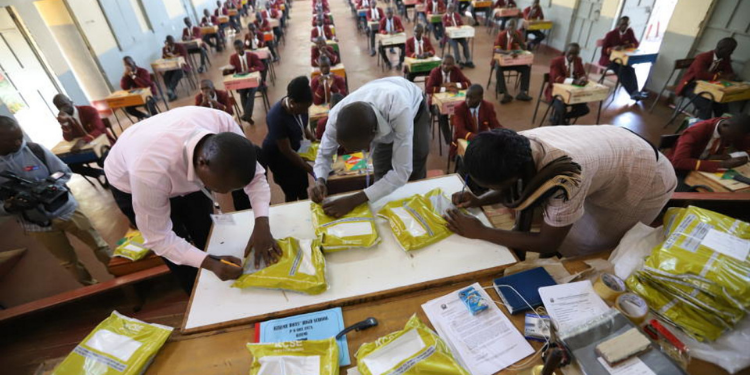
The School Examination and Invigilation programme, which includes KCSE, KPSEA, and KJSEA, requires Ksh14.72 billion but has been allocated Ksh9.9 billion, leaving a deficit of Ksh4.82 billion.
Low-cost boarding schools, which serve about 158,286 learners, have been allocated Ksh380 million against a requirement of Ksh800 million, leaving a deficit of Ksh420 million.
The allocation translates to about Ksh5 per learner per day for 180 days, covering meals and staff costs, but the ministry said it remains insufficient to fully support learners.
Meanwhile, primary school infrastructure improvement projects face a Ksh229.74 million shortfall after being allocated Ksh770.26 million, against a requirement of Ksh1 billion.
The Integrated Mechanism for Poverty Eradication and Sustainable Education, a donor-funded programme under NACONEK targeting out-of-school children and youth in ASAL counties, requires Ksh787 million but has been allocated Ksh251 million, leaving a deficit of Ksh536 million.
The construction of the KICD Education Resource Center requires Ksh300 million but has been allocated Ksh153 million, leaving a deficit of Ksh147 million.
At the same time, the State Department flagged Operations and Maintenance (O&M), which requires Ksh919.84 million.
It has been allocated Ksh232.97 million, leaving a deficit of Ksh686.87 million.