

Wednesday, October 14, 2026
  • News
    • Latest News
    • Breaking News
    • Fact Check
    • Investigations
    • Explainers
  • Politics
    • Global Politics
    • Elections
    • Government & Policy
    • Diplomacy
    • Conflicts & Security
    • Political Analysis
  • Business
    • Global Economy
    • Markets
    • Technology
    • Startups
    • Energy
    • Finance
  • World News
    • Americas
    • Asia
    • Asia Pacific
    • Africa
    • Europe
    • Middle East
  • Africa
    • Central Africa
    • East Africa
    • West Africa
    • Southern Africa
  • Health
    • Global Health
    • Public Health
    • Health Policy
    • Medical Research
    • Diseases & Conditions
    • Mental Health
    • Nutrition
    • Climate & Health
    • Health Explainers
  • Sports
    • World Cup 2026
    • Athletics
    • Basketball
    • Boxing
    • Cricket
    • Football
    • Formula 1
    • Golf
    • Rugby
  • Weather
    • Climate Business
    • Climate Change
    • Climate Solutions
    • Living Green
  • Culture
    • Arts
    • Film & TV
    • Food and Recipes
    • Music
    • Lifestyle
    • People
    • Travel
  • Opinion
    • Editorials
    • Letters
  • Behind The Brand
REGISTER
LOGIN
No Result
View All Result
The Kenya Times
  • News
    • Latest News
    • Breaking News
    • Fact Check
    • Investigations
    • Explainers
  • Politics
    • Global Politics
    • Elections
    • Government & Policy
    • Diplomacy
    • Conflicts & Security
    • Political Analysis
  • Business
    • Global Economy
    • Markets
    • Technology
    • Startups
    • Energy
    • Finance
  • World News
    • Americas
    • Asia
    • Asia Pacific
    • Africa
    • Europe
    • Middle East
  • Africa
    • Central Africa
    • East Africa
    • West Africa
    • Southern Africa
  • Health
    • Global Health
    • Public Health
    • Health Policy
    • Medical Research
    • Diseases & Conditions
    • Mental Health
    • Nutrition
    • Climate & Health
    • Health Explainers
  • Sports
    • World Cup 2026
    • Athletics
    • Basketball
    • Boxing
    • Cricket
    • Football
    • Formula 1
    • Golf
    • Rugby
  • Weather
    • Climate Business
    • Climate Change
    • Climate Solutions
    • Living Green
  • Culture
    • Arts
    • Film & TV
    • Food and Recipes
    • Music
    • Lifestyle
    • People
    • Travel
  • Opinion
    • Editorials
    • Letters
  • Behind The Brand
  • News
    • Latest News
    • Breaking News
    • Fact Check
    • Investigations
    • Explainers
  • Politics
    • Global Politics
    • Elections
    • Government & Policy
    • Diplomacy
    • Conflicts & Security
    • Political Analysis
  • Business
    • Global Economy
    • Markets
    • Technology
    • Startups
    • Energy
    • Finance
  • World News
    • Americas
    • Asia
    • Asia Pacific
    • Africa
    • Europe
    • Middle East
  • Africa
    • Central Africa
    • East Africa
    • West Africa
    • Southern Africa
  • Health
    • Global Health
    • Public Health
    • Health Policy
    • Medical Research
    • Diseases & Conditions
    • Mental Health
    • Nutrition
    • Climate & Health
    • Health Explainers
  • Sports
    • World Cup 2026
    • Athletics
    • Basketball
    • Boxing
    • Cricket
    • Football
    • Formula 1
    • Golf
    • Rugby
  • Weather
    • Climate Business
    • Climate Change
    • Climate Solutions
    • Living Green
  • Culture
    • Arts
    • Film & TV
    • Food and Recipes
    • Music
    • Lifestyle
    • People
    • Travel
  • Opinion
    • Editorials
    • Letters
  • Behind The Brand
No Result
View All Result
The Kenya Times ~ Trending, Breaking News and Videos
No Result
View All Result
ADVERTISEMENT

AI Could Improve Your Life

By Removing Bottlenecks Between What You Want and What You Get

Bruce SchneierbyBruce Schneier
December 29, 2023
Reading Time: 8 mins read
Ai Bot
FacebookTwitterLinkedInRedditWhatsApp
Advertisement

AI (Artificial intelligence) is poised to upend much of society, removing human limitations inherent in many systems. One such limitation is information and logistical bottlenecks in decision-making.

Traditionally, people have been forced to reduce complex choices to a small handful of options that don’t do justice to their true desires. Artificial intelligence has the potential to remove that limitation. And it has the potential to drastically change how democracy functions.

AI researcher Tantum Collins and I, a public-interest technology scholar, call this AI overcoming “lossy bottlenecks.” Lossy is a term from information theory that refers to imperfect communications channels – that is, channels that lose information.

Multiple-choice practicality

Imagine your next sit-down dinner and being able to have a long conversation with a chef about your meal. You could end up with a bespoke dinner based on your desires, the chef’s abilities and the available ingredients. This is possible if you are cooking at home or hosted by accommodating friends.


Also Read: ChatGPT and Its AI Chatbot Cousins Ruled 2023

ADVERTISEMENT

But it is infeasible at your average restaurant: The limitations of the kitchen, the way supplies have to be ordered and the realities of restaurant cooking make this kind of rich interaction between diner and chef impossible. You get a menu of a few dozen standardized options, with the possibility of some modifications around the edges.

That’s a lossy bottleneck. Your wants and desires are rich and multifaceted. The array of culinary outcomes are equally rich and multifaceted. But there’s no scalable way to connect the two. People are forced to use multiple-choice systems like menus to simplify decision-making, and they lose so much information in the process.

People are so used to these bottlenecks that we don’t even notice them. And when we do, we tend to assume they are the inevitable cost of scale and efficiency. And they are. Or, at least, they were.

The possibilities

Artificial intelligence has the potential to overcome this limitation. By storing rich representations of people’s preferences and histories on the demand side, along with equally rich representations of capabilities, costs and creative possibilities on the supply side, AI systems enable complex customization at scale and low cost. Imagine walking into a restaurant and knowing that the kitchen has already started work on a meal optimized for your tastes, or being presented with a personalized list of choices.

There have been some early attempts at this. People have used ChatGPT to design meals based on dietary restrictions and what they have in the fridge. It’s still early days for these technologies, but once they get working, the possibilities are nearly endless. Lossy bottlenecks are everywhere.

ADVERTISEMENT
Imagine a future AI that knows your dietary wants and needs so well that you wouldn’t need to use detail prompts for meal plans, let alone iterate on them as the nutrition coach in this video does with ChatGPT.

Take labor markets. Employers look to grades, diplomas and certifications to gauge candidates’ suitability for roles. These are a very coarse representation of a job candidate’s abilities. An AI system with access to, for example, a student’s coursework, exams and teacher feedback as well as detailed information about possible jobs could provide much richer assessments of which employment matches do and don’t make sense.


Also Read: Ai is the Future: Exploring the Exciting Possibilities of Artificial Intelligence


Or apparel. People with money for tailors and time for fittings can get clothes made from scratch, but most of us are limited to mass-produced options. AI could hugely reduce the costs of customization by learning your style, taking measurements based on photos, generating designs that match your taste and using available materials. It would then convert your selections into a series of production instructions and place an order to an AI-enabled robotic production line.

Or software. Today’s computer programs typically use one-size-fits-all interfaces, with only minor room for modification, but individuals have widely varying needs and working styles. AI systems that observe each user’s interaction styles and know what that person wants out of a given piece of software could take this personalization far deeper, completely redesigning interfaces to suit individual needs.

Removing democracy’s bottleneck

These examples are all transformative, but the lossy bottleneck that has the largest effect on society is in politics. It’s the same problem as the restaurant. As a complicated citizen, your policy positions are probably nuanced, trading off between different options and their effects. You care about some issues more than others and some implementations more than others.

If you had the knowledge and time, you could engage in the deliberative process and help create better laws than exist today. But you don’t. And, anyway, society can’t hold policy debates involving hundreds of millions of people. So you go to the ballot box and choose between two – or if you are lucky, four or five – individual representatives or political parties.

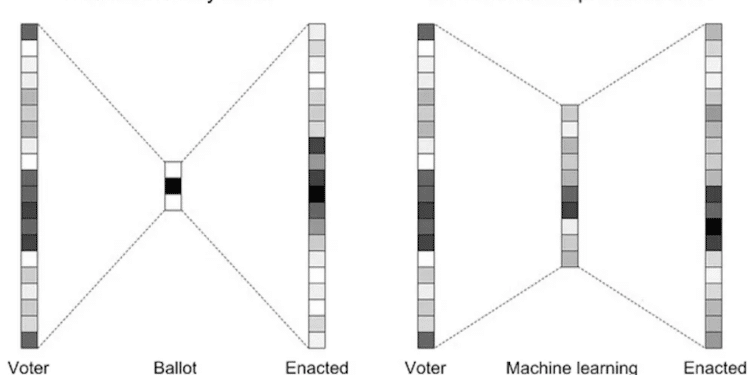
Imagine a system where AI removes this lossy bottleneck. Instead of trying to cram your preferences to fit into the available options, imagine conveying your political preferences in detail to an AI system that would directly advocate for specific policies on your behalf. This could revolutionize democracy.
Ballots And Voting
Ballots are bottlenecks that funnel a voter’s diverse views into a few options. AI representations of individual voters’ desires overcome this bottleneck, promising enacted policies that better align with voters’ wishes. Tantum Collins, CC BY-ND

One way is by enhancing voter representation. By capturing the nuances of each individual’s political preferences in a way that traditional voting systems can’t, this system could lead to policies that better reflect the desires of the electorate. For example, you could have an AI device in your pocket – your future phone, for instance – that knows your views and wishes and continually votes in your name on an otherwise overwhelming number of issues large and small.


Also Read: Some African Governments are Spending Millions to Spy on their Citizens


Combined with AI systems that personalize political education, it could encourage more people to participate in the democratic process and increase political engagement. And it could eliminate the problems stemming from elected representatives who reflect only the views of the majority that elected them – and sometimes not even them.

On the other hand, the privacy concerns resulting from allowing an AI such intimate access to personal data are considerable. And it’s important to avoid the pitfall of just allowing the AIs to figure out what to do: Human deliberation is crucial to a functioning democracy.

Also, there is no clear transition path from the representative democracies of today to these AI-enhanced direct democracies of tomorrow. And, of course, this is still science fiction.

First steps

These technologies are likely to be used first in other, less politically charged, domains. Recommendation systems for digital media have steadily reduced their reliance on traditional intermediaries. Radio stations are like menu items: Regardless of how nuanced your taste in music is, you have to pick from a handful of options. Early digital platforms were only a little better: “This person likes jazz, so we’ll suggest more jazz.”

Today’s streaming platforms use listener histories and a broad set of features describing each track to provide each user with personalized music recommendations. Similar systems suggest academic papers with far greater granularity than a subscription to a given journal, and movies based on more nuanced analysis than simply deferring to genres.

A world without artificial bottlenecks comes with risks – loss of jobs in the bottlenecks, for example – but it also has the potential to free people from the straightjackets that have long constrained large-scale human decision-making. In some cases – restaurants, for example – the impact on most people might be minor. But in others, like politics and hiring, the effects could be profound.The Conversation

Bruce Schneier, Adjunct Lecturer in Public Policy, Harvard Kennedy School

This article is republished from The Conversation under a Creative Commons license. Read the original article.

Tags: AIArtificial intelligence (AI)ChatGPTLifestyleLogisticsOpenAITechnology
Bruce Schneier

Bruce Schneier

Bruce Schneier is an internationally renowned security technologist, called a "security guru" by The Economist. He is the author of 14 books -- including the New York Times best-seller Data and Goliath: The Hidden Battles to Collect Your Data and Control Your World -- as well as hundreds of articles, essays, and academic papers. His influential newsletter "Crypto-Gram" and blog "Schneier on Security" are read by over 250,000 people. Schneier is a fellow at the Berkman Center for Internet and Society at Harvard University, a fellow at the Belfer Center at Harvard's Kennedy School of Government, and a board member of the Electronic Frontier Foundation. He is also a special advisor to IBM Security and the Chief Technology Officer of Resilient.

Related Posts

Court Clears Path For Dangote’s Lamu Oil Refinery

Court Clears Path for Dangote’s Lamu Oil Refinery

October 14, 2026
Epra Announces New Fuel Prices For October-November Cycle

EPRA Announces New Fuel Prices for October-November Cycle

October 14, 2026
Kcse 2026 Timetable: Examination Dates And Times For All Papers

KCSE 2026 Timetable: Date and Time Each Paper Will Be Examined

October 14, 2026
Phone Snatchers Arrested, 57 Recovered After Iphone 15 Pro Max Theft Along Limuru Road

Motorist Jumps Out of Car, Recovers iPhone 15 Pro Max After Police Chase

October 14, 2026
ADVERTISEMENT

The Kenya Times Facebook

LATEST NEWS

  • Trans Nzoia Power Projects Target Nearly 11,000 Homes
  • Court Clears Path for Dangote’s Lamu Oil Refinery
  • EPRA Announces New Fuel Prices for October-November Cycle
  • Kenya Confirms Second Ebola Case
  • How to Import Milk Buffaloes from India to Kenya: Costs, Licenses and Process
  • KCSE 2026 Timetable: Date and Time Each Paper Will Be Examined
  • Bobby Ogolla: How Gor Mahia’s ‘Six Million Dollar Man’ Made His Name
  • Motorist Jumps Out of Car, Recovers iPhone 15 Pro Max After Police Chase
  • Fastest Routes to Get From JKIA to Nairobi CBD
  • UDA Secretary General Hassan Omar Summoned
  • Kenyan MP Wins Global Award
  • Profile of Esther Arunga, Former KTN Anchor Who Dropped Husband’s Surname After 16 Years
  • How Mamlaka Hill Chapel Grew From 80 Worshippers Under Bishop Ng’ang’a Before His Dismissal
  • Why SRC Asked 2 Senior Judges to Step Aside From High-Profile Car Allowance Case
  • India Issues Kenya Travel Advisory Over New Entry Requirement
ADVERTISEMENT

Company

About Us

Our Authors

Our Experts

Social Media

Policies

Privacy Policy

House Rules

Standards and Policies

Terms and Conditions

Subscription

My Account

Contact Us

Contact Us

Join Our Team

Advertise With Us

© Copyright 2026 | The Kenya Times | All Rights Reserved

Welcome Back!

Sign In with Facebook
Sign In with Google
Sign In with Linked In
OR

Login to your account below

Forgotten Password? Sign Up

Create New Account!

Sign Up with Facebook
Sign Up with Google
Sign Up with Linked In
OR

Fill the forms below to register

All fields are required. Log In

Retrieve your password

Please enter your username or email address to reset your password.

Log In
Your Privacy and Cookies
We use cookies on our website to give you the most relevant experience by remembering your preferences and repeat visits. By clicking “Accept”, you consent to the use of ALL the cookies.
Do not sell my personal information.
Cookie settingsACCEPT
Privacy & Cookies Policy

Privacy Overview

This website uses cookies to improve your experience while you navigate through the website. Out of these cookies, the cookies that are categorized as necessary are stored on your browser as they are essential for the working of basic functionalities of the website. We also use third-party cookies that help us analyze and understand how you use this website. These cookies will be stored in your browser only with your consent. You also have the option to opt-out of these cookies. But opting out of some of these cookies may have an effect on your browsing experience.
Necessary
Always Enabled
Necessary cookies are absolutely essential for the website to function properly. This category only includes cookies that ensures basic functionalities and security features of the website. These cookies do not store any personal information.
Functional
Functional cookies help to perform certain functionalities like sharing the content of the website on social media platforms, collect feedbacks, and other third-party features.
Performance
Performance cookies are used to understand and analyze the key performance indexes of the website which helps in delivering a better user experience for the visitors.
Analytics
Analytical cookies are used to understand how visitors interact with the website. These cookies help provide information on metrics the number of visitors, bounce rate, traffic source, etc.
Advertisement
Advertisement cookies are used to provide visitors with relevant ads and marketing campaigns. These cookies track visitors across websites and collect information to provide customized ads.
Others
Other uncategorized cookies are those that are being analyzed and have not been classified into a category as yet.
SAVE & ACCEPT
LOGIN | REGISTER
  • Login
  • Sign Up
  • Cart
No Result
View All Result
  • News
    • Latest News
    • Breaking News
    • Investigations
    • Explainers
    • Fact Check
  • Politics
    • Global Politics
    • Conflicts & Security
    • Elections
    • Diplomacy
    • Government & Policy
    • Political Analysis
  • Business
    • Global Economy
    • Markets
    • Technology
    • Startups
    • Energy
    • Finance
  • World News
    • Americas
    • Asia
    • Asia Pacific
    • Africa
    • Europe
    • Middle East
  • Africa
    • East Africa
    • West Africa
    • Southern Africa
    • Central Africa
  • Health
    • Global Health
    • Public Health
    • Health Policy
    • Medical Research
    • Diseases & Conditions
    • Mental Health
    • Nutrition
    • Climate & Health
    • Health Explainers
  • Sports
    • World Cup 2026
    • Athletics
    • Basketball
    • Boxing
    • Cricket
    • Football
    • Formula 1
    • Golf
    • Rugby
  • Weather
    • Climate Business
    • Climate Change
    • Climate Solutions
    • Living Green
  • Culture
    • Arts
    • Film & TV
    • Food and Recipes
    • Lifestyle
    • Music
    • People
    • Travel
  • Opinion
    • Editorials
    • Letters
  • Behind The Brand
  • Contact Us

Not enough quota to unlock this post
Unlock left : 0
Are you sure want to cancel subscription?