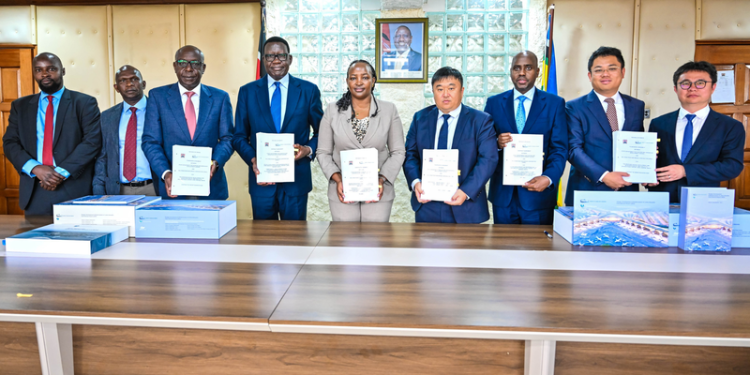
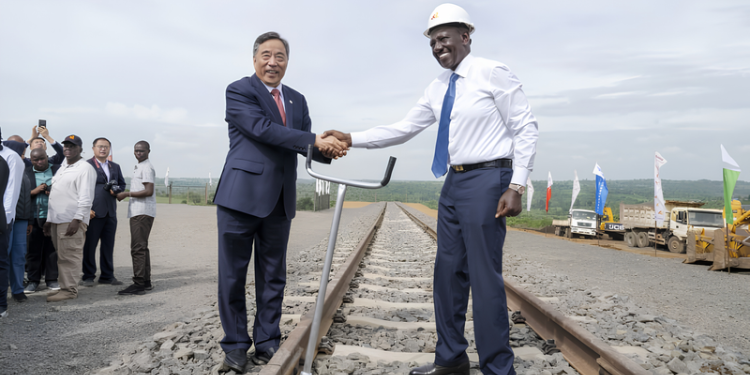
China Road and Bridge Corporation (CRBC), the Chinese state-owned construction company behind Kenya’s Standard Gauge Railway (SGR), Nairobi Expressway and several other multi-billion-shilling infrastructure projects, secured another government contract worth Ksh1.2 billion on November 9, 2026, when the Kenya Urban Roads Authority (KURA) awarded it the tender to install 10,000 streetlights across Nairobi.
KURA awarded CRBC the contract to install 10,000 streetlights across 11 informal settlements in Nairobi, covering 408.44 kilometres of roads.
The 30-month project is expected to involve trenching, installing electrical cables, erecting lighting poles, installing LED luminaires, and testing and commissioning.
The award adds to a growing portfolio of Kenyan infrastructure contracts held by the Chinese company, whose projects in the country were valued at more than Ksh1.2 trillion following its Ksh154.2 billion contract to modernise Jomo Kenyatta International Airport (JKIA) in June 2026.
However, CRBC’s international record includes an eight-year debarment by the World Bank following an investigation into collusive practices in a road construction programme in the Philippines.
World Bank’s Eight-Year Ban Against CRBC
On January 14, 2009, the World Bank announced that it had debarred CRBC for eight years after its Integrity Vice Presidency investigated alleged corruption and procurement irregularities involving companies bidding for contracts under the Philippines National Roads Improvement and Management Programme.
Also Read: KenGen Shareholders: Full List of Top 10 Owners and Their Stakes in the Company
The investigation uncovered evidence of a cartel involving local and international construction companies participating in the first phase of the programme, known as NRIMP 1.
According to the World Bank, the companies engaged in collusive practices that undermined competition in the procurement of road construction contracts.
The conduct constituted fraudulent practices under the procurement rules governing the programme.
CRBC was among seven companies and one individual sanctioned following the investigation. It received an eight-year debarment, preventing it from participating in World Bank-financed projects during the sanction period.
Other companies sanctioned included China State Construction Corporation, China Wu Yi Company Limited and China Geo-Engineering Corporation, which received debarment periods of six, six and five years respectively.
The World Bank said it could reduce or terminate CRBC’s sanction after five years if the company implemented a compliance programme satisfactory to the institution.
The original sanction was imposed on CRBC, not its Kenyan subsidiary or a specific Kenyan infrastructure project.
CRBC’s eight-year sanction subsequently expired in January 2017.
World Bank Extends Sanction to CRBC’s Parent Company
On July 29, 2011, the World Bank extended the consequences of the original debarment to China Communications Construction Company (CCCC), CRBC’s designated successor following corporate restructuring.
The institution explained that its sanctions system allowed penalties imposed on a company to apply to successor organisations following acquisitions or reorganisations.
As a result, CCCC and its subsidiaries became ineligible to participate in World Bank-financed road and bridge projects until January 12, 2017.
Also Read: Top Shareholders Behind Kenya’s Listed Companies and Their Ownership Stakes Revealed
CCCC is CRBC’s parent company and holds a 99 per cent stake in the construction firm, while China First Highway Engineering Company owns the remaining one per cent.
CRBC’s Growing Infrastructure Business in Kenya
CRBC entered Kenya in December 1984 and has since established itself as a major contractor in the country’s transport and infrastructure sector.
Its projects include the Standard Gauge Railway connecting Mombasa and Nairobi, which cost approximately Ksh658.1 billion and was financed through loans from China’s Export-Import Bank.
The company also constructed the 27.1-kilometre Nairobi Expressway, which cost approximately KSh86.8 billion and opened to motorists in 2022.
Other projects include Nairobi’s Southern, Eastern and Northern bypasses, the Nairobi-Nakuru-Mau Summit highway and the Ksh46 billion Talanta Stadium.
In June 2026, the government signed a Ksh154.2 billion agreement with CRBC the modernise and expand JKIA.
The project includes a new passenger terminal and upgrades to existing airport infrastructure, with the planned expansion increasing annual passenger-handling capacity from 7.5 million to 22 million.
In October 2026, KURA also awarded the company a Ksh3.22 billion contract to upgrade seven kilometres of Old Mombasa Road linking the Nairobi Inland Container Depot to Syokimau.
Another International Procurement Settlement
CRBC’s procurement history also attracted scrutiny from the European Investment Bank (EIB).
On June 3, 2025, the EIB announced an 18-month conditional non-exclusion settlement with CRBC following investigations into historical prohibited conduct involving the company as a tenderer in procurement procedures for several EIB-financed projects.
The settlement required CRBC to maintain its corporate compliance programme, cooperate with investigations and report significant developments in its compliance arrangements.
The agreement was not a blanket ban. It allowed the company to continue participating in EIB-financed procurement subject to the settlement conditions. The published exclusion period runs until December 2, 2026.
Separately, the EIB imposed an exclusion decision on CCCC, CRBC’s parent company, effective March 30, 2026, running until September 29, 2027.
The two decisions concern separate corporate entities and are not the same sanction.
Follow our WhatsApp Channel and X Account for real-time news updates and our YouTube Channel for in-depth interviews.