Tuesday, June 2, 2026
  • News
    • Latest News
    • Breaking News
    • Fact Check
    • Investigations
    • Explainers
  • Politics
    • Global Politics
    • Elections
    • Government & Policy
    • Diplomacy
    • Conflicts & Security
    • Political Analysis
  • Business
    • Global Economy
    • Markets
    • Technology
    • Startups
    • Energy
    • Finance
  • World News
    • Americas
    • Asia
    • Asia Pacific
    • Africa
    • Europe
    • Middle East
  • Africa
    • Central Africa
    • East Africa
    • West Africa
    • Southern Africa
  • Health
    • Global Health
    • Public Health
    • Health Policy
    • Medical Research
    • Diseases & Conditions
    • Mental Health
    • Nutrition
    • Climate & Health
    • Health Explainers
  • Sports
    • Athletics
    • Basketball
    • Boxing
    • Cricket
    • Football
    • Formula 1
    • Golf
    • Rugby
  • Weather
    • Climate Business
    • Climate Change
    • Climate Solutions
    • Living Green
  • Culture
    • Arts
    • Film & TV
    • Food
    • Music
    • Lifestyle
    • Travel
  • Opinion
    • Editorials
    • Letters
  • Behind The Brand
REGISTER
LOGIN
No Result
View All Result
The Kenya Times
  • News
    • Latest News
    • Breaking News
    • Fact Check
    • Investigations
    • Explainers
  • Politics
    • Global Politics
    • Elections
    • Government & Policy
    • Diplomacy
    • Conflicts & Security
    • Political Analysis
  • Business
    • Global Economy
    • Markets
    • Technology
    • Startups
    • Energy
    • Finance
  • World News
    • Americas
    • Asia
    • Asia Pacific
    • Africa
    • Europe
    • Middle East
  • Africa
    • Central Africa
    • East Africa
    • West Africa
    • Southern Africa
  • Health
    • Global Health
    • Public Health
    • Health Policy
    • Medical Research
    • Diseases & Conditions
    • Mental Health
    • Nutrition
    • Climate & Health
    • Health Explainers
  • Sports
    • Athletics
    • Basketball
    • Boxing
    • Cricket
    • Football
    • Formula 1
    • Golf
    • Rugby
  • Weather
    • Climate Business
    • Climate Change
    • Climate Solutions
    • Living Green
  • Culture
    • Arts
    • Film & TV
    • Food
    • Music
    • Lifestyle
    • Travel
  • Opinion
    • Editorials
    • Letters
  • Behind The Brand
  • News
    • Latest News
    • Breaking News
    • Fact Check
    • Investigations
    • Explainers
  • Politics
    • Global Politics
    • Elections
    • Government & Policy
    • Diplomacy
    • Conflicts & Security
    • Political Analysis
  • Business
    • Global Economy
    • Markets
    • Technology
    • Startups
    • Energy
    • Finance
  • World News
    • Americas
    • Asia
    • Asia Pacific
    • Africa
    • Europe
    • Middle East
  • Africa
    • Central Africa
    • East Africa
    • West Africa
    • Southern Africa
  • Health
    • Global Health
    • Public Health
    • Health Policy
    • Medical Research
    • Diseases & Conditions
    • Mental Health
    • Nutrition
    • Climate & Health
    • Health Explainers
  • Sports
    • Athletics
    • Basketball
    • Boxing
    • Cricket
    • Football
    • Formula 1
    • Golf
    • Rugby
  • Weather
    • Climate Business
    • Climate Change
    • Climate Solutions
    • Living Green
  • Culture
    • Arts
    • Film & TV
    • Food
    • Music
    • Lifestyle
    • Travel
  • Opinion
    • Editorials
    • Letters
  • Behind The Brand
No Result
View All Result
The Kenya Times ~ Trending, Breaking News and Videos
No Result
View All Result
ADVERTISEMENT

Kenya Could Run out of Money to Repay Massive Debts: How to Avoid This

Kenya's Ballooning Debt and Possible Economic Options to avoid defaulting

The ConversationbyThe Conversation
September 20, 2024
Reading Time: 9 mins read
President Williamaruto And Imf Director Kristalina Georgieva In Rome During Italy - Africa Summit. Photo/Pcs.

President WilliamaRuto and IMF Director Kristalina Georgieva in Rome during Italy - Africa Summit. PHOTO/PCS.

FacebookTwitterLinkedInRedditWhatsApp
Advertisement

Data from Kenya’s Central Bank (CBK) show that public debt (total money owed) declined between December 2023 and June 2024.

The drop in external debt – by 15.4 % – over this period does not mean that the country’s overall finances have improved. Rather, it is due to the gains in the value of the Kenyan shilling, thanks to pervasive state interventions since February 2024.

So high is Kenya’s public debt that servicing it ate up 69.6% of domestic revenues as of June 2024. This is more than double the recommended limit of 30%, making the country’s public debt unsustainable. This has been the case since at least 2019.

As a finance scholar with research interests that include development finance and economic growth in Africa, I think the high ratio of debt service to revenue leaves Kenya with few options and diminishing time to steer out of trouble.

In this article, I explore possible effects of unsustainable public debt and some ways through which Kenya could mitigate a sovereign debt default.

As late as January 2024, the International Monetary Fund (IMF) assessed Kenya’s debt as sustainable, even as it warned that “overall and external ratings for risk of debt distress remained high”. With its insistence, the government proposed a raft of tax measures, through the 2024 Finance Bill, aimed at raising additional revenues.

This ignited nationwide protests that forced the government to withdraw the bill. Consequently, the country’s tax revenue is expected to suffer a shortfall of about KES 346 billion (US$2.7 billion) during the 2024/25 fiscal year.

This constricts the government’s ability to repay debt. Despite its falling ability to pay, the government continues to pile up debt. Indeed, as recently as September 2024, senior government officials were in China negotiating additional loans.

Unless it secures a debt write-off, debt rescheduling, or similar deal to reduce the debt burden, Kenya will almost certainly end in debt default. The country must use every effort to avoid this possibility.
Kenya To Benefit From Ksh145 Billion World Bank Loan
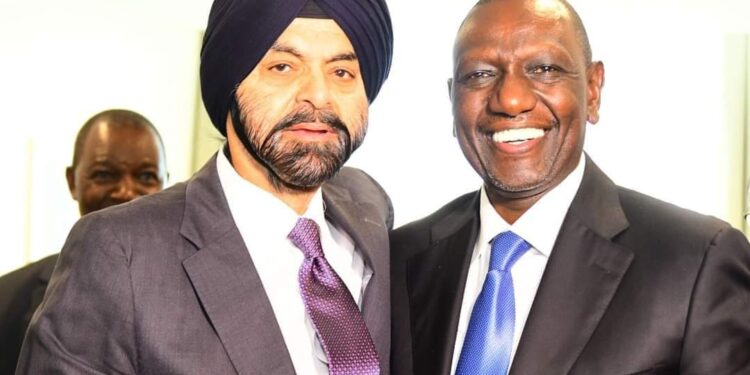
President William Ruto (right) with World Bank President Ajay Banga. PHOTO/PCS.

Avoiding debt default

When creditors believe that a country is likely to default, they seek to protect themselves from possible losses. Sometimes they force the government to take austerity measures.

Austerity means reducing public spending on most needs, including education and health, physical infrastructure such as roads, and social programmes such as food subsidies. It may also force a country to raise revenues by increasing taxes or selling state-owned enterprises.

Such measures can have a negative impact on development and on citizens’ quality of life. But countries on the brink of debt default often have no other option.

Countries at a high risk of default and those that have defaulted usually have their sovereign credit ratings downgraded by rating agencies. Kenya’s sovereign debt rating for example was downgraded in August 2024 notwithstanding that the IMF had earlier assessed it as “sustainable”. Sovereign credit ratings represent the confidence that creditors have about a country’s ability to pay its debt.

Rating downgrades lead creditors to demand higher interest rates on loans. Higher interest rates make it expensive for businesses and individuals to borrow. As a result, businesses may collapse, worsening unemployment, and individuals may lose their livelihoods.

As economic conditions deteriorate, investors may sell their assets and take their money elsewhere (capital flight). This triggers a drastic fall in asset prices, which may cause some markets, such the stock exchange, to collapse.

People who have money in banks may withdraw large amounts on short notice (bank run).

For banks to make the money available to savers in such unanticipated large amounts, they must sell some of their assets, such as treasury bills. However, because of falling prices, the assets may have to be sold at a loss and some banks may collapse.

If the failing banks make up a big part of the banking sector, the country’s financial system may fail altogether (financial crisis).

Kenya’s options

Kenya’s government has several options to avoid public debt default.

1. Dealing with wasteful spending: There is clear evidence of wasteful public spending. Weeding it out would reduce debt service needs and the risk of default. To start with, the 2024 Appropriation Bill could be amended to target recurrent spending on things like transport and entertainment, and allocations to spouses of senior government officials.

2. Fiscal policy rules: There is evidence that limiting the amount a country can borrow and its budget deficit may lower the risk of sovereign default. The rules limit what bureaucrats can spend. Kenya has on many occasions breached such rules or simply changed them.

3. Institutional reform and whistleblowing: Strong institutions play an important role in imposing fiscal discipline. Kenya has an elaborate institutional and policy framework. But its institutions are largely considered toothless and in need of reform.

For example, the auditor general could hold state officers criminally liable for neglecting their accounting responsibilities. And more legal protection and security would encourage whistleblowing.

4. Boosting tax revenue: Given the resistance to the IMF-backed taxation strategy, Kenya has to be more inventive. The government could collect revenue more efficiently, for example, through digitalisation and adoption of artificial intelligence.

5. Off-balance sheet financing: The government can begin to finance more of its development needs through private-public partnerships. But this is a medium-term measure; there are still capacity constraints.

Kenya’s creditors can help, too

Kenya could also consider approaching creditors to negotiate pre-emptive debt restructuring. The borrower can do this when a default is imminent but before it occurs. Debt restructuring eases pressure on government finances by reducing periodic repayments.

Another approach is debt reprofiling. This typically involves consolidating several obligations into one obligation with a longer repayment period or changing the debt to a different currency. The government appeared to make a reprofiling pitch to China as recently as September 2024.

What next

Excessive use of sovereign debt has caused serious economic problems in countries such as Argentina and Greece. There are many lessons from such countries that would help Kenya’s government to steer the economy in the right direction and avoid a debt crisis.The Conversation

Odongo Kodongo, Associate professor, Finance, University of the Witwatersrand

This article is republished from The Conversation under a Creative Commons license. Read the original article.

Follow our WhatsApp Channel for real-time news updates:

https://whatsapp.com/channel/0029VaB3k54HltYFiQ1f2i2C

President William Ruto At A Past Summit In Uganda. Photo/Pcs.
President William Ruto at a past summit in Uganda. PHOTO/PCS.
Tags: IMFKeny Debt CrisisKenya DebtKenya EconomyUhuru KenyattaWilliam RutoWorld Bank
The Conversation

The Conversation

The Conversation is an independent news organization that publishes evidence-based articles written by experts to help readers understand diverse topics. We cover a wide range of areas including arts, culture, education, health, politics, science, and more¹. Their content is characterized by in-depth analysis, research, news, and ideas from leading academics and researchers. The Conversation aims to provide academic rigor with journalistic flair.

Related Posts

In Iran War’s Shadow, Israel’s Renewed Lebanon Campaign Risks Repeating Failed Lessons And Occupations Of The Past

In Iran War’s Shadow, Israel’s Renewed Lebanon Campaign Risks Repeating Failed Lessons and Occupations of the Past

June 2, 2026
New El Nino Warning Puts Kenya’s Rainfall And Temperature Patterns In Focus

Kenya on Alert as Experts Issue Warning on Severe Weather Conditions Ahead

June 2, 2026
The Kenya National Examinations Council (Knec) Has Announced The Dates For The 2026/2027 Business And Technical Examination.

KNEC Announces 2026/2027 TVET Examination Registration Dates

June 2, 2026
Places Where Cctv Cameras Are Not Allowed In Kenya

Where CCTV Cameras Should Not Be Installed Under Kenyan Law

June 2, 2026
ADVERTISEMENT

The Kenya Times Facebook

LATEST ARTICLES

  • High Court Rejects Bia Tosha Bid to Halt KSh297 Billion EABL Stake Sale to Asahi Group
  • Who Is Bill Pulte? Meet the 38-Year-Old Trump Pick Replacing Tulsi Gabbard as Acting DNI
  • Florentius Koech: Neurosurgeon and Founder of Tophill Brain and Spine Hospital
  • In Iran War’s Shadow, Israel’s Renewed Lebanon Campaign Risks Repeating Failed Lessons and Occupations of the Past
  • Meet the Ismaili Family Behind Nairobi’s 4-Star Best Western Plus Meridian Hotel
  • Kenya on Alert as Experts Issue Warning on Severe Weather Conditions Ahead
  • KNEC Announces 2026/2027 TVET Examination Registration Dates
  • PS Oluga Clarifies Nationality of 37 People Quarantined After Returning from Congo
  • How to Send Money Internationally: Cheapest Methods in 2026
  • Where CCTV Cameras Should Not Be Installed Under Kenyan Law
  • Profile of Henry Wooster, Trump’s Nominee for U.S. Ambassador to Kenya
  • Mudavadi Asks Africa to Stop Depending on Aid
  • KeNHA Advances Plans for Mau Summit-Eldoret Road Upgrade After Securing Funding
  • Sasini PLC Appoints New Company Secretary
  • Pressure on Ruto to Allow Atheism in All Schools Countrywide
ADVERTISEMENT

Company

About Us

Our Authors

Our Experts

Social Media

Policies

Privacy Policy

House Rules

Standards and Policies

Terms and Conditions

Subscription

My Account

Contact Us

Contact Us

Join Our Team

Advertise With Us

© Copyright 2026 | The Kenya Times | All Rights Reserved

Welcome Back!

Sign In with Facebook
Sign In with Google
Sign In with Linked In
OR

Login to your account below

Forgotten Password? Sign Up

Create New Account!

Sign Up with Facebook
Sign Up with Google
Sign Up with Linked In
OR

Fill the forms below to register

All fields are required. Log In

Retrieve your password

Please enter your username or email address to reset your password.

Log In
Your Privacy and Cookies
We use cookies on our website to give you the most relevant experience by remembering your preferences and repeat visits. By clicking “Accept”, you consent to the use of ALL the cookies.
Do not sell my personal information.
Cookie settingsACCEPT
Privacy & Cookies Policy

Privacy Overview

This website uses cookies to improve your experience while you navigate through the website. Out of these cookies, the cookies that are categorized as necessary are stored on your browser as they are essential for the working of basic functionalities of the website. We also use third-party cookies that help us analyze and understand how you use this website. These cookies will be stored in your browser only with your consent. You also have the option to opt-out of these cookies. But opting out of some of these cookies may have an effect on your browsing experience.
Necessary
Always Enabled
Necessary cookies are absolutely essential for the website to function properly. This category only includes cookies that ensures basic functionalities and security features of the website. These cookies do not store any personal information.
Functional
Functional cookies help to perform certain functionalities like sharing the content of the website on social media platforms, collect feedbacks, and other third-party features.
Performance
Performance cookies are used to understand and analyze the key performance indexes of the website which helps in delivering a better user experience for the visitors.
Analytics
Analytical cookies are used to understand how visitors interact with the website. These cookies help provide information on metrics the number of visitors, bounce rate, traffic source, etc.
Advertisement
Advertisement cookies are used to provide visitors with relevant ads and marketing campaigns. These cookies track visitors across websites and collect information to provide customized ads.
Others
Other uncategorized cookies are those that are being analyzed and have not been classified into a category as yet.
SAVE & ACCEPT
LOGIN | REGISTER
  • Login
  • Sign Up
  • Cart
No Result
View All Result
  • News
    • Latest News
    • Breaking News
    • Investigations
    • Explainers
    • Fact Check
  • Politics
    • Global Politics
    • Conflicts & Security
    • Elections
    • Diplomacy
    • Government & Policy
    • Political Analysis
  • Business
    • Global Economy
    • Markets
    • Technology
    • Startups
    • Energy
    • Finance
  • World News
    • Americas
    • Asia
    • Asia Pacific
    • Africa
    • Europe
    • Middle East
  • Africa
    • East Africa
    • West Africa
    • Southern Africa
    • Central Africa
  • Health
    • Global Health
    • Public Health
    • Health Policy
    • Medical Research
    • Diseases & Conditions
    • Mental Health
    • Nutrition
    • Climate & Health
    • Health Explainers
  • Sports
    • Athletics
    • Basketball
    • Boxing
    • Cricket
    • Football
    • Formula 1
    • Golf
    • Rugby
  • Weather
    • Climate Business
    • Climate Change
    • Climate Solutions
    • Living Green
  • Culture
    • Arts
    • Film & TV
    • Food
    • Lifestyle
    • Music
    • Travel
  • Opinion
    • Editorials
    • Letters
  • Behind The Brand
  • Contact Us

Not enough quota to unlock this post
Unlock left : 0
Are you sure want to cancel subscription?