
Tuesday, June 2, 2026
  • News
    • Latest News
    • Breaking News
    • Fact Check
    • Investigations
    • Explainers
  • Politics
    • Global Politics
    • Elections
    • Government & Policy
    • Diplomacy
    • Conflicts & Security
    • Political Analysis
  • Business
    • Global Economy
    • Markets
    • Technology
    • Startups
    • Energy
    • Finance
  • World News
    • Americas
    • Asia
    • Asia Pacific
    • Africa
    • Europe
    • Middle East
  • Africa
    • Central Africa
    • East Africa
    • West Africa
    • Southern Africa
  • Health
    • Global Health
    • Public Health
    • Health Policy
    • Medical Research
    • Diseases & Conditions
    • Mental Health
    • Nutrition
    • Climate & Health
    • Health Explainers
  • Sports
    • Athletics
    • Basketball
    • Boxing
    • Cricket
    • Football
    • Formula 1
    • Golf
    • Rugby
  • Weather
    • Climate Business
    • Climate Change
    • Climate Solutions
    • Living Green
  • Culture
    • Arts
    • Film & TV
    • Food
    • Music
    • Lifestyle
    • Travel
  • Opinion
    • Editorials
    • Letters
  • Behind The Brand
REGISTER
LOGIN
No Result
View All Result
The Kenya Times
  • News
    • Latest News
    • Breaking News
    • Fact Check
    • Investigations
    • Explainers
  • Politics
    • Global Politics
    • Elections
    • Government & Policy
    • Diplomacy
    • Conflicts & Security
    • Political Analysis
  • Business
    • Global Economy
    • Markets
    • Technology
    • Startups
    • Energy
    • Finance
  • World News
    • Americas
    • Asia
    • Asia Pacific
    • Africa
    • Europe
    • Middle East
  • Africa
    • Central Africa
    • East Africa
    • West Africa
    • Southern Africa
  • Health
    • Global Health
    • Public Health
    • Health Policy
    • Medical Research
    • Diseases & Conditions
    • Mental Health
    • Nutrition
    • Climate & Health
    • Health Explainers
  • Sports
    • Athletics
    • Basketball
    • Boxing
    • Cricket
    • Football
    • Formula 1
    • Golf
    • Rugby
  • Weather
    • Climate Business
    • Climate Change
    • Climate Solutions
    • Living Green
  • Culture
    • Arts
    • Film & TV
    • Food
    • Music
    • Lifestyle
    • Travel
  • Opinion
    • Editorials
    • Letters
  • Behind The Brand
  • News
    • Latest News
    • Breaking News
    • Fact Check
    • Investigations
    • Explainers
  • Politics
    • Global Politics
    • Elections
    • Government & Policy
    • Diplomacy
    • Conflicts & Security
    • Political Analysis
  • Business
    • Global Economy
    • Markets
    • Technology
    • Startups
    • Energy
    • Finance
  • World News
    • Americas
    • Asia
    • Asia Pacific
    • Africa
    • Europe
    • Middle East
  • Africa
    • Central Africa
    • East Africa
    • West Africa
    • Southern Africa
  • Health
    • Global Health
    • Public Health
    • Health Policy
    • Medical Research
    • Diseases & Conditions
    • Mental Health
    • Nutrition
    • Climate & Health
    • Health Explainers
  • Sports
    • Athletics
    • Basketball
    • Boxing
    • Cricket
    • Football
    • Formula 1
    • Golf
    • Rugby
  • Weather
    • Climate Business
    • Climate Change
    • Climate Solutions
    • Living Green
  • Culture
    • Arts
    • Film & TV
    • Food
    • Music
    • Lifestyle
    • Travel
  • Opinion
    • Editorials
    • Letters
  • Behind The Brand
No Result
View All Result
The Kenya Times ~ Trending, Breaking News and Videos
No Result
View All Result
ADVERTISEMENT

Kenya’s Shilling Is Gaining Value, but Don’t Expect It to Last – Expert

The ConversationbyThe Conversation
April 17, 2024
Reading Time: 10 mins read
How To Invest Using Dhowcsd Tool Launched By Ruto - Cbk

President William Ruto and CBK Governor Dr. Kamau Thugge. PHOTO/PCS.

FacebookTwitterLinkedInRedditWhatsApp
Advertisement

Shortly after Kenya’s 2022 elections, the shilling depreciated rapidly against the US dollar – the country’s main currency for international transactions – fuelling a wave of political discontent.

More than a year later, the Central Bank of Kenya, taking its cue from the International Monetary Fund, said that the run on the shilling was a market correction for a currency that had been overvalued by between 20% and 25%.

By early this year, the shilling recovered. Finance scholar Odongo Kodongo answers our questions about Kenya’s exchange rate fluctuations.

How is the shilling exchange rates determined?

Kenya operates a floating exchange rate regime. This means that the value of the shilling is, in principle, determined by market demand and supply. Market demand and supply are affected by movements of money across national borders.

Movements of money into the country are driven by forces such as the value of exports and transfers from abroad (such as diaspora remittances), and the value of investments from abroad. For example, if Kenya exports more goods at higher prices, this increases the shilling’s demand as Kenyan exporters convert their dollar receipts to shillings. The shilling appreciates, all else equal.

On the supply side are the value of imports and outbound transfers (like pensions of retired expatriates), and the value of investments abroad. For example, to buy shares abroad, Kenyans must sell shillings to buy foreign currencies. This increases the shilling’s supply, causing it to depreciate, all else equal.

The drivers of international money flows are, in turn, affected by economic factors (called fundamentals) such as interest rates, inflation, and income. For example, a fall in interest rates in Kenya may encourage businesses to borrow to finance their investment opportunities, increasing Kenya’s economic production.


Also Read: Why the Dollar is Falling and Whether You Should Sell – Experts


The rise in economic production generates more goods to be sold in Kenya and abroad. Sales abroad increase the value of exports, which causes the shilling to appreciate. Contrarily, an increase in government borrowing from abroad initially causes a shilling appreciation as Kenya’s foreign currency reserves grow. However, it also raises the expectation that Kenya will henceforth pay more to foreign creditors, which may elicit some reversal in the initial appreciation.

Why Kenyan Banks Make Profits: Demystifying Banking Business
Central Bank of Kenya. PHOTO/Courtesy.

Why does the exchange rate matter?

The exchange rate matters for several reasons.

First, it may drive domestic inflation. For example, if one barrel of oil trades for US$100 and the exchange rate is KES 120/US dollar, we pay KES 12,000 per barrel. Should the shilling depreciate to KES 150/dollar, we would now pay more: KES 15,000 per barrel. Because oil is used in the manufacture of goods and provision of services (such as transport), a higher oil bill makes those goods and services more expensive.

Second, the exchange rate also affects how much we earn from exports. For example, exports worth US$1,000 would fetch us more shillings (KES 150,000) at KES 150/dollar exchange rate rather than only KES 120,000 at KES 120/dollar.

However, economic sectors are not affected the same way by exchange rate changes. Sectors that do not export or import goods and those that do not compete with imported goods are hardly affected by exchange rates.

What role does Kenya’s central bank play in the foreign exchange market?

In a market-driven exchange rate system such as Kenya’s, the central bank’s responsibility is fairly straightforward. It is to ensure exchange rate stability to facilitate planning by businesses and households and to maintain confidence in the currency. It does this by intervening in the market whenever necessitated by exchange rate fluctuations.

For example, on 5 December 2023, the central bank’s monetary policy committee intervened by increasing the policy interest rate from 10.5% to 12.5% on the argument that the shilling had depreciated “more than necessary to reestablish equilibrium”. An increment in the interest rate is expected to attract foreign investors, creating a demand for the shilling and causing it to appreciate.

However, this action did not alter the market’s expectations. The shilling continued falling, and, by 25 February 2024, the shilling had depreciated to 163/US$. This is probably because there were other reasons keeping the shilling weak, such as investors’ fears about a possible default on Kenya’s maturing Eurobond debt.

In mid-January 2024, Kenya sought to refinance its US$2 billion maturing eurobond obligation. On being approached, two multilateral institutions, the International Monetary Fund and Trade and Development Bank, committed close to US$ 1 billion in new loans.

This “success” induced the initial change of tide in the value of the shilling. Later, nudged by Cote d’Ivoire’s success, Kenya issued a US$1.5 billion seven-year note in the Eurobond market, the success of which triggered a strong rally in the shilling’s value: by 10 April 2024, it had strengthened to about 129/US$.

Is the current shilling’s appreciation sustainable?

Like many market-driven currencies, the shilling is not floating freely. As explained, the central bank often intervenes in the currency market to achieve objectives such as, to smooth fluctuations (reduce the speed of transition from one rate to another), or to stem further fluctuations.

Related to this is that currency values may change in response to sentiment. For example, when Kenya recently paid off part of its Eurobond debt, media reports suggested that the shilling was thereafter unlikely to suffer a strain from a possible sovereign default (which the market had already priced into the shilling’s value). The positive sentiment conveyed by such reports likely informed the shilling’s initial euphoric appreciation.

However, currency value changes induced by sentiment or intervention are not sustainable. If Kenya wants to keep the shilling’s value artificially high, for example, it will soon realise that foreign currency reserves, used for intervention, are not limitless.

An appreciable depletion in reserves causes expectations of a shilling decline, which induces capital flight. Capital flight then increases the shilling’s supply causing it to depreciate. Thus, to keep the strong shilling sustainable requires strong economic fundamentals.
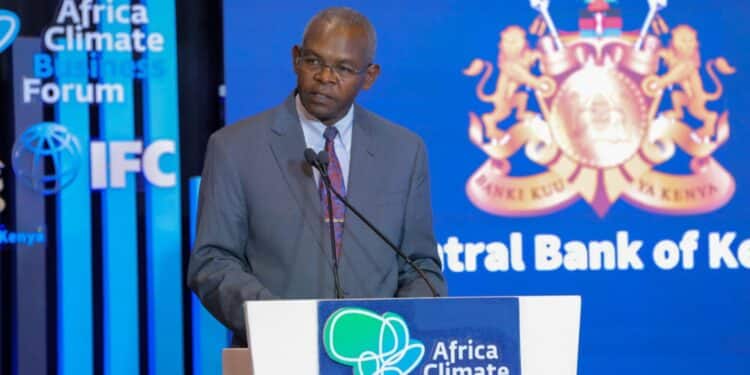
Demystifying Kenya'S Banking Sector.
Central Bank of Kenya Governor Kamau Thugge. PHOTO/CBK.

Have Kenya’s economic fundamentals improved?

The short answer is, “no”. Let’s examine some factors. First, as explained, the country recently borrowed almost US$2.5 billion abroad to refinance a US$2 billion debt. The result was a net growth of almost US$500 million in external debt. This will further increase the proportion of public revenue committed to debt servicing (called the debt burden).


Also Read: Gachagua Revisits His Inauguration Speech on Kenya’s Economy


As of first quarter 2023, debt servicing was gobbling up about 67.5% of Kenya’s tax revenues, leaving very little money for development spending: during 2023, development expenditure constituted only 16.5% of revenues (excluding grants). Reduced development spending imperils economic performance, and weakens the shilling in the long run.

Second, Kenya’s trade balance (value of exports minus value of imports) has been negative. Of concern is that the negative balance has been growing: from 4.9% of GDP in 1975 to 9.3% in 2022. This situation is not expected to change soon. The growing negative trade balance is consistent with a long run shilling depreciation.

Third, in its February 2024 review, the central bank raised the policy interest rate to 13%. This has pushed up the cost of money, with central bank’s discount window (the rate at which central bank lends money to banks experiencing short-term liquidity shortfalls) rising to 16%.

The higher cost of money discourages private sector investments and lowers economic production. Low economic production reduces exports and increases imports, leading to currency depreciation.

Further, the high interest rates have raised yields on assets such as the benchmark 10-year government bond. This has attracted hot money (speculative foreign capital seeking high asset returns) which has partly driven the shilling’s appreciation. Gains from short term investments often dissipate quickly when interest rates begin to fall as the recent Treasury bills auction shows. With gains diminishing, the hot money will flee, pulling down the shilling’s value with it.

Finally, because of its role in organisation of production and labour productivity, human capital plays a critical role in economic performance. Higher human capital development is associated with higher levels of innovation and risk taking, which help to expand economic activities (economic and export diversification) and to improve production efficiency. Kenya’s human capital development index has remained largely weak, growing from 0.52 in 2017 to 0.54 in 2020, which is not good for export diversification and portends long run shilling depreciation.The Conversation

Odongo Kodongo, Associate professor, Finance, University of the Witwatersrand

This article is republished from The Conversation under a Creative Commons license. Read the original article.

Kenya Seeks New Ksh.140 Billion Loan
Kenya’s Treasury CS Prof Njuguna Ndung’u with the 2023/2024 budget briefcase. PHOTO/Courtesy.
Tags: CBKCentral Bank of KenyaDollar Exchange RateKenya ShillingNational TreasuryPresident William Ruto
The Conversation

The Conversation

The Conversation is an independent news organization that publishes evidence-based articles written by experts to help readers understand diverse topics. We cover a wide range of areas including arts, culture, education, health, politics, science, and more¹. Their content is characterized by in-depth analysis, research, news, and ideas from leading academics and researchers. The Conversation aims to provide academic rigor with journalistic flair.

Related Posts

The Kenya National Examinations Council (Knec) Has Announced The Dates For The 2026/2027 Business And Technical Examination.

KNEC Announces 2026/2027 TVET Examination Registration Dates

June 2, 2026
Places Where Cctv Cameras Are Not Allowed In Kenya

Where CCTV Cameras Should Not Be Installed Under Kenyan Law

June 2, 2026
Mudavadi Urges Africa To End Aid Dependency, Embrace Trade And Investment

Mudavadi Asks Africa to Stop Depending on Aid

June 2, 2026
Kenha Advertises Mau Summit–Eldoret Road Tender After Securing Funding

KeNHA Advances Plans for Mau Summit-Eldoret Road Upgrade After Securing Funding

June 2, 2026
ADVERTISEMENT

The Kenya Times Facebook

LATEST ARTICLES

  • KNEC Announces 2026/2027 TVET Examination Registration Dates
  • PS Oluga Clarifies Nationality of 37 People Quarantined After Returning from Congo
  • How to Send Money Internationally: Cheapest Methods in 2026
  • Where CCTV Cameras Should Not Be Installed Under Kenyan Law
  • Profile of Henry Wooster, Trump’s Nominee for U.S. Ambassador to Kenya
  • Mudavadi Asks Africa to Stop Depending on Aid
  • KeNHA Advances Plans for Mau Summit-Eldoret Road Upgrade After Securing Funding
  • Sasini PLC Appoints New Company Secretary
  • Pressure on Ruto to Allow Atheism in All Schools Countrywide
  • Here Are The 6 Things That Make Certain Sports a Lot More Popular
  • Emotional Utumishi Girls Survivor Recounts Horrific Night That Killed Classmates, Calls for Justice
  • Ruto Recalls How Leaders Warned Him Against Appointing Francis Ogolla
  • Trump Nominates Diplomat Henry Wooster as US Ambassador to Kenya
  • High Court Orders Govt to Disclose All Agreements and Approvals on Ebola Facility
  • Opinion | How Kenya Failed the Girls of Utumishi Academy
ADVERTISEMENT

Company

About Us

Our Authors

Our Experts

Social Media

Policies

Privacy Policy

House Rules

Standards and Policies

Terms and Conditions

Subscription

My Account

Contact Us

Contact Us

Join Our Team

Advertise With Us

© Copyright 2026 | The Kenya Times | All Rights Reserved

Welcome Back!

Sign In with Facebook
Sign In with Google
Sign In with Linked In
OR

Login to your account below

Forgotten Password? Sign Up

Create New Account!

Sign Up with Facebook
Sign Up with Google
Sign Up with Linked In
OR

Fill the forms below to register

All fields are required. Log In

Retrieve your password

Please enter your username or email address to reset your password.

Log In
Your Privacy and Cookies
We use cookies on our website to give you the most relevant experience by remembering your preferences and repeat visits. By clicking “Accept”, you consent to the use of ALL the cookies.
Do not sell my personal information.
Cookie settingsACCEPT
Privacy & Cookies Policy

Privacy Overview

This website uses cookies to improve your experience while you navigate through the website. Out of these cookies, the cookies that are categorized as necessary are stored on your browser as they are essential for the working of basic functionalities of the website. We also use third-party cookies that help us analyze and understand how you use this website. These cookies will be stored in your browser only with your consent. You also have the option to opt-out of these cookies. But opting out of some of these cookies may have an effect on your browsing experience.
Necessary
Always Enabled
Necessary cookies are absolutely essential for the website to function properly. This category only includes cookies that ensures basic functionalities and security features of the website. These cookies do not store any personal information.
Functional
Functional cookies help to perform certain functionalities like sharing the content of the website on social media platforms, collect feedbacks, and other third-party features.
Performance
Performance cookies are used to understand and analyze the key performance indexes of the website which helps in delivering a better user experience for the visitors.
Analytics
Analytical cookies are used to understand how visitors interact with the website. These cookies help provide information on metrics the number of visitors, bounce rate, traffic source, etc.
Advertisement
Advertisement cookies are used to provide visitors with relevant ads and marketing campaigns. These cookies track visitors across websites and collect information to provide customized ads.
Others
Other uncategorized cookies are those that are being analyzed and have not been classified into a category as yet.
SAVE & ACCEPT
LOGIN | REGISTER
  • Login
  • Sign Up
  • Cart
No Result
View All Result
  • News
    • Latest News
    • Breaking News
    • Investigations
    • Explainers
    • Fact Check
  • Politics
    • Global Politics
    • Conflicts & Security
    • Elections
    • Diplomacy
    • Government & Policy
    • Political Analysis
  • Business
    • Global Economy
    • Markets
    • Technology
    • Startups
    • Energy
    • Finance
  • World News
    • Americas
    • Asia
    • Asia Pacific
    • Africa
    • Europe
    • Middle East
  • Africa
    • East Africa
    • West Africa
    • Southern Africa
    • Central Africa
  • Health
    • Global Health
    • Public Health
    • Health Policy
    • Medical Research
    • Diseases & Conditions
    • Mental Health
    • Nutrition
    • Climate & Health
    • Health Explainers
  • Sports
    • Athletics
    • Basketball
    • Boxing
    • Cricket
    • Football
    • Formula 1
    • Golf
    • Rugby
  • Weather
    • Climate Business
    • Climate Change
    • Climate Solutions
    • Living Green
  • Culture
    • Arts
    • Film & TV
    • Food
    • Lifestyle
    • Music
    • Travel
  • Opinion
    • Editorials
    • Letters
  • Behind The Brand
  • Contact Us

Not enough quota to unlock this post
Unlock left : 0
Are you sure want to cancel subscription?