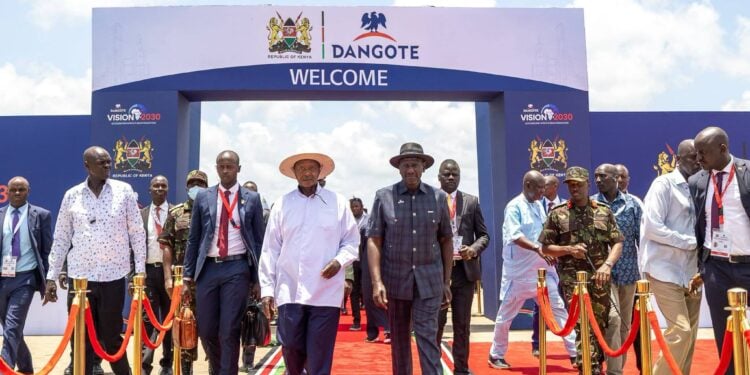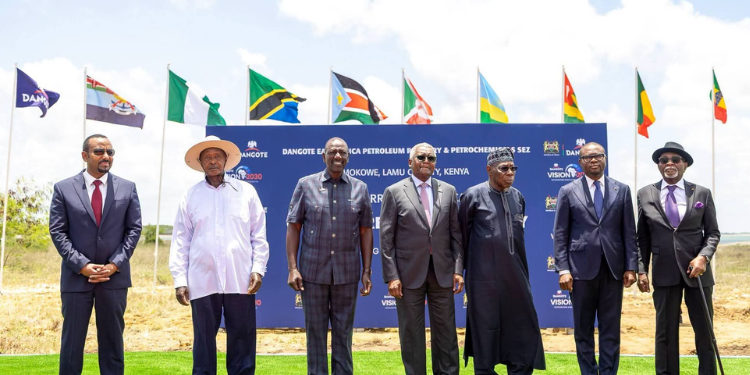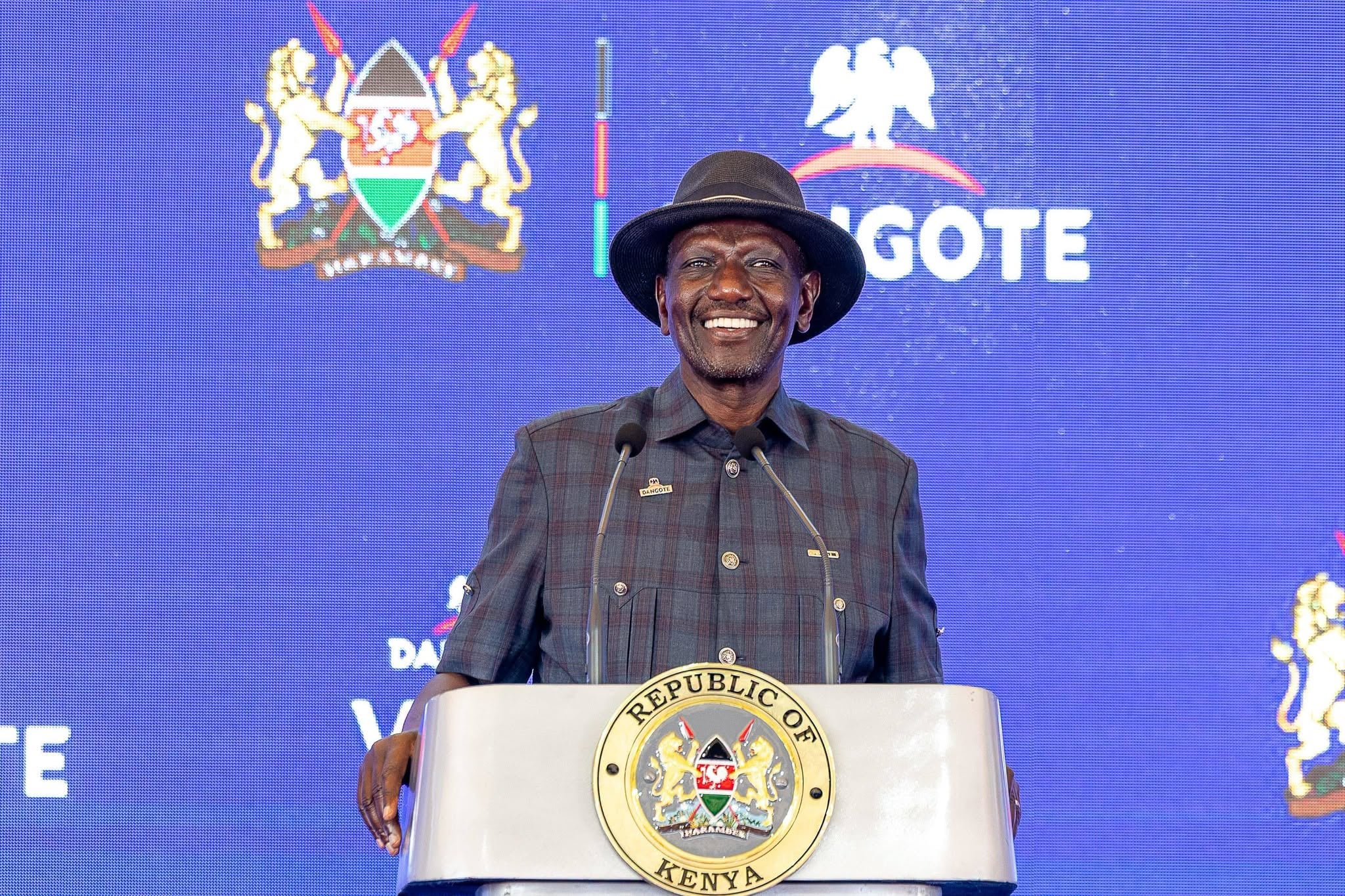
Kenya’s President William Ruto used the groundbreaking of the Dangote East Africa Refinery in Lamu on 30 September 2026 to argue that Africa must stop exporting crude and importing finished fuel. Speaking before regional leaders and Aliko Dangote, he framed the $16 billion, 700,000-barrel-a-day complex as energy security, industrial policy and a test of whether Lamu’s people will share the jobs, contracts and land rights that follow. African leaders who attended the event included Ethiopia’s Prime Minister Abiy Ahmed, Uganda’s President Yoweri Museveni, Benin’s Romuald Wadagni, Togo’s Jean-Lucien Savi de Tové, and former Nigerian President Olusegun Obasanjo. Here is the full speech:
“Your Excellencies, Heads of State and Government, Mr Aliko Dangote, President and Chief Executive of the Dangote Group, Distinguished guests, Ladies and gentlemen;
Today, we break ground in Lamu.
We turn a proposal into an industry. We transform a long-held ambition into real opportunity for Kenya, for East Africa, and for Africa.
We gather in a place that connected Africa to the world for centuries. UNESCO recognises Lamu Old Town as the oldest and best-preserved Swahili settlement in East Africa.
Long before the industrial age, the people of Lamu understood trade. They understood enterprise. They understood the world beyond the horizon.
Yet Lamu, which stood at the centre of our history, has too often been at the margins of our progress. Today, we, however, change that forever.
Last week, at the United Nations General Assembly in New York, I told the world that Africa does not come to plead. I said Africa’s resources must become the beginning of African industry, not the end of Africa’s contribution to global prosperity.
And I said that within a week, we expected to break ground on a refinery here in Lamu. Today, we keep our word. Today, we are witnessing the beginning of a generational undertaking: a
$16 billion (Ksh 2 trillion) petrochemical complex designed to process up to 700,000 barrels of crude oil every day and serve not merely Kenya, but the wider Eastern African region.
The project also envisages up to 1,000 megawatts of power generation, part of which could ultimately serve needs beyond the refinery.
Dangte in Lamu is bigger than a refinery
This is bigger than a refinery. It is an investment in energy security, industrialisation, and regional integration. Above all, it is a declaration that Africa has entered a new age in which we will increasingly finance, build, process and add value here at home.
This is African ambition, backed by African capital, building African industry for African prosperity.
And, remarkably, this journey began with the simplest of actions. An idea; then a letter, then an invitation, and then a conversation.
Earlier this year, in April, together with fellow African leaders and the Africa Finance Corporation, we convened the Africa We Build Summit here in Kenya around a simple proposition: that infrastructure must become the engine of Africa’s industrialisation.
Also Read: Presidents, High-Level Delegations at Dangote Refinery Groundbreaking: Who Missed?
I wrote to my brother, Alhaji Aliko Dangote, and invited him to participate. I asked him not simply to attend another African conference, but to imagine with us an East African energy security and refining platform capable of confronting one of the great contradictions of our time. According to Afreximbank, in 2024 Africa produced approximately 6.8 million barrels of crude oil, while consuming approximately 4.5 million barrels a day of refined petroleum products.
Those figures tell us two things: we have the resource, and we have the market. Yet too much of the value between that resource and that market is still created somewhere else.
Produce what we consume
The argument is simple. We must produce more of what we consume. We must add value to more of what we produce. And we must progressively replace what we import with what we manufacture.
This refinery puts all three to work. For too long, Africa has supplied the raw materials while others captured the processing, the manufacturing, the jobs, and the commercial benefit.
Crude oil leaves; refined products return. Cotton leaves; garments return. Cocoa leaves; chocolate returns. Between the raw material and the finished product are skills to build, industries to grow, value to capture and incomes to earn. Too often, we have let these opportunities sail away with the cargo we export.
Kenya’s own market tells the same story. Last year, we spent Ksh 530 billion importing petroleum products.
Let me be clear: A refinery will not make that bill disappear overnight. Crude must still be bought. Fuel must still be produced and delivered at a competitive price. But that figure tells us why Kenya and our neighbours must build the capacity to refine closer to the markets we serve, and to build new industries around it. We have already seen what African enterprise can achieve. Last Friday, I stood in Lekki, Nigeria, at the refinery my friend Aliko Dangote built. It is one of the largest refining enterprises in the world. For years, many said a project of that scale was beyond Africa’s reach.
A groundbreaking is a promise
Ladies and gentlemen,
A groundbreaking is a promise. A refinery is a promise kept. Between the two lies the real work: Structuring financing, building infrastructure, training the workforce, delivering on time, sourcing crude, and securing the markets.
Every figure we speak of today is a target. None of it is automatic. All of it is achievable. And we will pursue it with discipline.
Lamu stands at the heart of this opportunity. Its port can support construction today and, in time, move crude and refined products. The LAPSSET Corridor was conceived to connect this coast to our interior and to our neighbours.
But a corridor without commerce is just a road. A port without industry is just a harbour. This investment gives both the road and port a reason to grow.
The refinery will be the anchor. Around it, we will work with transporters and engineers, contractors, and service providers. Petrochemicals and manufacturing will follow because the economics make sense.
That is how infrastructure becomes an economy. A port that serves enterprise. An enterprise that creates demand for skills and services. And a corridor that carries opportunity far beyond the coast.
Government enables, private capital builds
How we build this project matters as much as what we build. This is a Government-enabled, private sector-driven project.
Government provides policy certainty, coordination, infrastructure and regulation, the conditions that make investment possible. Private enterprise mobilises capital, the technical expertise and carries the commercial obligations of management.
There is another lesson here. We cannot build twenty-first-century infrastructure using yesterday’s financing model. Government cannot finance every road, railway, port, energy project and industrial undertaking from taxes and public debt alone.
That is why we established the National Infrastructure Fund, to mobilise our assets, savings and capital markets and crowd in long-term investment, local and foreign.
Our task is no longer simply to ask how much government can spend. Our measure is how much investment every shilling of public capital can mobilise from the private sector, pension funds, insurance and other long-term assets both locally and globally. That is how we build at the scale required to transform Kenya and our region into a first-world economy.
For too long, too many of our ambitions waited for one source of money: The public purse. Government cannot borrow or raise taxes to build every factory, finance every industry, and carry every commercial risk.
So, we must make Kenya a place where investment capital flows, agreements are honoured, projects are delivered and where public interest is harnessed.
And the world is responding. Last year, Kenya attracted a record
$3.2 billion in foreign direct investment, the highest in our history. That is up 38% in a single year, and more than double what we attracted in 2022.
That is not luck. It is confidence. Confidence earned by reforms that make it easier to invest, safer to operate and more rewarding to stay. Lamu is the next test of that confidence. And we intend to pass it.
What this means for the people of Lamu
Which brings me to the people of Lamu. Wananchi wa Lamu, you are entitled to ask what this means for you.
Who will get the jobs? Will local businesses win contracts? What will happen to our land? Will our fishermen keep their livelihoods? How will our water, our coastline, our mangroves, and our heritage be protected?
These questions are not obstacles to development. They are questions responsible development must answer.
So let me give you my assurance. Your interests will be taken care of. Your rights will be protected. Your voice will be heard, from today until the day this refinery runs, and beyond.
Land matters will be handled lawfully and fairly. Environmental and social impacts will be assessed rigorously. And the safeguards we agree on will be enforced during construction and during operation.
This project must also open a fair route to jobs and enterprise. Current estimates envisage up to 60,000 direct and indirect jobs.
I expect clear recruitment and training plans. Our technical and vocational institutions and universities must prepare the welders, technicians, engineers, and managers this project will need. Young people from Lamu, neighbouring counties and Kenya must get a fair chance to learn skills and compete fairly for jobs.
Also Read: Dangote Announces Jobs for Kenyans with Engineering Degree and Diploma
I also expect clear opportunities for local businesses. A project of this size needs transport, food, accommodation, maintenance, construction materials, logistics and professional services. The people beginning with those of Lamu must know what is needed, what standards apply and prepare to take part.
We will also advance planning for the proposed new town on the mainland, and examine how the Affordable Housing Programme can help meet the demand for homes. The people of Lamu must help shape that growth.
I expect the National Government, the county government, and the developer to keep a standing channel open, where residents, businesses and CBOs can raise concerns and get answers.
This refinery’s scale will be measured in barrels and dollars. Its success must be measured in skills gained, enterprises built, livelihoods protected and public trust earned.
A project worthy of Africa’s ambition must be worthy of the trust of the people of Kenya.
The unfinished work of sovereignty
Ladies and gentlemen,
Africa does not lack resources. We do not lack talent. We do not lack enterprise. We do not lack markets.
What we must build is the capacity to bring them together: To produce, to process, to finance and to trade on terms that create more value for our people. That is the unfinished economic work of our sovereignty.
Our forebears secured the flag. Our generation must build the industries that make independence real in the lives of every citizen.
I thank you. God bless Lamu. God bless Kenya. And God bless Africa.”
Follow our WhatsApp Channel and X Account for real-time news updates.