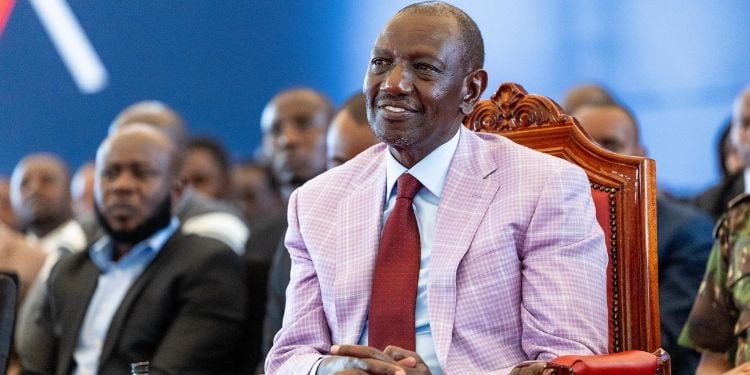
President William Ruto lauded his daughter, Mia, for developing a greater appreciation for learning under Kenya’s Competency-Based Curriculum (CBC), contrasting her experience with his own school days.
Speaking during the 98th Kenya Music Festival State Concert at the Bungoma State Lodge on August 14, Ruto said he had seen a difference in the way his daughter approaches learning, which he attributed to the competency-based education system.
In his remarks, the President said he strongly supports Competency-Based Education and Training (CBET), which he said focuses on what learners can do with the knowledge they acquire.
“And I am a very solid believer in competency-based education and training. I see it in our children. I see it in my own daughter, Mia, that she appreciates stuff better than I did when I was her age, and it is because of the kind of education that she is going through,” he said.
Ruto Says CBC Is Shaping Skills, Not Just Grades
Ruto defended Kenya’s Competency-Based Curriculum (CBC), saying the education system is helping children develop skills and abilities beyond simply memorizing information.
The president also said the education system should help learners identify and develop their talents while preparing them to apply what they learn in real-life situations.
“Our education system must therefore do more than prepare children to produce correct answers. It must help every child discover the question their life is equipped to answer,” Ruto said.
Also Read: Ruto Announces KSh5 Million for Every School That Reached National Music Festival
He contrasted the competency-based approach with the traditional emphasis on recalling information.
“We are moving from an education system that asks, ‘ What do you remember? To one that asks, ‘ What can you do with what you know?” Ruto said.
According to the President, the shift aims to place greater emphasis on practical skills, creativity, talent development and the ability to apply knowledge
Ruto said the competency-based education system is founded on access, equity, quality and relevance, arguing that children should have opportunities to discover and develop their abilities regardless of where they come from.
“This system is founded on access, equity, quality and relevance because a child in the city and one on the slopes of Mount Elgon must have an equal opportunity to discover their talent and compete with the best in the world,” he said.
CBC Faces Challenges Despite Government Support
While President William Ruto defended the competency-based system, CBC has faced criticism from parents, teachers and education stakeholders since its implementation.
Also Read: Kenya Divided on CBC Grading with 45% Dissatisfied as Fees, Uniforms Plague Grade 10 Transition
Some of the main concerns have centred on the cost of supporting learners, teacher preparedness, availability of learning materials, and inadequate infrastructure in some schools.
The Ministry of Education has acknowledged several of these challenges, including an overloaded curriculum, inequalities, unclear parental responsibilities, inadequate teacher capacity, and insufficient learning materials and infrastructure. These concerns have fuelled debate over how effectively CBC is being implemented across the country.
The transition has also placed additional demands on schools and families, particularly where learners require digital devices, specialized materials or other resources to complete school assignments and projects.
Parents have also raised concerns about the cost of CBC, as families must provide additional learning materials and cover expenses linked to projects and practical activities.
Questions have been raised about whether schools have enough classrooms, teachers, laboratories, learning materials, and other facilities to support the new pathways and the growing number of learners.
An Infotrak survey published in January found that 51% of respondents felt education under CBC had either remained the same or worsened compared with the former 8-4-4 system, while 49% believed it had improved.
The government, however, has continued to support the reforms, arguing that CBC is intended to move Kenya away from an education system centred mainly on examinations and memorization. The approach instead seeks to develop practical competencies, creativity, values and individual talents.
Follow our WhatsApp Channel and X Account for real-time news updates.