



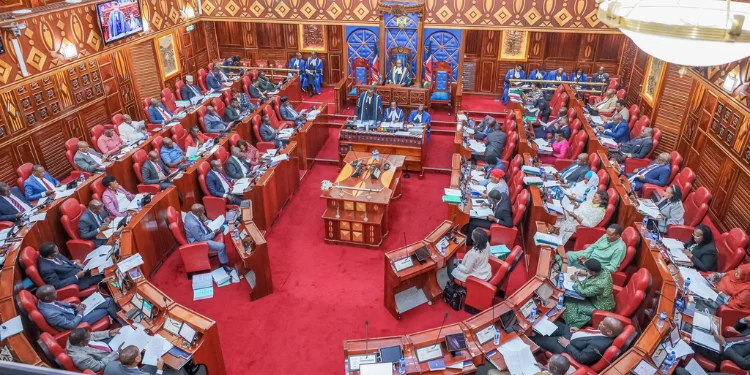
A Senate committee has uncovered how the National Transport and Safety Authority’s (NTSA) controversial annual vehicle inspection programme came into force.
According to the committee’s report, the inspections are based on the Traffic (Motor Vehicle Inspection) Rules, 2026, as set out in Legal Notice No. 13 of 2026.
The regulations established the legal framework requiring annual inspections for specified categories of motor vehicles. NTSA later operationalized the rules by directing eligible vehicle owners to begin booking inspections from July 1, 2026.
However, after scrutinising the legal notice alongside submissions from the regulation-making authority and stakeholders, the Senate committee concluded that the rules should be annulled, finding they failed to comply with the requirements of the Statutory Instruments Act fully.
Why the Senate Wants NTSA’s Inspection Rules Annulled
The committee found that although the regulation-making authority prepared a Regulatory Impact Statement, it did not provide sufficient justification for requiring annual inspections instead of inspections every two or three years.
Also Read: High Court Issues Orders Suspending NTSA Annual Inspection Notice
“The regulatory impact statement does not give any justification for annual inspection of motor vehicles, and why, for instance, biennial inspection or inspection once every three years would not be sufficient,” the report states.
The committee also faulted the impact assessment for failing to adequately analyze the likely consequences of introducing annual inspections.
According to the committee, the assessment did not examine the cost of inspections, the financial burden on motorists, the capacity and viability of vehicle inspection centres, logistical challenges that vehicle owners could face, possible disruptions arising from annual inspections, or the effect of inspection costs amid the rising cost of living.
The report further notes that the assessment failed to consider possible violations of the right to privacy, arguing that privately owned vehicles are regarded as personal spaces.
The committee also raised concerns over the public participation process.
While the regulation-making authority published notices in the Kenya Gazette and on MyGov, senators observed that the proposals were not advertised in a newspaper with nationwide circulation likely to reach members of the public most affected by the regulations, contrary to the requirements of the law.
NTSA Announcement on Mandatory Vehicle Inspections
The National Transport and Safety Authority (NTSA) announced that it would begin conducting annual inspections of motor vehicles more than 4 years old starting July 1, 2026.
Also Read: NTSA Lists Official Contacts for Driving Licenses, Registration and Inspections
In a notice on Friday, June 26, the Authority said the inspections are part of its mandate under the NTSA Act, 2012, which gives it responsibility for the registration, licensing, inspection, and certification of motor vehicles and motorcycles.
NTSA stated that in accordance with Section 55 of the Traffic Act (Cap 403), all motor vehicle owners whose vehicles are more than four years old as of the recorded date of manufacture will be required to book annual inspections through the NTSA service portal on the eCitizen platform.
“In implementation of Section 55 of the Traffic Act(Cap 403), the Authority shall conduct inspection of motor vehicles within NTSA centers from 1st July 2026. All motor vehicle owners with vehicles more than four years from the recorded date of manufacture are therefore expected to book an annual inspection through the NTSA service portal accessible via the eCitizen platform,” stated NTSA.
However, NTSA clarified that the enforcement of mandatory inspections for private motor vehicles will be communicated to the public in due course, meaning the inspection programme will begin before enforcement measures are announced.
Follow our WhatsApp Channel and X Account for real-time news updates.


I support the Senate position on the proposed motor vehicles annual inspection