


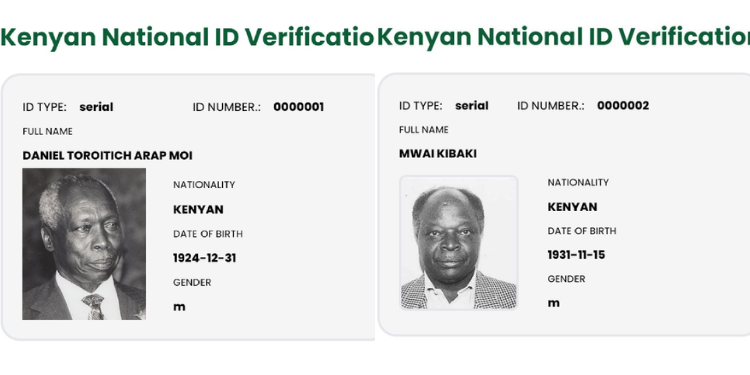
Former President Daniel arap Moi held Kenya’s national identity card number 000001.
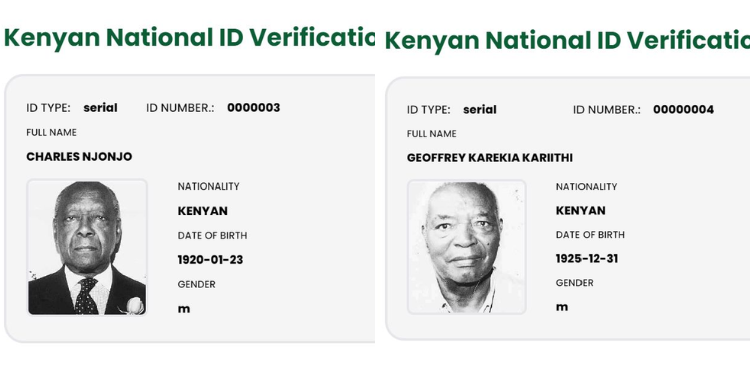
His deputy at the time, Mwai Kibaki, reportedly held 000002, while former Attorney General Charles Njonjo was linked to 000003.
When Kenya rolled out a new generation of national identity cards in 1980, the country’s top leaders were among the first people to receive the new documents.
Moi, who was President at the time, received ID number 000001, while Kibaki and Njonjo followed with some of the country’s lowest numbers.
The mystery has fascinated Kenyans for years and often resurfaces whenever old documents bearing the numbers make their way online.
Rather than being issued to the first citizens to register, the numbers are widely believed to reflect the senior government leadership overseeing the registration exercise.
By the time Moi became the holder of ID number 000001, Kenya already had a long and controversial history of registering its people.
The journey stretches back to the colonial era when African men were required to carry registration documents under the infamous Kipande system.
The Colonial Identity
Introduced by the British colonial administration in 1915, the Kipande served as a form of identification and movement control for African male workers.
Also Read: Safaricom Explains Why Some Users Experience Frequent Logouts on the My OneApp
The document contained personal details such as fingerprints and tribal affiliation and was carried inside a small metal container hung around the neck.
Many Africans viewed it as a symbol of oppression and colonial domination.
The system allowed authorities to monitor and track workers and became deeply unpopular among the local population.
Years later, the Kipande was replaced by a passbook system, which remained in use during the latter years of colonial rule and continued after independence.
Despite political freedom in 1963, changes to the identity registration system were slow.
For years, registration largely focused on men, leaving women outside a system that had become an important part of citizenship and access to government services.
That eventually changed in the late 1970s when amendments expanded registration requirements to include women.
Another reform later raised the registration age from 16 to 18 years.
Against this backdrop, Kenya introduced a new generation of national identity cards in 1980.
The move marked an important milestone in the country’s administrative history and laid the foundation for the modern identification system used today.
The Numbers That Still Raise Questions
When the new IDs were introduced, Moi was serving as President.
Also Read: New Report Indicates Tundu Lissu’s Life at Serious Risk
Historical accounts indicate that he became the holder of ID number 000001.
Kibaki, then Vice President, reportedly received 000002.
Njonjo, then Attorney General, is widely believed to have been assigned number 000003.
The list is also said to include former Head of Civil Service Geoffrey Kariithi as holder of 000004 and senior civil servant Aaron Kandie as holder of 000005.
The allocation has generated curiosity over the years, although many observers view it as a natural outcome of a fresh registration exercise involving the country’s top leadership.
What is clear is that the numbers were not necessarily issued according to who registered first.
Kenya had been identifying and registering its citizens in one form or another for decades before the 1980 rollout.
This means that holding ID number 000001 did not automatically make Moi the first Kenyan to possess an identity document.
Still, the association with the country’s most powerful figures only deepened public curiosity.
In 1995, Kenya introduced the smaller card-sized national IDs familiar to most citizens today, replacing the larger paper-based documents that had been in use since 1980.
Today, millions of Kenyans carry national identity cards without giving much thought to the digits printed on them.
Yet among the millions of numbers in circulation, none attract more intrigue than 000001, 000002 and 000003.
Follow our WhatsApp Channel and X Account for real-time news updates.



Amazing 😄