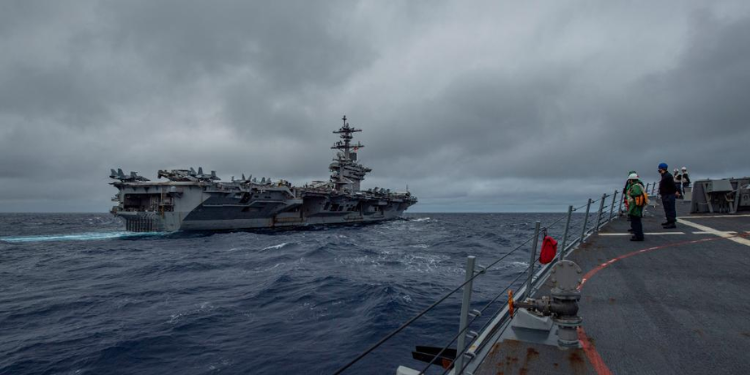
The United States has expanded its naval presence in the Middle East after another guided-missile destroyer entered the region, bringing the total number of U.S. warships operating in nearby waters to 12 amid heightened tensions with Iran.
According to defence-related updates monitoring naval deployments, the USS John Finn (DDG-113), an Arleigh Burke-class guided-missile destroyer, entered the United States Central Command (CENTCOM) area of responsibility.
Its arrival increases the number of U.S. warships operating in the Middle East to 12. The total does not include destroyers currently deployed as part of carrier strike groups led by the USS Gerald R. Ford (CVN-78) and the USS Abraham Lincoln (CVN-72).
The USS John Finn was commissioned on July 15, 2017, during a ceremony at Joint Base Pearl Harbor-Hickam in Hawaii. The vessel was constructed by Huntington Ingalls Industries in Pascagoula, Mississippi.
Also Read: Trump Cornered as Iran Starts Firing Missiles Following Earlier Threat
The guided-missile destroyer displaces approximately 9,140 tons and measures 509 feet in length, with a beam of 66 feet and a navigational draft of 31 feet.
In addition, the ship is powered by four LM2500 General Electric Marine Gas Turbines driving two propellers, enabling speeds of up to 31 knots.
Arleigh Burke-class destroyers are multi-mission surface combatants designed to conduct anti-air, anti-submarine, and anti-surface warfare operations.
The vessels are also capable of missile defense and precision strike missions, making them a central component of U.S. naval operations worldwide.
U.S. expands military activity
The deployment of the USS John Finn forms part of a broader increase in U.S. naval activity across Middle Eastern waters.
The increased deployment comes as Washington continues to strengthen its military posture in the Middle East amid ongoing tensions with Iran and growing concerns over a possible escalation.
Earlier this week, the USS Gerald R. Ford passed through the Strait of Gibraltar into the Mediterranean. The world’s largest warship is believed to be heading toward the Middle East.
Ship-tracking data also showed the USS Mahan (DDG-72), one of the destroyers assigned to the carrier strike group, transiting the strait.
Another carrier strike group, centered on the USS Abraham Lincoln, has already been identified in the Arabian Sea, roughly 700 kilometers from Iran and about 240 kilometers off the coast of Oman.
The two carrier groups operate thousands of personnel and dozens of aircraft. Last week, tracking identified U.S. destroyers operating in the eastern Mediterranean near the Souda Bay naval facility, vessels positioned in the Red Sea, and ships stationed at Bahrain’s naval base in the Persian Gulf.
The United States is also deploying advanced air power to the region. Twelve F-22 stealth fighter jets, on February 24, 2025, departed Royal Air Force Lakenheath in the United Kingdom and are being deployed to an Israeli air force base in southern Israel as part of the expanding U.S. military buildup.
One aircraft reportedly returned to the British base due to a technical issue. The stealth fighters had arrived at RAF Lakenheath the previous week and remained there for several days, reportedly due to issues with their aerial refueling aircraft.
Also Read: Iran’s Ayatollah Makes Final Wish and Preparations Ahead of Imminent US Attack
The movement of the jets comes as President Donald Trump considers whether to take military action against Iran.
In addition to the F-22 deployment, dozens of other aircraft have been tracked heading into the region in the last three weeks.
These include F-35, F-15, and F-16 fighter jets, as well as large numbers of refueling tankers and cargo aircraft.
Open-source flight analysts have also tracked hundreds of military cargo flights into the region since mid-February, indicating sustained logistical activity supporting the deployments.
Other aircraft deployed include KC-135 and KC-46 aerial refueling tankers, E-3 Sentry airborne command and surveillance aircraft, C-17A and C-5M strategic transport aircraft, and Navy P-8A maritime patrol aircraft used for reconnaissance and anti-submarine warfare.
U.S. and Iran diplomacy
The military buildup comes as diplomatic contacts between Washington and Tehran continue. U.S. and Iranian officials concluded a second round of indirect nuclear talks in Geneva, Switzerland, on February 17, 2026.
These discussions, mediated by Oman, focused on Iran’s nuclear program and the potential removal of U.S. sanctions.
President Trump said the world would likely know within about ten days whether negotiations would produce a deal or whether the United States would move toward military action.
Iran conducted its own military exercises earlier this week in response to recent U.S. deployments. The Islamic Revolutionary Guard Corps launched maritime drills in the Strait of Hormuz, a major global oil transit route through which roughly one-fifth of the world’s oil and gas supplies pass.
Iranian state media also reported additional naval exercises in the Gulf of Oman involving Russian forces and units from both Iran’s regular navy and the IRGC naval forces.
Follow our WhatsApp Channel and X Account for real-time news updates.