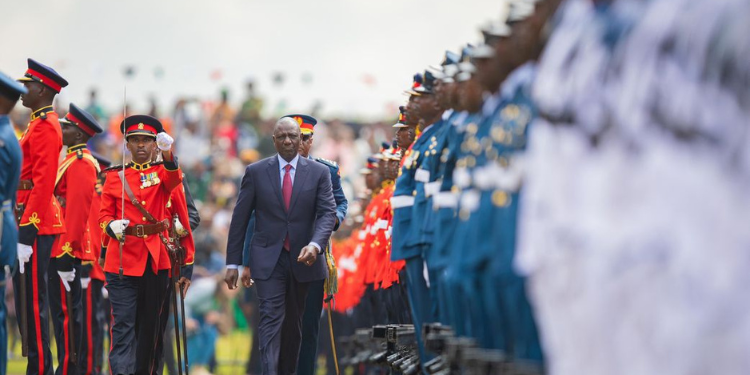
The Kenya Defence Forces (KDF) offers military careers with opportunities for promotion, specialised training, and access to welfare programmes that support service members and their families.
Personnel progress through different military ranks depending on their training, performance, experience and qualifications. The rank structure also determines the level of responsibility and authority a soldier exercises within the military.
KDF comprises three services: the Kenya Army, Kenya Air Force and Kenya Navy. Each has its own operational responsibilities, but all operate under the Ministry of Defence.
Kenya Army: Primarily conducts land-based military operations and protects the country’s territorial integrity on land.
Kenya Air Force: Provides air capabilities and support for military operations, including air defence and other aerial responsibilities.
Kenya Navy: Responsible for maritime security and military operations at sea, including protecting Kenya’s maritime interests.
The military has two broad personnel categories: commissioned officers and service members, commonly referred to as non-commissioned personnel.
KDF Military Ranks from the Highest to the Lowest
The Ministry of Defence describes the KDF rank structure as a two-tier system comprising commissioned officers and service members.
Commissioned officers occupy the senior leadership positions, while service members advance through the other ranks.
1. Commissioned officers
The commissioned officer hierarchy, from the lowest to the highest, is:
Second Lieutenant: This is the entry-level commissioned rank after an officer completes the required training and receives a commission. Second Lieutenants begin their careers with junior leadership responsibilities and gain experience through military assignments and further training.
Lieutenant: Officers advance to this rank after gaining experience and meeting the required promotion conditions. Their duties include leading military personnel and overseeing operations at troop or platoon level, depending on their appointment.
Captain: Captains take on greater command and administrative responsibilities. They may lead sub-units, participate in operational planning and supervise the training and discipline of personnel.
Major: A Major is a senior field officer who may command a sub-unit or serve in staff appointments. Responsibilities include operational planning, training, administration and discipline.
Lieutenant Colonel: Officers at this level may command larger military units or hold senior staff appointments. They coordinate operations and oversee personnel under their command.
Colonel: A Colonel holds a senior officer position and may serve in command, administrative or strategic planning roles. The responsibilities depend on the appointment and service.
Brigadier: A Brigadier is a senior field officer who may command a brigade or hold an equivalent senior appointment.
Major General: A Major General holds a senior command or staff position and may oversee a division or other major military formation.
Lieutenant General: One of the highest commissioned ranks. Officers at this level may hold top-level command and strategic leadership responsibilities.
General: This is the highest commissioned rank in KDF. The Ministry of Defence identifies it as a four-star rank held by the Chief of the Defence Forces. The Ministry states that only one officer holds the four-star General rank at any given time.
Promotion is not automatic. According to the Ministry, officers must meet merit requirements, pass promotional examinations and demonstrate discipline and integrity.
Also Read: KDF Announces Countrywide Recruitment
2. Non-commissioned officers and service members
Service members form the other ranks within the military. They begin at junior levels and can progress into senior supervisory and advisory positions.
The Ministry of Defence identifies Private as the lowest rank and Warrant Officer Class One as the highest in this category.
The general rank structure includes:
Private: This is the entry-level service-member rank attained after completing training at the Recruits Training School. Personnel at this level undertake duties assigned by their commanders as they gain military experience.
Lance Corporal: This is a junior supervisory rank. Personnel at this level may lead small teams and help maintain discipline and coordinate daily duties.
Corporal: Corporals take on greater supervisory responsibilities, including overseeing junior personnel, equipment and assigned tasks.
Sergeant: Sergeants are experienced service members who supervise personnel, enforce discipline and support the training of junior soldiers. They may also advise junior officers on matters relating to their units.
Senior Sergeant: This is a more senior supervisory position. Personnel at this level provide leadership, guidance and oversight to other service members.
Warrant Officer Class Two: Warrant Officers Class Two hold senior positions within the service-member structure. Their responsibilities include advising commanders, overseeing discipline and supporting the professional development of personnel.
Warrant Officer Class One: This is the highest service-member rank. Personnel at this level are experienced military leaders who provide senior advice on discipline, training and the welfare of service members.
The Ministry says promotions among service members are based on performance, discipline, career courses, integrity and seniority in service.
It also gives service members with specialised skills an opportunity to apply to join the officers’ cadre.
Personnel holding the substantive rank of Sergeant, with certain specialised skills and at least 10 years of service, may apply for consideration for commissioning as Special Duty Officers, subject to recommendation and training.
How much do KDF soldiers earn?
Salaries within the Kenya Defence Forces vary depending on rank, years of service, qualifications and the terms of appointment.
Under Section 29 of the Kenya Defence Forces Act, the Defence Council determines the salaries of military personnel on the advice of the Salaries and Remuneration Commission (SRC).
The SRC operates a four-year remuneration review cycle for the public service. However, this does not mean that every KDF rank automatically receives a salary increase after four years.
Kenya Army ranks and estimated monthly salaries
| Rank | Monthly salary |
|---|---|
| Cadet (in training) | KSh 7,172 |
| Private | KSh 19,941 – 30,000 |
| Lance Corporal | KSh 26,509 – 50,000 |
| Corporal | KSh 32,250 – 70,000 |
| Captain | KSh 73,182 – 110,000 |
| Major | KSh 102,106 – 150,000 |
| Lieutenant Colonel / Colonel | KSh 130,735 – 180,000 |
| Brigadier | KSh 153,317 – 300,000 |
| Lieutenant General | KSh 632,984 – 800,000 |
| General | KSh 894,897 – 1.2 million |
Kenya Air Force ranks and estimated monthly salaries
| Rank | Monthly salary |
|---|---|
| Air Vice Marshal | KSh 927,500 |
| Air Commodore | KSh 906,014 |
| Wing Commander | KSh 153,117 |
| Squadron Leader | KSh 130,735 |
| Flight Lieutenant | KSh 102,106 |
| Flying Officer | KSh 73,182 |
| Corporal | KSh 32,250 |
| Leading Aircraftman II | KSh 26,509 |
| Leading Aircraftman | KSh 19,941 |
Kenya Navy ranks and estimated monthly salaries
| Rank | Monthly salary |
|---|---|
| Kenya Navy Commander | KSh 902,432 |
| Admiral | KSh 695,625 basic salary, plus a reported KSh 278,250 allowance |
| Commodore | KSh 906,014 |
| Captain | KSh 153,317 |
| Commander | KSh 130,735 |
| Lieutenant | KSh 102,106 |
| Midshipman | KSh 73,182 |
| Able Seaman | KSh 32,250 |
| Leading Seaman | KSh 26,509 |
| Junior Seaman | KSh 19,941 |
Also Read: KDF Announces Nationwide Recruitment: How to Apply
Benefits and privileges KDF soldiers enjoy
Beyond their salaries, military personnel have access to welfare programmes covering accommodation, healthcare, financial support and retirement benefits.
The Ministry of Defence has highlighted several initiatives to improve the living standards of serving personnel and their families.
1. Military housing
Housing is one of the major welfare areas receiving investment from the government.
In March 2026, the Ministry of Defence announced that KDF personnel and their families had started moving into newly constructed housing units at Roysambu Military Camp.
The project includes two-bedroom and three-bedroom houses, along with facilities such as a school, medical centre, and Defence Forces Welfare Services shopping centre.
The Ministry has also outlined plans for additional military housing under the Affordable Housing Programme.
In July 2026, the Ministry announced that the first phase of its housing programme would deliver 10,095 units across Lang’ata Garrison, Embakasi Garrison, Kahawa Garrison, Moi Air Base and Roysambu Military Camp.
The development includes 4,100 family housing units and 5,995 single living quarters.
The Ministry said the programme was intended to improve accommodation for personnel and their families.
2. Healthcare services
KDF personnel have access to military healthcare facilities and welfare arrangements.
The Ministry of Defence lists the Defence Forces Medical Insurance Scheme (DEFMIS) among its personnel welfare institutions.
In March 2026, the Ministry explained that DEFMIS was designed to provide medical cover for KDF members and their dependants after retirement, when government-provided healthcare for serving personnel ceases.
The military also operates healthcare facilities through the Ulinzi Health Services Fund, which supports medical services within the defence community.
Its facilities provide outpatient and inpatient care, emergency services, specialist clinics, maternity services, and rehabilitation.
3. Mortgage and home ownership support
KDF personnel also have access to initiatives that help them acquire homes.
In November 2026, the Kenya Army highlighted its KDF Mortgage Scheme, established through an arrangement involving the Defence Forces, the Civil Servants Housing Scheme Fund, the Affordable Housing Board, and KCB Bank.
The programme is intended to provide eligible service members with access to affordable mortgage financing.
Personnel are sensitised on eligibility requirements, financing options, application procedures and repayment terms.
The initiative is part of wider efforts to improve financial security and long-term welfare among military families.
Also Read: How to Join KDF Military Police: Requirements, Process and Salary
4. Pension and gratuity
Military personnel may qualify for pension and gratuity benefits in accordance with the applicable laws and regulations.
Section 244 of the Kenya Defence Forces Act provides for pensions and gratuities for members of the Defence Forces.
The Kenya Defence Forces (Pensions and Gratuities) (Officers and Service Members) Regulations, 2021, provide further details on how such benefits are assessed and administered.
The regulations cover pension computation, gratuities, benefits for dependants, and compensation in cases involving death or disability.
However, pension and gratuity payments are subject to the applicable eligibility requirements and conditions.
5. Training and career development
KDF personnel have opportunities to undertake military and professional training as they progress through their careers.
The Ministry of Defence lists several training institutions within the defence structure, including the National Defence University-Kenya, Kenya Military Academy, Joint Command and Staff College, Defence Forces Technical College and Defence College of Health Sciences.
These institutions support military education, leadership development and specialised professional training.
The National Defence University-Kenya offers programmes in defence and strategic studies, national security, crisis and disaster management, information technology, and health sciences.
Career development also plays a role in promotions, with the Ministry identifying discipline, performance, integrity and completion of relevant courses as factors considered when personnel advance through the ranks.
6. Welfare and financial support programmes
The Ministry of Defence also operates institutions intended to support the financial and social welfare of military personnel.
These include Defence Forces Welfare Services (DEFWES), Defence SACCO (DESACCO), the Defence Forces Medical Insurance Scheme and the Ulinzi Health Services Fund.
The institutions provide different forms of support, including financial services, medical cover and welfare assistance.
The military has also introduced welfare centres and systems to improve the handling of compensation claims and provide assistance to personnel, veterans and their families.
Follow our WhatsApp Channel and X Account for real-time news updates, and subscribe to our YouTube Channel for in-depth interviews.