

Friday, August 28, 2026
  • News
    • Latest News
    • Breaking News
    • Fact Check
    • Investigations
    • Explainers
  • Politics
    • Global Politics
    • Elections
    • Government & Policy
    • Diplomacy
    • Conflicts & Security
    • Political Analysis
  • Business
    • Global Economy
    • Markets
    • Technology
    • Startups
    • Energy
    • Finance
  • World News
    • Americas
    • Asia
    • Asia Pacific
    • Africa
    • Europe
    • Middle East
  • Africa
    • Central Africa
    • East Africa
    • West Africa
    • Southern Africa
  • Health
    • Global Health
    • Public Health
    • Health Policy
    • Medical Research
    • Diseases & Conditions
    • Mental Health
    • Nutrition
    • Climate & Health
    • Health Explainers
  • Sports
    • World Cup 2026
    • Athletics
    • Basketball
    • Boxing
    • Cricket
    • Football
    • Formula 1
    • Golf
    • Rugby
  • Weather
    • Climate Business
    • Climate Change
    • Climate Solutions
    • Living Green
  • Culture
    • Arts
    • Film & TV
    • Food and Recipes
    • Music
    • Lifestyle
    • Travel
  • Opinion
    • Editorials
    • Letters
  • Behind The Brand
REGISTER
LOGIN
No Result
View All Result
The Kenya Times
  • News
    • Latest News
    • Breaking News
    • Fact Check
    • Investigations
    • Explainers
  • Politics
    • Global Politics
    • Elections
    • Government & Policy
    • Diplomacy
    • Conflicts & Security
    • Political Analysis
  • Business
    • Global Economy
    • Markets
    • Technology
    • Startups
    • Energy
    • Finance
  • World News
    • Americas
    • Asia
    • Asia Pacific
    • Africa
    • Europe
    • Middle East
  • Africa
    • Central Africa
    • East Africa
    • West Africa
    • Southern Africa
  • Health
    • Global Health
    • Public Health
    • Health Policy
    • Medical Research
    • Diseases & Conditions
    • Mental Health
    • Nutrition
    • Climate & Health
    • Health Explainers
  • Sports
    • World Cup 2026
    • Athletics
    • Basketball
    • Boxing
    • Cricket
    • Football
    • Formula 1
    • Golf
    • Rugby
  • Weather
    • Climate Business
    • Climate Change
    • Climate Solutions
    • Living Green
  • Culture
    • Arts
    • Film & TV
    • Food and Recipes
    • Music
    • Lifestyle
    • Travel
  • Opinion
    • Editorials
    • Letters
  • Behind The Brand
  • News
    • Latest News
    • Breaking News
    • Fact Check
    • Investigations
    • Explainers
  • Politics
    • Global Politics
    • Elections
    • Government & Policy
    • Diplomacy
    • Conflicts & Security
    • Political Analysis
  • Business
    • Global Economy
    • Markets
    • Technology
    • Startups
    • Energy
    • Finance
  • World News
    • Americas
    • Asia
    • Asia Pacific
    • Africa
    • Europe
    • Middle East
  • Africa
    • Central Africa
    • East Africa
    • West Africa
    • Southern Africa
  • Health
    • Global Health
    • Public Health
    • Health Policy
    • Medical Research
    • Diseases & Conditions
    • Mental Health
    • Nutrition
    • Climate & Health
    • Health Explainers
  • Sports
    • World Cup 2026
    • Athletics
    • Basketball
    • Boxing
    • Cricket
    • Football
    • Formula 1
    • Golf
    • Rugby
  • Weather
    • Climate Business
    • Climate Change
    • Climate Solutions
    • Living Green
  • Culture
    • Arts
    • Film & TV
    • Food and Recipes
    • Music
    • Lifestyle
    • Travel
  • Opinion
    • Editorials
    • Letters
  • Behind The Brand
No Result
View All Result
The Kenya Times ~ Trending, Breaking News and Videos
No Result
View All Result
ADVERTISEMENT

How Hackers Can Steal Your Data Through Public Wi-Fi, Power Sockets, and Bluetooth

Daisy MoraabyDaisy Moraa
July 22, 2026
Reading Time: 5 mins read
How Public Wi-Fi, Usb Charging Ports, And Bluetooth Put Your Personal Data At Risk

An Anonymous Hacker PHOTO/Grok

FacebookTwitterLinkedInRedditWhatsApp
Advertisement

Public Wi-Fi, public USB charging ports, and Bluetooth have become some of the most common ways cybercriminals and hackers gain unauthorized access to personal data.

Their widespread use and the trust users place in them make them attractive targets for attackers.

Here are some of the most common ways users can unknowingly fall victim to data theft through these everyday technologies;

Connecting to Public Wi-Fi Networks

 Public Wi-Fi is one of the most common ways cybercriminals steal personal information.

According to the Federal Communications Commission (FCC), attackers can create fake hotspots that appear legitimate, tricking users into connecting and exposing their internet activity.

Hackers can also intercept data transmitted over shared networks using techniques such as man-in-the-middle (MitM) attacks.

ADVERTISEMENT

“Many Wi-Fi users choose to use public networks instead of a device’s data plan for accessing the internet. But the convenience of public Wi-Fi can be risky. Hackers can access your connection and compromise sensitive information stored on your devices and in your online accounts,” FCC explained.

This may allow them to capture login credentials, banking details, emails, session tokens, or redirect users to fake websites.

Even password-protected public Wi-Fi networks can pose risks if they use shared encryption keys.

Attackers connected to the same network may attempt to access other devices or exploit vulnerabilities in file-sharing and remote access services.

Public Wi-Fi remains a major cybersecurity risk because it is widely available in airports, hotels, shopping malls, offices, and other public places where users often perform sensitive online activities.

To stay Safe, avoid online banking or entering passwords while using public Wi-Fi.

If you must connect, use a trusted VPN, verify the network name with the venue, ensure websites use HTTPS, and disable automatic connections to open Wi-Fi networks.

ADVERTISEMENT

Public USB Charging Ports (“Juice Jacking”)

Public USB charging stations can expose users to a cyberattack known as juice jacking.

Unlike standard electrical outlets, USB ports are designed to transfer both power and data, creating an opportunity for attackers to access connected devices.

A compromised charging station can behave like a computer when a phone is plugged in.

Once a data connection is established, it may install malware, steal contacts, messages, photos, login credentials, and other sensitive information, or create a backdoor that can be accessed later.

According to Avast Academy researchers, cybercriminals can tamper with charging stations in airports, hotels, shopping malls, taxis, and other public places. Even official-looking charging panels may contain hidden devices designed to communicate with smartphones over USB.


Also Read: Hackers Give State House Until 6 PM After Taking Over Ruto’s Website


“In simple terms, juice jacking happens when hackers tamper with public USB charging stations, turning them into digital ambush points. The moment you connect your phone, tablet, or laptop to a compromised port, the hacker can secretly steal data from the connected device or inject it with malware that may spy on you, track your usage, or even grant remote control,” the research explained.

The risk has grown as more people rely on public USB-A and USB-C charging ports while traveling or commuting.

Users may also unknowingly approve data access by tapping prompts such as “Trust this computer?” without verifying the source.

To stay safe, use your own charger with a standard AC wall socket or carry a power bank whenever possible. If you need to use a public USB port, use a USB data blocker that allows charging but prevents data transfer. Never approve unexpected “Trust this computer?” prompts on your device.

Bluetooth

Bluetooth is another common entry point for cyberattacks, especially when devices are left turned on or discoverable in public places.


Also Read: Finals Week Nightmare as Hackers Hijack Canvas, Threaten to Leak Millions of Student Records


According to the FCC, weak pairing methods or automatic connections can allow nearby attackers to gain unauthorized access.

Most of the time, a user must allow a Bluetooth connection to occur before data is shared – a process called “pairing” – which provides a measure of data security. But like Wi-Fi connections, Bluetooth can put your personal data at risk.

Here are some steps you can take when using Bluetooth:

  • Turn Bluetooth off when not in use. Keeping it active enables hackers to discover what other devices you connected to before, spoof one of those devices, and gain access to your device.
  • If you use Bluetooth to connect your mobile phone to a rental car, be sure to unpair your phone and clear any personal data from the car before you return it. Take the same steps when selling a car that has Bluetooth.
  • Use Bluetooth in “hidden” mode rather than “discoverable” mode. This prevents other unknown devices from finding your Bluetooth connection.

Follow our WhatsApp Channel and X Account for real-time news updates.
How Public Wi-Fi, Usb Charging Ports, And Bluetooth Put Your Personal Data At Risk
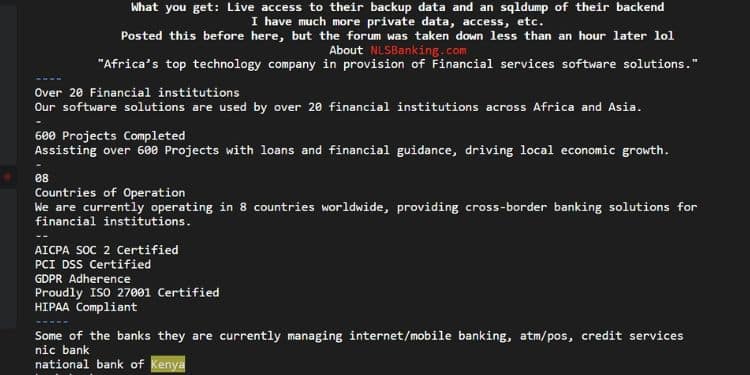
Screengrabs of Hackers are reportedly leaking sensitive government data on the dark web. PHOTO/ Ed Edd Eddy on X
Tags: Public Wi-FiUSB Charging Ports
Daisy Moraa

Daisy Moraa

Daisy Moraa is an all-round journalist at The Kenya Times, covering education, business, politics, and health. She specializes in storytelling, news reporting, and content creation, with experience across both mainstream and digital media platforms. She actively champions for the Sustainable Development Goals (SDGs), focusing on mental health awareness and sustainability. She holds a Bachelor of Science in Communication and Journalism from Rongo University. She can be reached at [email protected].

Related Posts

Milk Shortage In Kenya? Supermarkets Limit Purchases As Popular Brands Disappears From Shelves

Milk Shortage in Kenya? Supermarkets Limit Purchases as Popular Brands Disappear From Shelves

August 28, 2026
From Healthcare Pioneer To Microsoft East Africa Boss: Angela Nganga’s Unlikely Path To Power  

 From Healthcare Pioneer to Microsoft East Africa Boss: Angela Nganga’s Unlikely Path to Power  

August 28, 2026
Rosemary Koech Death: Kcb Mourns Head Of Data Protection As Kictanet Sets Up Ksh1M Fund

KCB Publicly Mourns Rosemary Koech as KSh 1M Children’s Fund Is Seeded

August 28, 2026
Njeri Maina Wants Dci To Probe Wangui Ngirici Over Gachagua Rally Violence

Njeri Maina Wants DCI to Probe Wangui Ngirici Over Gachagua Rally Violence

August 28, 2026

Leave a Reply Cancel reply

Your email address will not be published. Required fields are marked *

ADVERTISEMENT

The Kenya Times Facebook

LATEST NEWS

  • Milk Shortage in Kenya? Supermarkets Limit Purchases as Popular Brands Disappear From Shelves
  •  From Healthcare Pioneer to Microsoft East Africa Boss: Angela Nganga’s Unlikely Path to Power  
  • KCB Publicly Mourns Rosemary Koech as KSh 1M Children’s Fund Is Seeded
  • The Role of the United Nations in Addressing Severe Diseases in Africa 
  • Who Is Fredah Onduso, the Actress Now Making Waves in Linda Mwananchi?
  • How Kenyans Can Check and Claim HELB Refunds After Overpaying Their Loans
  • Njeri Maina Wants DCI to Probe Wangui Ngirici Over Gachagua Rally Violence
  • Kericho Referral Hospital Upgrades Bring New Services Closer to Residents
  • Kenya’s Next Football Stars Are Rising Through the SportPesa League
  • Protests Erupt in Nairobi CBD After Govt Directive
  • Another Police Recruitment Coming Before 2027 Elections?
  • CBK Invites Investors to Bid in KSh10 Billion Treasury Bond Switch Auction
  • Key Features of New Police Uniform Unveiled by Ruto
  • Gladys Wanga Recounts Her Battle with Cancer and Role Beth Mugo Played in Her Journey
  • Ruto Honors Top Police Recruits: What the Awards Mean
ADVERTISEMENT

Company

About Us

Our Authors

Our Experts

Social Media

Policies

Privacy Policy

House Rules

Standards and Policies

Terms and Conditions

Subscription

My Account

Contact Us

Contact Us

Join Our Team

Advertise With Us

© Copyright 2026 | The Kenya Times | All Rights Reserved

Welcome Back!

Sign In with Facebook
Sign In with Google
Sign In with Linked In
OR

Login to your account below

Forgotten Password? Sign Up

Create New Account!

Sign Up with Facebook
Sign Up with Google
Sign Up with Linked In
OR

Fill the forms below to register

All fields are required. Log In

Retrieve your password

Please enter your username or email address to reset your password.

Log In
Your Privacy and Cookies
We use cookies on our website to give you the most relevant experience by remembering your preferences and repeat visits. By clicking “Accept”, you consent to the use of ALL the cookies.
Do not sell my personal information.
Cookie settingsACCEPT
Privacy & Cookies Policy

Privacy Overview

This website uses cookies to improve your experience while you navigate through the website. Out of these cookies, the cookies that are categorized as necessary are stored on your browser as they are essential for the working of basic functionalities of the website. We also use third-party cookies that help us analyze and understand how you use this website. These cookies will be stored in your browser only with your consent. You also have the option to opt-out of these cookies. But opting out of some of these cookies may have an effect on your browsing experience.
Necessary
Always Enabled
Necessary cookies are absolutely essential for the website to function properly. This category only includes cookies that ensures basic functionalities and security features of the website. These cookies do not store any personal information.
Functional
Functional cookies help to perform certain functionalities like sharing the content of the website on social media platforms, collect feedbacks, and other third-party features.
Performance
Performance cookies are used to understand and analyze the key performance indexes of the website which helps in delivering a better user experience for the visitors.
Analytics
Analytical cookies are used to understand how visitors interact with the website. These cookies help provide information on metrics the number of visitors, bounce rate, traffic source, etc.
Advertisement
Advertisement cookies are used to provide visitors with relevant ads and marketing campaigns. These cookies track visitors across websites and collect information to provide customized ads.
Others
Other uncategorized cookies are those that are being analyzed and have not been classified into a category as yet.
SAVE & ACCEPT
LOGIN | REGISTER
  • Login
  • Sign Up
  • Cart
No Result
View All Result
  • News
    • Latest News
    • Breaking News
    • Investigations
    • Explainers
    • Fact Check
  • Politics
    • Global Politics
    • Conflicts & Security
    • Elections
    • Diplomacy
    • Government & Policy
    • Political Analysis
  • Business
    • Global Economy
    • Markets
    • Technology
    • Startups
    • Energy
    • Finance
  • World News
    • Americas
    • Asia
    • Asia Pacific
    • Africa
    • Europe
    • Middle East
  • Africa
    • East Africa
    • West Africa
    • Southern Africa
    • Central Africa
  • Health
    • Global Health
    • Public Health
    • Health Policy
    • Medical Research
    • Diseases & Conditions
    • Mental Health
    • Nutrition
    • Climate & Health
    • Health Explainers
  • Sports
    • World Cup 2026
    • Athletics
    • Basketball
    • Boxing
    • Cricket
    • Football
    • Formula 1
    • Golf
    • Rugby
  • Weather
    • Climate Business
    • Climate Change
    • Climate Solutions
    • Living Green
  • Culture
    • Arts
    • Film & TV
    • Food and Recipes
    • Lifestyle
    • Music
    • Travel
  • Opinion
    • Editorials
    • Letters
  • Behind The Brand
  • Contact Us

Not enough quota to unlock this post
Unlock left : 0
Are you sure want to cancel subscription?