
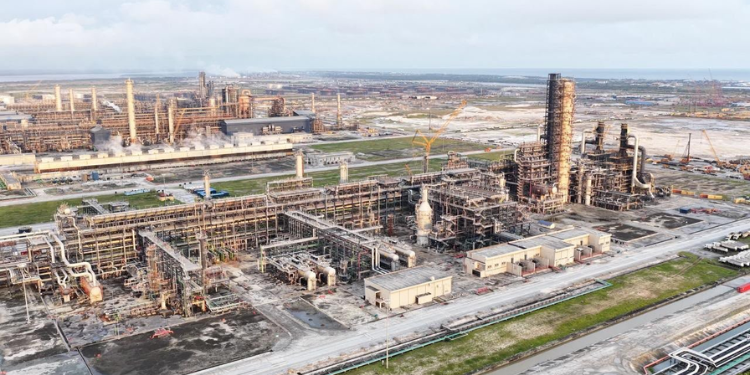
The proposed $16 billion Dangote East Africa Petroleum Refinery in Lamu has been presented as a transformative investment that could reposition Kenya as a regional energy and industrial hub. But beneath the optimism surrounding the September 2026 groundbreaking lies a fundamental question: does the project’s commercial logic match its political ambition?
The refinery, designed to process 700,000 barrels of crude oil daily, promises jobs, industrialisation and reduced dependence on imported petroleum products. Yet its feasibility will depend less on political endorsements than on crude supply, regional demand, financing and logistics.
The political dimension emerged when Aliko Dangote reportedly told Kenyans they were lucky to have President William Ruto. From an investor’s perspective, a president who facilitates negotiations and removes bureaucratic obstacles is a valuable partner. Citizens, however, judge leadership against a broader range of outcomes, including taxation, employment, living costs and public services.
A TIFA Research survey reported in June 2026 found that 76 per cent of respondents believed Kenya was heading in the wrong direction, with inflation, high prices and taxation among the leading concerns. A separate Politrack survey conducted in September placed Ruto at 45.1 per cent in stated presidential preference. These figures measure different things, but they illustrate why an investor’s praise may not reflect the broader public mood.
Attracting investment matters, but it does not automatically prove the success of an administration’s economic policies. The refinery’s projected completion around 2030 also means that its eventual benefits may fall under a different government from the one championing its launch.
Dangote refinery: The crude supply challenge
The first test of the refinery’s feasibility is feedstock security.
Kenya does not currently produce crude oil at anything approaching the proposed refinery’s capacity. Even if projected domestic production eventually reaches 50,000 barrels daily, that would cover only about seven per cent of the refinery’s requirements.
At full capacity, the facility would process approximately 255.5 million barrels annually. The balance would have to come from regional producers or international markets.
Uganda’s crude-export strategy is linked to the East African Crude Oil Pipeline, which terminates at Tanzania’s port of Tanga. South Sudan’s exports have historically depended on transit infrastructure through Sudan. Securing regional crude for Lamu would therefore require commercially viable supply agreements and reliable transport arrangements.
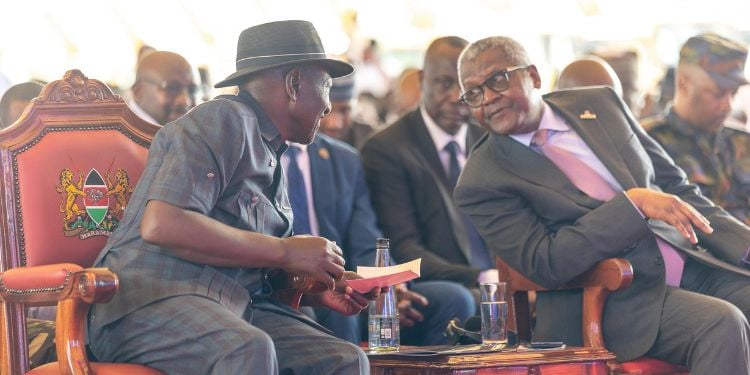
Also Read: Ruto Addresses Beef with Museveni Over Dangote Deal
Importing crude by sea is entirely feasible. The question is whether the refinery can deliver sufficient volumes at competitive prices throughout its operating life.
Investors need clarity on supply contracts, crude quality, transport costs and expected capacity utilisation. Without these details, the headline capacity says little about actual production or profitability.
Is Lamu the optimal location?
Lamu’s deep-water port and access to the Indian Ocean offer potential advantages for importing crude and exporting refined products. However, proximity to customers is only one component of refinery economics.
The investment decision must consider the total cost of delivering crude to the plant and distributing finished products. If regional crude is directed to Tanga, diverting it to Lamu could add costs. If the refinery relies predominantly on imported crude, its competitiveness will depend on shipping, storage and marine infrastructure.
The government and investors should disclose the technical and economic studies supporting the choice of Lamu, including comparisons with alternative locations. Strategic importance alone does not establish commercial superiority.
Can the region absorb the capacity?
The proposed refinery also raises questions about market demand. Regional reporting cites East African refined petroleum demand of about 416,000 barrels per day equivalent. Although this is not directly comparable with crude-processing capacity, it highlights the scale of the proposed investment relative to the regional market.
Uganda is pursuing a refinery of about 60,000 barrels daily, while Tanzania has proposed a 200,000-barrel-per-day facility at Tanga.
These projects could coexist if they serve different markets. Lamu might export beyond East Africa or support petrochemical industries. But the business case must show who will buy the output, at what prices, and under what demand assumptions.
Independent market forecasts, realistic utilisation scenarios and sensitivity analyses are essential to establishing whether the region can sustain this additional capacity.
Museveni’s reservations and regional competition
Ugandan President Yoweri Museveni welcomed the Lamu project while reaffirming Uganda’s intention to develop its own refinery and indicating that Uganda would not invest in the Kenyan project at this stage.
His position reflects a national interest in retaining jobs, taxes and industrial value addition at home. Supporting regional integration is not necessarily contradictory to pursuing domestic refining. However, it exposes a weakness in any business case that assumes political goodwill will automatically translate into crude supply, investment or guaranteed customers.
Regional cooperation must be supported by enforceable commercial agreements, not simply diplomatic endorsements.
Financing and political risk
The project’s scale makes transparency over financing, government commitments and construction obligations essential. Announcing engineering partners and a completion timetable does not, by itself, demonstrate that the entire project has achieved financial close.
Kenyans should know the proposed equity and debt structure, the infrastructure expected from government, and whether tax concessions, guarantees or other public commitments are involved.
Also Read: Full Speech: Ruto’s Lamu Address at the Dangote Refinery Groundbreaking
The timing is significant. With the next general election scheduled for 2027 and completion targeted around 2030, the project must survive an electoral transition. Its foundations should be transparent contracts and predictable institutions, not dependence on one president’s relationship with an investor.
The Nigerian Dangote refinery’s share offer is also a separate investment. Kenya’s Capital Markets Authority clarified in October that the offer did not constitute an offer of shares in the proposed Lamu refinery. Investors must not confuse the two.
Meanwhile, land acquisition, compensation, environmental protection and the interests of Lamu communities require rigorous scrutiny and lawful resolution.
From groundbreaking to measurable value
The refinery could expand Kenya’s industrial capacity, support manufacturing and strengthen regional energy security. But five requirements must be demonstrated: secure crude supply, credible market demand, committed financing, lawful environmental and land arrangements, and measurable benefits in employment and domestic value addition.
Dangote’s praise of Ruto is not, by itself, evidence of improper political influence. Equally, presidential endorsement cannot substitute for commercial evidence.
Kenya needs investment that can expand its productive economy. The Lamu refinery should neither be dismissed because of its political associations nor accepted uncritically because of its promoter’s reputation.
A groundbreaking marks the beginning of a project. Its success will be determined by sound economics, reliable supply chains, transparent financing and tangible benefits to Kenyans.
Follow our WhatsApp Channel and X Account for real-time news updates.