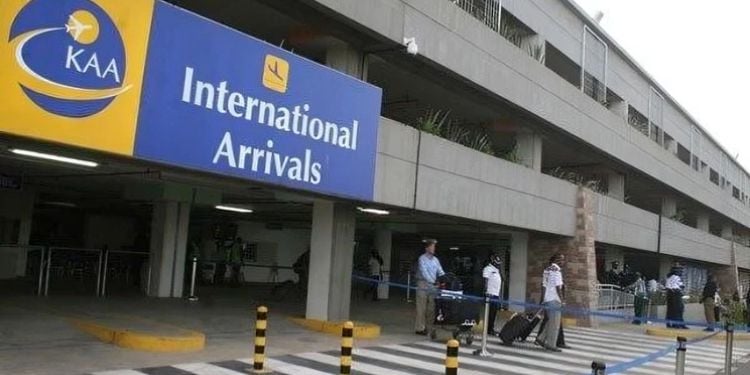
The Directorate of Criminal Investigations (DCI) has launched a new biometric identification system at the Diplomatic Police Unit (DPU) Headquarters, allowing diplomats, foreign nationals and staff of international missions to apply for Police Clearance Certificates locally without traveling to DCI Headquarters or Huduma Centers.
In a statement on October 14, the DCI stated that the Multi-Biometric Identification System (MBIS) is part of the DCI’s nationwide rollout of digital services that make applying for and processing Police Clearance Certificates (PCCs), commonly known as Certificates of Good Conduct, faster and more accessible.
“The launch extends access to the digital service to the diplomatic community as part of the ongoing nationwide rollout, which is aimed at improving the efficiency and accessibility of PCC processing,” stated the DCI.
According to the DCI, the system has reduced the time required to process Police Clearance Certificates from 14 days to same-day issuance, while increasing the capacity to handle and search criminal records.
The platform’s record-handling capacity has increased from two million to 10 million records, while its daily search capacity has risen from 4,500 to 20,000, and the improvements aim to speed background checks and strengthen the DCI’s ability to process applications as demand for police clearance services grows.
How the New Biometric System Works
The MBIS uses fingerprint, palm print, and facial recognition technologies to improve identification accuracy and support forensic investigations.
Also Read: How to Get a Kenyan Certificate of Good Conduct While Living Abroad
It replaces traditional ink-based fingerprinting and paper-based procedures with live digital biometric capture, allowing applicants’ biometric information to be collected electronically.
By combining multiple biometric identifiers, the system is designed to improve the accuracy of identity verification and assist investigators in examining records during criminal investigations.
DCI stated that the technology also increases the volume of records that can be stored and searched, enabling the DCI to handle more applications and identification requests within shorter periods.
DCI Expands Biometric Services Across the Country
The system was first launched at DCI Headquarters on July 23 by Interior Cabinet Secretary Kipchumba Murkomen.
DCI announced the rollout of the new digital platform, expected to reduce the time required to process Police Clearance Certificates, commonly known as Certificates of Good Conduct.
In a statement on July 15, the DCI said it will officially launch the Multi-Biometric Identification System (MBIS)-ABIS Version 5 on Monday, July 20.
According to the agency, the new platform was designed to modernize the issuance of Police Clearance Certificates by introducing advanced biometric technology to improve efficiency and speed up processing.
The DCI said the system marks a major upgrade in service delivery, promising applicants a faster, more seamless experience when applying for the certificate, and the agency noted that the new technology is expected to eliminate long waiting periods traditionally associated with obtaining the document.
“DCI is set to revolutionize how you get your Police Clearance Certificate (Certificate of Good Conduct). Starting Monday, July 20,we roll out the Multi-Biometric Identification System (MBIS)-ABIS Version 5, a game-changing platform built to fast-track processing and deliver faster, smarter service. No longer waits. Better technology. Better experience,” the DCI said.
In September, the second phase of the rollout expanded the service to 20 additional centers, mainly in the Central Region and neighboring areas.
The expansion brought the number of connected Police Clearance Certificate application centres to 26 out of the 63 centres planned countrywide, including six centres previously connected in Nairobi.
The second phase covered Kajiado Central, Kajiado West–Kisamis, Machakos, Thika, Kamwangi, Murang’a, Nyeri, Nyandarua–Ol Kalou, Nanyuki, Laikipia East–Makutano, Samburu–Maralal, Kerugoya, Mwea, Embu, Chuka, Marimanti, Maara, Kathwana, Meru and Isiolo.
Also Read: Certificate of Good Conduct to Be Delivered in 24 Hours as DCI Unveils New Biometric System
How Foreigners Who Previously Lived in Kenya Can Get a Certificate of Good Conduct
The DCI earlier said foreign nationals who previously lived in Kenya but are now outside the country must provide documents showing their immigration status in Kenya.
The required documents may include a work permit, dependent pass, diplomatic document, student pass, or another document authorized by the Immigration Department.
Applicants without an e-Citizen account should start by creating one.
“Majority of them may not have their e-Citizen account, so they start by creating an e-Citizen account,” the directorate guided.
They then log into the DCI service on e-Citizen and upload the relevant immigration document under the applicable category.
DCI reviews and approves the application. Once approved, the applicant makes the required payment and downloads the application forms together with the payment receipt.
They must then present the forms at a Kenyan embassy, High Commission, or consulate for fingerprint capture.
The fingerprints are submitted back to Kenya through diplomatic channels via the Ministry of Foreign and Diaspora Affairs.
Once received, the Forensic Fingerprint Identification Bureau analyses the fingerprints and generates the Certificate of Good Conduct online, together with the applicable remarks for the applicant.
Follow our WhatsApp Channel and X Account for real-time news updates.