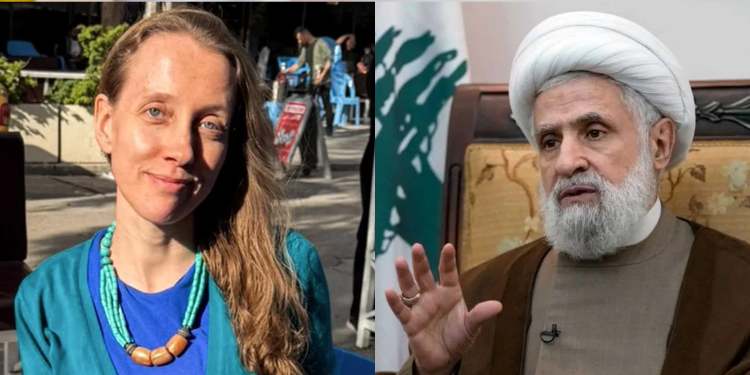
Relief swept across the United States (U.S) after Hezbollah confirmed the release of American journalist Shelly Kittleson, who had been held following her abduction in the Middle East.
The confirmation, issued through an official‑style statement circulated on Telegram, brought an end to days of intense concern over the fate of the experienced foreign correspondent.
The statement, dated April 7, 2026, said Kittleson had been released and instructed to leave the country immediately.
It said the decision was made in acknowledgment of the country’s stance and leadership of an elected prime minister, although it did not provide details of the negotiations that led to the release.
“This initiative will not be repeated,” the statement said, describing the release as a one‑time decision.
It warned that the group considers itself to be in a state of war against the United States and Israel, and added that, in such circumstances, many considerations no longer apply.
Shelly Kittleson
Shelly Kittleson, a US citizen, is a veteran freelance journalist known for reporting from conflict zones across Iraq, Syria, Afghanistan, and the wider Middle East.
Her work has appeared in major international outlets, including Al‑Monitor, BBC World Service, Foreign Policy, and Italian media.
Also Read: PM Keir Starmer Issues Statement After Kanye West Barred from Entering UK
She has built a reputation for covering security issues, armed groups, and regional politics, often working independently on the ground.
Kittleson was abducted in Baghdad on March 31, 2026, in broad daylight.
Security footage later showed her being forced into a vehicle near a major street close to the Baghdad Hotel.
Iraqi security forces pursued the kidnappers and intercepted one of the cars involved, arresting a suspect, but she was not found during that operation.
US and Iraqi officials later said the abduction was linked to Kataib Hezbollah, an Iran-backed Iraqi militia that functions independently from Lebanon’s Hezbollah but shares its ideology and alliances.
The group has a history of detaining foreign nationals during times of regional tension.
In the days after her kidnapping, the U.S. State Department confirmed it was working with Iraqi authorities and the FBI to secure her release.
Officials said Shelly Kittleson had previously been warned of increased risks in Iraq amid escalating conflict involving Iran, Israel, and the United States.
The Hezbollah statement confirming her release did not specify where she was freed, who physically transferred custody, or how she exited the country.
It stated only that she was no longer being held and must leave immediately, a condition that has accompanied past releases of foreign detainees.
The announcement eased concern among journalists’ unions, press freedom groups and Kittleson’s colleagues, who had raised alarm about the dangers faced by reporters working in Iraq.
Also Read: Trump Calls North Korea’s Nuclear Weapons an American Failure
Her case revived memories of earlier kidnappings of foreign journalists and researchers in the country, some of whom were held for months or years.
For the United States, the release marked a rare positive outcome amid heightened regional tensions and repeated warnings to Americans to avoid travel to Iraq.
Hezbollah’s Message Warfare Strategy
Hezbollah’s recent tactics are part of a broader trend toward controlled escalation and political signaling rather than sustained confrontation.
The group has combined limited military actions with media statements and symbolic moves, including the detention and release of foreign nationals, to influence governments and public opinion.
These actions are meant to exert pressure without causing a full-scale war.
Hezbollah has also relied heavily on messaging through allied channels to present its actions as defensive and strategic.
The approach aims to stay relevant, discourage opponents, and handle risks amid regional conflict involving Israel, the United States, and Iran.