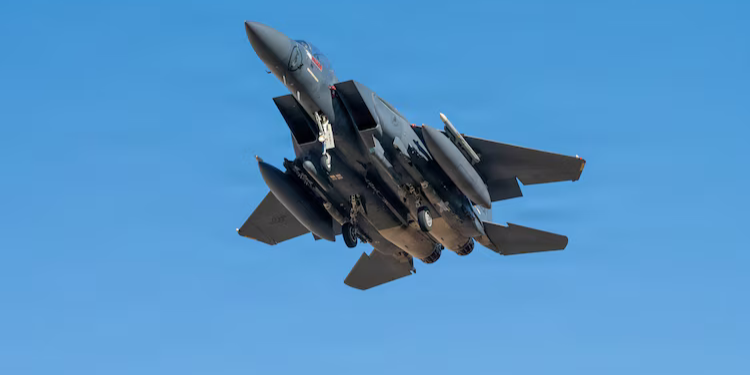
Iranian military commanders said on Saturday, April 4, they deployed a new air defense system that brought down a U.S. F-15E Strike Eagle fighter jet the day before, marking the first confirmed loss of a manned American combat aircraft over Iranian territory since the war began in late February.
The announcement came from Iran’s Khatam al-Anbiya Central Headquarters, which coordinates air defenses for both the regular armed forces and the Islamic Revolutionary Guard Corps.
Reuters reports that officials described the system as newly introduced and operated by the IRGC Aerospace Force. They linked it directly to the engagement that downed the F-15E on April 3 over southern or central Iran.
U.S. officials confirmed the loss of the F-15E; the two-seat jet carried a pilot and a weapons systems officer.
American forces rescued one crew member during a search-and-rescue operation but continued looking for the second as of Saturday.
A separate U.S. A-10 Thunderbolt II attack plane was also reportedly hit Friday during the rescue effort near the Strait of Hormuz; its pilot ejected and was recovered safely.
Also Read: Iran Rejects Ceasefire as U.S. Two U.S. Helicopters Struck During Rescue Mission
Iranian state media released images of what they said was wreckage from the downed fighter, including tail sections and debris consistent with an F-15.
U.S. sources have not publicly disputed the aircraft type, though they have not commented on the specific weapon used.
For more than a month, U.S. and Israeli aircraft conducted thousands of strikes across Iran with minimal interference from Iranian surface-to-air missiles.
American and Israeli commanders said they gained localized air superiority early in the campaign. This gave bombers and fighters considerable freedom to attack missile factories, radar sites, and leadership targets.
Iran’s long-range systems, such as the Russian-made S-300 and the home-made Bavar-373, lost significant power during repeated suppression missions.
Iran’s military command said the new system changes that equation. They promised it would help Tehran regain “full control” of its airspace after weeks of coalition dominance.
Details about Iran’s new defense system remain scanty.
No details were released about the system’s name, radar type, or missile range, but commanders described it as advanced and designed specifically to counter high-performance jets operating at medium to high altitudes.
Iran has long relied on a mix of imported Russian hardware and homegrown designs developed under sanctions.
One of Iran’s systems, the Bavar-373, uses road-mobile launchers and phased-array radars to track multiple targets.
The new system appears to build on those efforts, possibly incorporating improved sensors or integration to survive initial strikes on fixed sites.
Independent verification of the exact weapon remains limited. U.S. Central Command has not released a technical analysis of the engagement.
Open-source analysts say Iran’s air defenses are weaker now, but they still retain some capabilities thanks to mobile units and layered, shorter-range systems that are harder to eliminate completely.
The incident happened at a time when Iranian defenses were under more pressure. For weeks, coalition strikes have been hitting command nodes, radar networks, and missile production lines.
Also Read: Trump Says Talks Will Continue After Iran Downs U.S. Jet
It should be noted that the F-15E Strike Eagle is a proven workhorse used for ground-attack and air-superiority roles, suggesting that Iran’s new defense system could be capable.
Its loss in enemy territory simply means Israel and U.S. Forces planners will need to rethink routes, electronic warfare support, and the balance between deep strikes and troop protection.
Iranian officials said the event was a turning point after more than a month of constant air pressure.
The U.S. side has been calm, with officials confirming the loss of the plane and the ongoing search efforts, but they have not given any immediate details on how the jet was hit or whether the new Iranian system is part of a larger revival of air defenses.