President Donald Trump has said that the downing of a U.S. F-15E fighter jet over Iran would not derail ongoing negotiations to end the conflict.
In his first public comments since the incident, the president downplayed the significance of the loss in an exclusive interview with NBC News, saying talks with Tehran would continue despite the setback.
The remarks came hours after Iranian forces shot down the American warplane on Friday, April 3, in what marks the first confirmed case of a U.S. fighter jet lost to enemy fire over Iranian territory in the nearly five-week-old war.
One of the two crew members has been rescued and is receiving medical attention, while search efforts persist for the second airman amid heightened tensions.
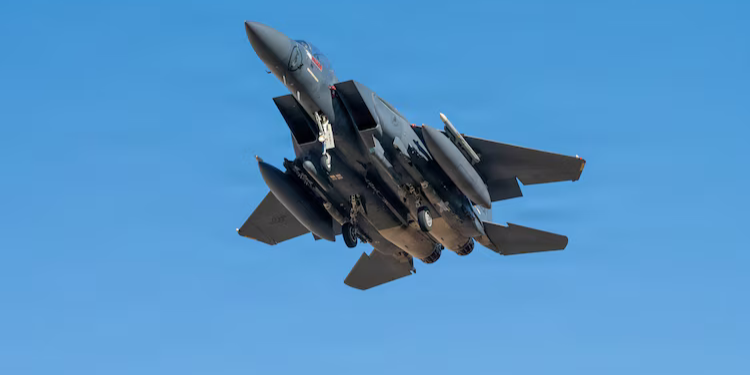
U.S. officials confirmed the aircraft was an F-15E Strike Eagle, a twin-seat fighter capable of both air-to-air and ground-attack missions.
The jet went down in southwestern Iran after being struck by Iranian air defenses. Iranian state media quickly released photos of wreckage, including pieces of the tail fin bearing U.S. Air Force markings and an empty ejection seat, claiming a major victory.
Also Read: All Eyes on Trump as Iran Rejects U.S. Demands Ahead of April 6 Strait of Hormuz Deadline
The incident marks a blow to the Trump administration’s narrative of overwhelming U.S. air superiority.
Just days earlier, in an address to the nation, Trump had asserted that Iranian radar and anti-aircraft systems had been largely destroyed, allowing American planes to operate freely.
“We’re flying wherever we want,” he had said. The downing of the F-15E was a sharp indication that Iranian defenses still pose a risk.
One crew member was recovered alive by U.S. special forces operating on Iranian soil, according to multiple sources.
The second remains missing, with rescue operations underway in a high-risk environment. A separate U.S. A-10 Warthog aircraft involved in related search efforts also faced trouble in the region, but its pilot was safely recovered after an incident.
White House Press Secretary Karoline Leavitt confirmed that President Trump had been briefed on the situation shortly after it unfolded.
The administration has so far avoided detailed public discussion of the rescue mission, citing operational security.
The jet’s loss comes at a delicate moment in the wider conflict. The United States and its allies have been pressing military operations against Iranian missile sites, naval assets, and infrastructure tied to its nuclear program and support for regional proxies.
Trump, with endless warnings
Trump has repeatedly warned of further strikes if Iran does not come to the table on U.S. terms.
Despite the escalation, indirect negotiations between Washington and Tehran have continued through back channels.
Iran has rejected several U.S. ceasefire proposals, including offers linked to reopening the strategically vital Strait of Hormuz, a critical chokepoint for global oil shipments.
Tehran has also pushed back against demands to dismantle remaining atomic capabilities and curb its ballistic missile program.
Iran’s Islamic Revolutionary Guard Corps hailed the downing of the F-15E as a “powerful blow” against American aggression.
Also Read: U.S. Rescue Helicopters Come Under Fire in Iran as Search Intensifies for Downed F-15 Pilots
Spokesmen for the group accused the Trump administration of spreading misinformation about the state of Iranian defenses and vowed to defend the country’s airspace.
The conflict, which started in late February following U.S. and Israeli strikes on Iranian nuclear facilities, has already disrupted energy markets and raised fears of wider regional involvement.
Oil prices have fluctuated with each new development around the Strait of Hormuz, where Iranian forces have targeted shipping and infrastructure in retaliation.
Officials in the U.S. have maintained that the overall campaign has so far met important goals, such as reducing Iran’s stockpiles of missiles and naval power.
But the loss of the F-15E suggests that fighting is still ongoing and hard to predict.
Trump’s decision to emphasize talks even after the jet incident shows he wants to keep diplomatic options open while maintaining military pressure.
The president has long combined tough rhetoric with economic incentives to encourage Iran to reach a comprehensive agreement.