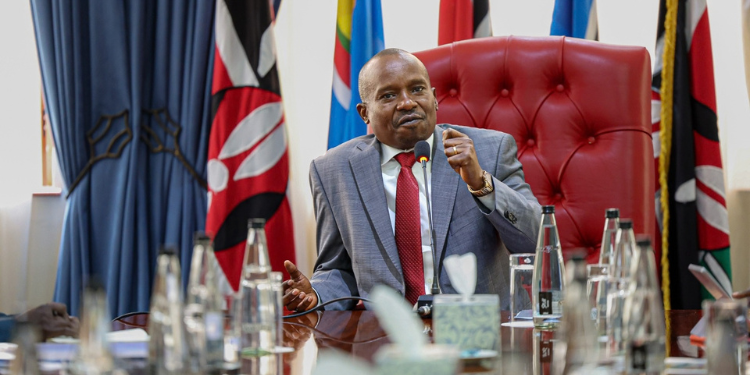
Chairperson of the President’s Council of Economic Advisors, David Ndii, has explained why Dangote’s planned 700,000 barrels-per-day (bpd) single-train refinery could not be built in Isiolo.
Ndii was responding to a social media user who asked why the giant refinery project was not proposed for Isiolo, a town often viewed as strategically located within Kenya.
This is the same model adopted by Nigerian billionaire Aliko Dangote for his flagship refinery in Lekki, Lagos. The refinery was constructed close to the Atlantic Ocean, allowing crude oil tankers to dock directly at marine facilities built specifically for the project.
The proposed Kenyan refinery follows a similar approach, with plans centred on Lamu, whose deepwater port forms part of the Lamu Port-South Sudan-Ethiopia Transport (LAPSSET) Corridor.
Ndii Says Deepwater Port Is Non-Negotiable
Responding to the query on X, Ndii dismissed the suggestion that Isiolo could host a refinery of such magnitude, arguing that the issue goes beyond land availability or central location.
“He was not asked. A 700 bpd single-train refinery needs a deepwater port. It’s physically impossible to move 100m+ crude distillation column beyond 5km,” Ndii wrote.
The crude distillation column, the main processing unit of any refinery, is among the largest pieces of industrial equipment used in the oil and gas sector.
Also Read: Africa’s Largest Bank Backs Dangote Refinery Plan, Signals Billions in Expansion Support
For a 700,000-bpd single-train refinery, the column can be well over 100 meters long and weigh hundreds of tonnes.
The column is manufactured elsewhere and transported by specialized heavy-lift ships directly to the refinery site. Once unloaded, it is moved only a short distance using specialised transport systems before installation.
Transporting the equipment hundreds of kilometers inland would require roads, bridges and transport infrastructure capable of handling extraordinary loads, making it technically and economically impractical.
Why Coastal Locations Are Preferred for Mega Refineries
Beyond transporting equipment, deepwater ports play a crucial role in the day-to-day operation of large oil refineries.
A refinery processing 700,000 barrels of crude oil every day requires a continuous supply of crude delivered by large oil tankers. It also needs efficient routes to export refined petroleum products such as petrol, diesel, aviation fuel and liquefied petroleum gas (LPG) to domestic and international markets.
Building the refinery near a port significantly lowers transportation costs while simplifying the import of crude oil and export of finished products.
Dangote Confirms East African in Lamu
Nigerian billionaire Aliko Dangote has confirmed that his proposed 700,000 barrels-per-day (bpd) East African oil refinery will be built in Lamu, Kenya, ending months of speculation over the project’s location and cementing Kenya as the preferred destination for what is expected to become the region’s largest refining facility.
Also Read: Details of Ruto’s Phone Call with Dangote on Oil Refinery Project in East Africa
According to Dangote Industries Vice President for Oil and Gas Edwin Devakumar, the company has already selected the site in Lamu, completed preliminary soil tests and commenced design and engineering work.
Devakumar stated that Construction is expected to take up to three years, with the refinery marking Dangote Group’s biggest refining investment outside Nigeria.
The project will be financed through a combination of internally generated cash, bond issuances and proceeds from a planned initial public offering (IPO). Although the company has not disclosed the final cost, Devakumar said it would be comparable to the more than $20 billion invested in Dangote’s Lagos refinery, currently Africa’s largest single-train refinery.
The refinery is expected to process 700,000 barrels of crude oil per day and supply refined petroleum products to Kenya and neighboring countries, including Uganda, South Sudan, Rwanda, Burundi and the Democratic Republic of Congo.
Follow our WhatsApp Channel and X Account for real-time news updates.