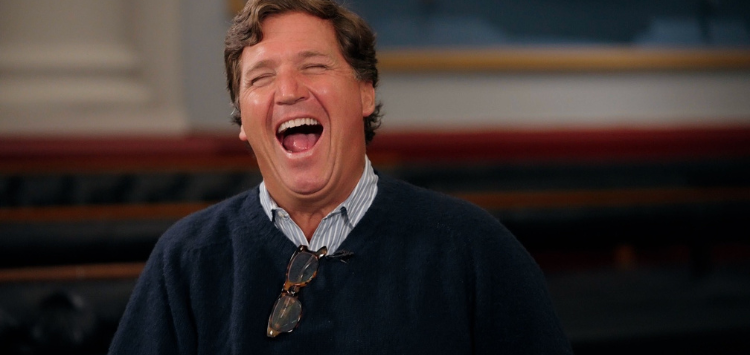
Former television host and political commentator Tucker Carlson has found himself at the center of controversy after claims emerged that he may have played an unwitting role in U.S. operations against Iranian leader Ali Khamenei.
According to social media commentator Drew Pavlou, the CIA was reportedly aware that Carlson had been communicating with the Iranian regime prior to the strike.
Pavlou suggested that when President Donald Trump invited Carlson to multiple Oval Office meetings in the lead‑up to the Iran operation, he may have leveraged Carlson as a counter‑intelligence asset to give Khamenei a false sense of security.
“Trump was basically able to kill Khamenei thanks to Tucker’s arrogance,” Pavlou wrote, adding that the situation now exposes Carlson to serious legal jeopardy.
Also Read: Trump Gets Major Boost from Former Prime Minister Over War Against Iran
Tucker Carlson is currently facing an unexpected storm of legal and political controversy after claiming that the Central Intelligence Agency has read his private text messages and is preparing a criminal referral accusing him of violating the Foreign Agents Registration Act (FARA).
Carlson, once one of the most influential voices in conservative media, says the alleged case revolves around communications he had with individuals in Iran before the outbreak of war.
Though he insists he was never a foreign agent, and that his contacts were part of his work as a journalist, the mere suggestion of an investigation has thrust him into a new and uncertain chapter of his public life.
In a video shared social media, Carlson framed the alleged actions against him as politically motivated. “When you discover the CIA has been reading your texts in order to frame you for a crime,” he said in a message shared widely online.
Carlson also addressed the potential legal jeopardy directly in a video statement. He portrayed the possible referral to the Justice Department as overblown and legally unfounded, saying the notion that talking to people in Iran could be criminal “is ludicrous.”
According to Carlson, his conversations were part of his job as a journalist, and he said that he has never taken money from foreign entities or acted against U.S. interests.
Also Read: Blow to Trump as Country Rejects US Military Flyover Requests Tied to Iran War
“I am not an agent of a foreign power,” Carlson said. “Unlike a lot of people commenting on U.S. politics and global affairs, I have only one loyalty and that’s to the United States … its interests are the only interests I care about because I’m from here and I have a lot of kids.”
Beyond the legal claims, the social media sphere has been aflame with accusations about Carlson’s role in recent international events. One political activist suggested Carlson was a “counter‑intelligence asset” who misled Iranian leadership about the intentions of the United States and its allies.
The activist claimed that Carlson’s interactions with Iran helped build confidence among Iranian commanders and ultimately set the stage for a high‑level meeting that made Iranian leaders vulnerable in the run‑up to a U.S. strike.
Another social media commentator, Drew Pavlou went even further, alleging that President Donald Trump’s invitations to Carlson in the Oval Office were part of a broader strategy that hinged on Carlson’s communications, which supposedly assured Iranian authorities that nothing significant was imminent.
“Trump was basically able to kill Khamenei thanks to Tucker’s arrogance,” the comment read, a claim that mixes political grievance and speculation about espionage, with no supporting documentation.
Carlson himself rejected any suggestion of wrongdoing or secret coordination. “I have no secrets to divulge,” he said, adding that speaking to people around the world is inherent to his profession.
He framed his critics as misunderstanding the role of journalists and commentators in engaging with global actors and stressed that he had no intention of ceasing to contact foreign sources.
The Foreign Agents Registration Act, the statute Carlson referenced in his remarks, is a law designed to ensure that individuals acting on behalf of foreign principals disclose their activities to the U.S. government.