


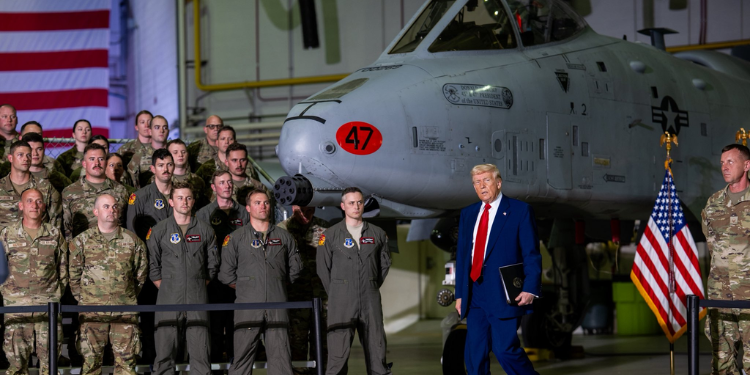
A European nation has rejected two U.S. military flyover requests related to the ongoing war involving Iran. Switzerland rejected the requests but approved three other flights deemed unrelated to combat operations.
In a statement released Saturday, March 15, 2026, the Swiss Federal Council said the decisions were made in accordance with Switzerland’s neutrality laws as fighting continues between the United States, Israel, and Iran.
The rejected requests involved reconnaissance aircraft scheduled to pass through Swiss airspace on Saturday.
However, Swiss authorities approved three other requests — including a maintenance flight and two transport aircraft overflights — after determining that they were not directly linked to military operations in the conflict.
Neutrality rules
According to Swiss officials, the country’s neutrality laws prohibit overflights by military aircraft that directly support parties engaged in an active conflict.
Also Read: Trump Says U.S. Could Use Bases in Foreign Nation “Without Approval” Amid Iran War
The requests were evaluated by the Federal Office of Civil Aviation (FOCA) in coordination with multiple government departments, including the foreign affairs and defence ministries.
At the same time, Switzerland clarified that humanitarian and medical flights — including those transporting wounded personnel — will continue to be approved.
“The law of neutrality prohibits overflights by the parties to the conflict that pursue a military purpose related to the conflict. Humanitarian and medical transits, including the transport of the wounded, as well as overflights unrelated to the conflict, are permitted,” the Federal Council said.
Officials also said flights that are clearly unrelated to the war will generally be allowed. Swiss authorities also announced new criteria for handling future requests by the U.S. military to pass through Swiss airspace.
Under the guidelines, flights unrelated to the war will be permitted, while requests tied to military operations in the conflict will be rejected.
Aircraft already covered by existing annual diplomatic clearances can still operate, but those linked to direct support for combat operations between the United States, Israel, and Iran are excluded.
“The U.S. continues to have an annual permit for clearly designated state aircraft. Specifically excluded are state flights that would constitute military support in the war between the U.S., Israel, and Iran,” the statement adds. Any aircraft outside that list must obtain individual approval from FOCA.
Switzerland takes cautious stance on Iran war
The decision comes days after the Swiss government expressed alarm over the conflict and called for de-escalation and respect for international law.
Earlier this week, Switzerland temporarily closed its embassy in Tehran due to security concerns as missile exchanges intensified across the region.
Also Read: Macron Pushes Back After Trump Urges Allies to Send Warships to Hormuz
The Federal Department of Foreign Affairs (FDFA) said that the move forced Swiss diplomatic staff, including Ambassador Olivier Bangerter, to leave the country by land.
“Due to the attacks by the US and Israel against Iran and Iran’s attacks on various countries in the Middle East, the security of staff at the Swiss embassy in Tehran can no longer be guaranteed. The FDFA has therefore decided to temporarily close its embassy in Tehran. Four Swiss employees had already left the country on 3 March. The remaining six employees, including Ambassador Olivier Bangerter, left Iran by land today.”
Despite the closure, Switzerland said it will continue to serve as a communication channel between Washington and Tehran, in its longstanding role as the protecting power for U.S. interests in Iran.
The development comes as President Donald Trump on Saturday urged allied nations to deploy warships to help secure the strategic Strait of Hormuz amid rising tensions with Iran.
However, France has pushed back against reports of expanded military deployments.
The French Ministry for Europe and Foreign Affairs earlier Saturday denied claims that France was sending a carrier strike group to the Gulf, saying its naval posture remains defensive and that its aircraft carrier group remains in the Eastern Mediterranean.




It does not really seem like a blow. He asked; Switzerland answered in a manner consistent with how Switzerland has operated for decades. Nothing ventured, nothing gained. The US asked, and Switzerland gave nothing new, just the same as always.