
The Athletics Integrity Unit (AIU) has suspended a Kenyan athlete after testing positive for doping.
AIU, in a statement on Thursday, November 27, announced the suspension of athlete Brian Limo over the presence or use of a prohibited substance and tampering.
“AIU has provisionally suspended Brian Limo (Kenya) for Presence/Use of a Prohibited Substance (Salbutamol) & tampering.”
The Athletics Integrity Unit Disciplinary Process applies to both doping and non-doping cases that are pursued by the Athletics Integrity Unit under the World Athletics Anti-Doping Rules and the World Athletics Integrity Code of Conduct, respectively.
AIU’s jurisdiction covers International-Level Athletes and their Athlete Support Personnel, World Athletics officials and member Federation officials (limited to their dealings with World Athletics).
Also Read: Russia to Send 15 Athletes for Special Training in Kenya
The Disciplinary Process has five separate stages, including provisional suspension in force, pending first instance cases, first instance decisions, pending appeal, and appeal decision.
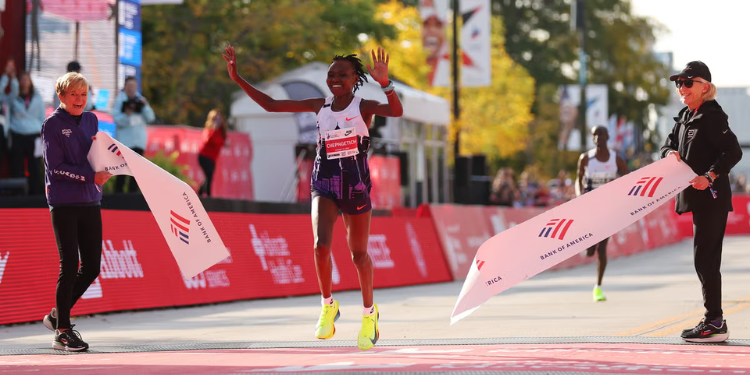
Limo’s suspension comes after Women’s marathon world record-holder, Ruth Chepng’etich was banned for three years by AIU last month after admitting to Anti-Doping Rule Violations (ADRVs) regarding the presence and use of Hydrochlorothiazide (HCTZ).
Ruth Chepng’etich banned
The 31-year-old former World marathon champion accepted the charges and sanction following a positive test for the banned diuretic from a sample on March 14 this year and a subsequent AIU investigation into the circumstances.
“Whilst diuretics are known to be abused by athletes to mask the presence in urine of other Prohibited Substances, HCTZ has also been identified as a potential contaminant in pharmaceutical products. It has been ascribed by WADA a minimum reporting limit of 20ng/ml, below which a positive test should not be reported. An estimated concentration of 3800ng/mL of HCTZ was found in the positive urine sample of Chepng’etich,” said AIU in a statement.
When initially interviewed by the unit’s investigators, on April 16, 2025, Chepng’etich could not provide an explanation for the positive test.
To rule out the possibility of contamination, evidence was collected from her including her detailed recollection of all the supplements and medications she had taken in the lead up to the positive test, and all available supplements and medications in her possession were immediately retained by the AIU for analysis. Chepng’etich’s mobile phone was also copied for analysis.
At a subsequent interview, Chepng’etich was on July 11, 2025, confronted with evidence acquired from her mobile telephone indicating a reasonable suspicion that her positive test may have been intentional.
She was also informed that all the supplements and medications that had been taken for analysis had been reported by a WADA-accredited laboratory as negative for HCTZ.
Also Read: Kenyan World Marathon Record-Holder Banned for 3 Years
The three-time winner of the Chicago Marathon maintained her position at this second interview that she could not explain the positive test and that she had never doped.
Admission
On July 31, 2025, Chepng’etich changed her previous explanation. She wrote to the AIU to state that she now recalled that she had taken ill two days before the positive test and she had taken her housemaid’s medication as treatment, without taking any steps to verify if it contained a prohibited substance.
The athlete stated that she had forgotten to disclose this incident to the AIU investigators. She sent a photo of the medication blister pack which clearly marked the medication as being ‘Hydrochlorothiazide’.
“While the AIU considered her new explanation to be hardly credible, for the purposes of the AntiDoping Rules (ADR), it did not assist in mitigating the standard two-year sanction for a specified substance such as HCTZ. To the contrary, the ADR treats the type of recklessness described by Chepng’etich in taking her housemaid’s medication as being indirect intent, for which an increased four-year sanction applies. Therefore, on August 22, 2025, the AIU issued Chepngetich with a Notice of Charge seeking a four-year sanction.”
Chepng’etich admitted the ADRVs and, since she accepted the proposed sanction within 20 days on September 10, 2025, she was granted an automatic one-year reduction of the four years due to the Early Admission and Acceptance of Sanction provision in ADR 10.8.1.
Follow our WhatsApp Channel and X Account for real-time news updates.