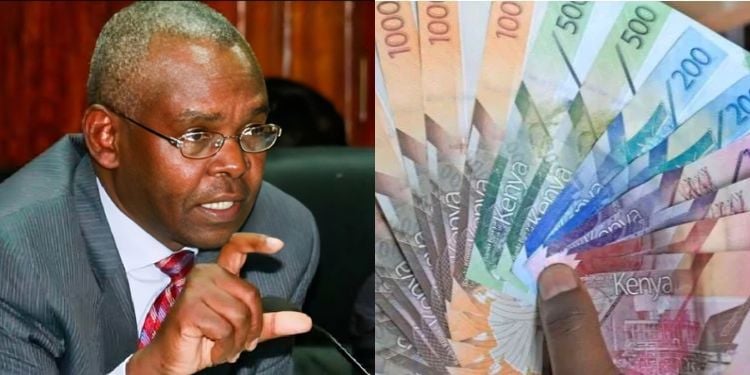

Treasury Cabinet Secretary John Mbadi has announced plans to raise the proposed Pay As You Earn (PAYE) tax exemption threshold from KSh30,000 to KSh32,800 to ease the tax burden on low-income earners.
Speaking on Friday at The Eldoret National Polytechnic (TENP) in Eldoret, Uasin Gishu County, where he presided over the opening of the Mashujaa Day 2026 Economy (Finance) Thematic Week, held under the theme “An Economy for the People”, Mbadi said the proposal is expected to be presented to Parliament.
The Exchequer boss said the ministry had agreed with President William Ruto to recognise the sacrifices lower-income earners made, noting that Kenyans contributed to the country’s economic recovery through difficult years.
At the same time, Mbadi noted the government will introduce an amendment in Parliament in November this year to exempt workers earning KSh32,800 and below from PAYE.
Mbadi Announces PAYE Tax Relief Plan for Kenyans Earning KSh32,800 and Below
The CS added that the proposed change would raise the threshold from the KSh30,000 figure the government previously discussed.
“Those Kenyans who are earning 32,800 and below, why don’t we tell them, take all your salary and go, don’t pay taxes? That is an improvement from the 30,000 we talked about, isn’t it?” Mbadi said.
“So, at the end of this month, in the month of November, we are bringing that amendment to Parliament to tell those Kenyans that we appreciate the sacrifices.”
Mbadi said the proposed exemption is meant to increase disposable income for lower-paid workers by letting them keep more of their monthly earnings.
“In the month of November, we are bringing that amendment to Parliament to tell those Kenyans that we appreciate the sacrifices, however little or however big you have made,” he added.
Under the existing tax structure, the first KSh24,000 of monthly taxable income attracts a 10 per cent PAYE rate. Eligible resident taxpayers receive KSh2,400 per month in personal relief, which offsets the tax payable on that portion of income.
The proposed exemption would require parliamentary approval before implementation. Until the amendment is passed and takes effect, the existing tax rules will remain in force.
Also Read: Mbadi Gives Fresh Timeline for PAYE Changes After September Promise
Government Extends Fuel Tax Relief
Mbadi also outlined measures the government has taken to contain household costs, including keeping Value Added Tax (VAT) on petroleum products at 8 per cent instead of 16 per cent for another 90 days.
The CS estimated that the reduced fuel tax had cost the government about KSh54 billion in revenue over six months.
He said the cost could exceed KSh100 billion annually if the reduced VAT rate were maintained throughout a full year.
The measure is intended to cushion consumers against high fuel costs, which affect transport fares, food distribution, manufacturing and the prices of other essential goods.
Also Read: Salaried Kenyans Squeezed Hard as PAYE and VAT Push KRA Collections to KSh2.8 Trillion
Kenya’s Economic Growth Outlook
Mbadi’s remarks come as Kenya’s economy continues to grow amid concerns about household purchasing power, fuel costs, and the wider global economic outlook.
According to the Kenya National Bureau of Statistics, the economy grew 5.3 per cent in the first quarter of 2026 and 5.1 per cent in the second quarter, compared with 4.6 per cent in 2025.
The National Treasury has projected economic growth of 5 per cent in 2026, matching the Central Bank of Kenya’s October forecast, which was revised upwards from 4.9 per cent following stronger activity in the industrial and services sectors.
Other international institutions have projected slower growth. The African Development Bank forecasts growth of 4.6 per cent, while the International Monetary Fund projects 4.5 per cent and the World Bank 4.3 per cent.
The World Bank lowered its forecast by 0.6 percentage points following the conflict in the Middle East, citing higher energy prices and pressure on household purchasing power and investment.
Follow our WhatsApp Channel and X Account for real-time news updates.