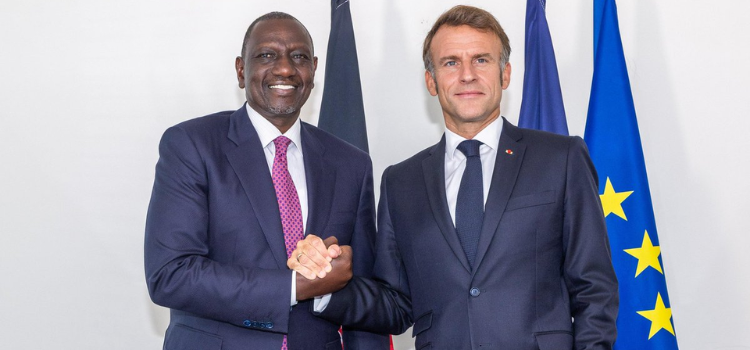
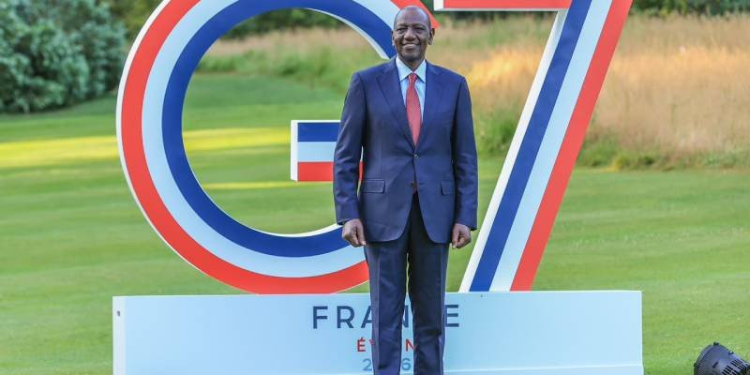
On June 16, President William Ruto arrived in Évian, France, to represent Africa at the G7 Leaders’ Summit.
Ruto is attending the high-level meeting at the invitation of French President Emmanuel Macron, who is chairing this year’s summit of the world’s seven advanced economies and democracies.
His participation followed a decision reached during the Africa Forward Summit in Nairobi on May 11, where African Heads of State and Government called upon France and Kenya to present the continent’s unified position on key issues, including economic transformation, financial reform, climate action and digital development.
“We call on France, together with Kenya, which is associated with the G7, to convey this important concern of the African continent to the Summit in Evian in June 2026,” read part of the statement.
Kenya has been invited as a guest country alongside Brazil, Egypt, India, and South Korea.
The Head of State joined leaders from some of the world’s major economies at the summit, including French President Emmanuel Macron, US President Donald Trump, Canadian Prime Minister Mark Carney, German Chancellor Friedrich Merz, Italian Prime Minister Giorgia Meloni, Japanese Prime Minister Shigeru Ishiba, UK Prime Minister Keir Starmer, President of the European Council António Costa and President of the European Commission Ursula von der Leyen, alongside other invited leaders.
Mudavadi on Why Ruto Is Attending G7 Summit
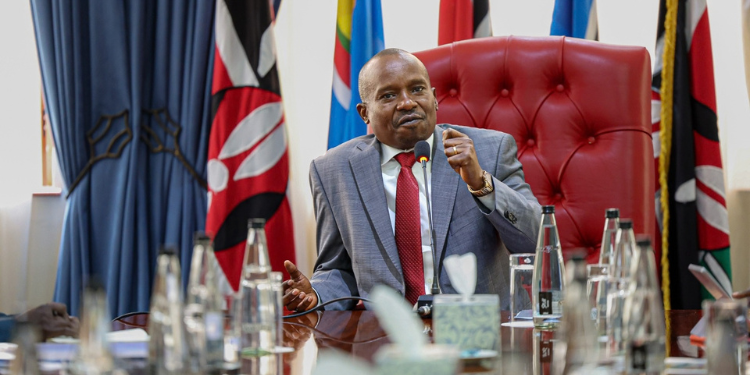
Prime Cabinet Secretary and Foreign Affairs CS Musalia Mudavadi said Ruto was invited to the G7 Summit in France for Kenya’s growing diplomatic influence and role in advancing Africa’s interests on the global stage.
Speaking from Évian-les-Bains, France, on June 16, Mudavadi said Kenya was among only five partner nations invited to the high-level gathering alongside India, Brazil, South Korea and Egypt.
He described the invitation as a reflection of the country’s “growing diplomatic capital, global influence and strategic importance in international affairs.”
“Kenya is among only five partner nations invited to the summit alongside India, Brazil, South Korea and Egypt, a reflection of the country’s growing diplomatic capital, global influence and strategic importance in international affairs,” Mudavadi said.
Also Read: Ruto Reveals How Africa Will Drive Global Economic Growth
What Is the G7 and Why Does It Matter?
The Group of Seven (G7) is an informal bloc of the world’s leading industrialized democracies comprising the United States, Canada, France, Germany, Italy, Japan and the United Kingdom.
The European Union also participates through the presidents of the European Council and the European Commission.
The leaders meet annually to discuss major global issues, including economic growth, international security, trade, climate change, emerging technologies and geopolitical conflicts.
Although the G7 has no formal charter, treaty, or permanent secretariat, it exerts influence due to its economic and political power.
The group traces its origins to the 1973 oil crisis, when finance ministers from the United States, Britain, France, Japan and West Germany began holding informal consultations to address global economic turmoil caused by soaring oil prices and recession.
Unlike organizations such as the United Nations or NATO, the G7 does not make legally binding decisions.
Instead, it relies on consensus among major democracies. When members agree, their coordinated actions can significantly influence global policy, financial markets, and diplomatic responses.
Also Read: President William Ruto to Fly Out Again
How Countries Join the G7 or Participate in Summits
The G7 comprises Canada, France, Germany, Italy, Japan, the United Kingdom, the United States, and the European Union. There is no formal application or membership process for countries seeking to join.
For a country to become a member, it must be among the world’s largest economies and established liberal democracies.
Instead of expanding permanent membership, the G7 often invites non-member countries to participate as guests during its annual summit.
These invitations are issued by the country holding the rotating presidency and are used to broaden discussions on global issues such as security, climate change and economic development.
Follow our WhatsApp Channel and X Account for real-time news updates.