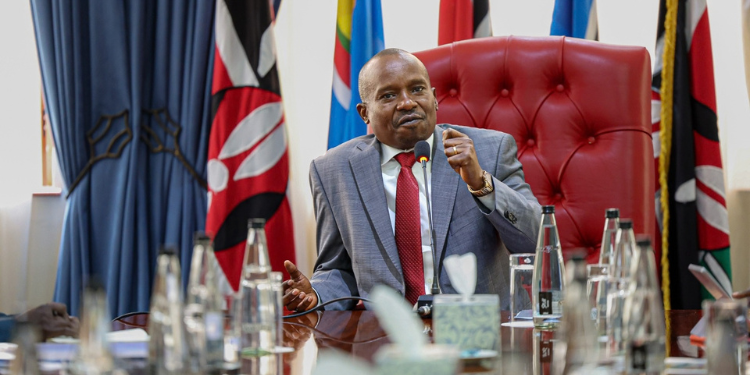

The National Treasury has dismissed reports circulating on social media alleging that the government plans to borrow money saved in Savings and Credit Cooperative Societies (SACCOs) to finance the proposed National Infrastructure Fund.
In a statement shared through its official communication channels on July 7, the Treasury termed the reports false, fabricated and intended to mislead members of the public.
However, the Treasury said no such statement had been made by the Cabinet Secretary and urged Kenyans to disregard the information.
Public Urged to Rely on Official Channels
The Treasury warned that the spread of false information can create unnecessary anxiety among Kenyans, particularly millions of SACCO members who rely on cooperative societies for savings, loans and investment opportunities.
It advised the public to verify information through official government communication platforms before sharing it on social media.
Also Read: Kenyan Investors Get More Options as CMA Approves New Unit Trust Funds
According to the statement, members of the public should rely on verified government channels for accurate updates on policy matters and public finance issues.
The clarification comes at a time when discussions around government borrowing and public debt continue to attract significant public interest.
SACCOs play a major role in Kenya’s financial sector and hold billions of shillings in member deposits.
Any suggestion that the government could access the savings is therefore likely to generate concern among members and investors.
Cooperative societies have for many years served as a key source of affordable credit and savings for workers, farmers, traders and other groups across the country.
Because of their importance in the economy, reports touching on the security of members’ savings often attract widespread attention.
Treasury on Funding Model for Infrastructure Fund
The government’s proposed National Infrastructure Fund is expected to raise about Sh5 trillion over a 10-year period to finance major projects while reducing reliance on conventional borrowing and public debt.
Treasury Cabinet Secretary John Mbadi has previously stated that the fund will primarily attract capital from private and institutional investors, including pension funds, insurance firms, sovereign wealth funds and other local and foreign investors interested in commercially viable infrastructure projects.
Also Read: EACC Moves to Recover Ksh1.5 Billion After Court Upholds Ruaraka Land Ruling
According to the Treasury, the fund is designed as an investment vehicle rather than a traditional borrowing program, with investors expected to earn returns from projects financed through the initiative.
The clarification follows the circulation of a fake social media graphic claiming that the government planned to borrow more than Sh1 trillion held in SACCO savings for the fund.
The National Infrastructure Fund has been at the center of public debate in recent months, with the government presenting it as an alternative source of funding for roads, airports, energy, and other strategic infrastructure projects.
The proposed fund is part of the government’s broader efforts to reduce dependence on external borrowing and create new ways of financing large-scale development projects.
Officials have argued that rising debt obligations have constrained the country’s fiscal space, necessitating the exploration of alternative funding mechanisms.
Among the projects expected to benefit from the fund are transport networks, energy infrastructure, irrigation schemes and logistics facilities considered capable of generating revenues over the long term.
The government believes such projects can attract investors seeking steady returns while supporting national development.
However, the proposal has attracted criticism from some stakeholders who have questioned its governance structure and accountability mechanisms.
Concerns have also been raised over how projects will be selected and managed, prompting calls for greater transparency as the initiative moves through the legislative process.
The fund has also faced legal scrutiny, with court cases challenging aspects of its establishment and operations.
The litigation has contributed to public debate surrounding the initiative even as government officials continue to defend it as a key pillar of the country’s infrastructure financing strategy.
Earlier this year, Mr Mbadi dismissed claims of inconsistencies in the fund’s status, maintaining that the National Infrastructure Fund Bill was before Parliament and remained central to the government’s plans to mobilize private capital for infrastructure development.
He has repeatedly argued that the fund should be viewed as an investment platform rather than a conventional government financing program.
According to the Cabinet Secretary, investors will be able to participate in commercially viable projects that generate returns over time.
Follow our WhatsApp Channel and X Account for real-time news updates.