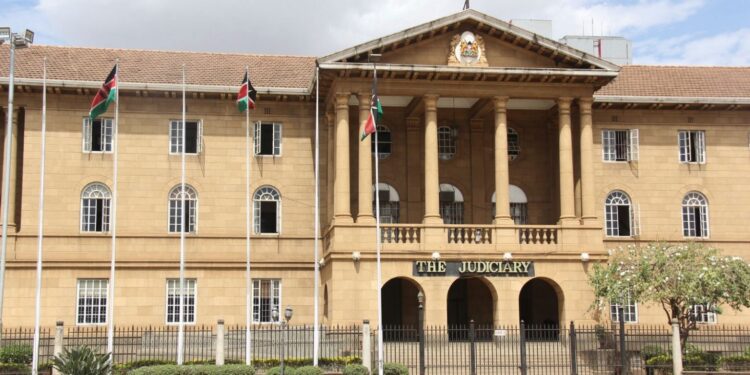
A lawyer has filed a fresh petition in the High Court seeking to stop Kenya’s 2027 General Election until the Independent Electoral and Boundaries Commission (IEBC) completes a review of constituency and ward boundaries, as required by the Constitution.
The petition, filed by Philip Kiplimo Langat, argues that the electoral commission violated Article 89 of the Constitution by failing to complete the review within the prescribed timeline.
According to the petition, the last nationwide boundary review was conducted in 2012, meaning a fresh review should have been completed by March 2024.
The petitioner argues that the constitutional obligation remains in effect notwithstanding delays in reconstituting the IEBC.
Langat is asking the court to block the 2027 General Election until the commission redraws constituency and ward boundaries and complies with its constitutional mandate.
The case adds a fresh twist to legal and political debates surrounding preparations for the next elections, with the petitioner arguing that the failure to undertake the review raises questions about the legality of conducting polls under existing electoral boundaries.
Petition Puts IEBC Under Fresh Scrutiny
At the center of the petition is Article 89 of the Constitution, which requires the IEBC to periodically review constituency and ward boundaries.
The petitioner argues that population changes and demographic shifts over the years have made the review necessary and that the commission’s failure to complete the exercise within the constitutional timeline cannot be excused, even though the country went for years without a fully constituted electoral commission.
Also Read: Oburu Blasts Uhuru for Handing Power to Ruto If Raila Won
Langat further argues that the constitutional duty did not lapse when the deadline passed and that the IEBC remains obligated to complete the exercise before the next General Election.
The petition seeks court intervention to compel compliance with the constitutional requirement before Kenyans return to the ballot.
The case comes as the newly reconstituted IEBC is expected to oversee preparations for the 2027 elections, including voter registration and other key electoral processes.
Kenya’s History of Electoral Boundary Reviews
Kenya has conducted four major electoral boundary reviews since independence, in 1966, 1986, 1996 and 2012.
While electoral boundaries were first established between 1962 and 1963 ahead of independence, that exercise is regarded as an initial delimitation rather than a review because there were no existing independent Kenya boundaries to reassess.
The Kenya Regional Boundaries Commission, also known as the Royal Commission, created the first constituencies and established 117 constituencies.
In drawing the boundaries, the commission considered factors including population size, geographical features, communication networks, community interests and existing administrative units.
Kenya’s first post-independence boundary review came in 1966 after Parliament enacted the Parliamentary Constituencies (Preparatory Review) (No. 2) Act, 1966.
The Electoral Commission was directed to review the number and boundaries of constituencies and prescribe new limits, with the exercise increasing the number of constituencies from 117 to 158.
EC held public hearings across the country, including in Nairobi, Mombasa, Machakos, Embu, Nyeri, Nakuru, Kisumu, Kakamega, Kisii, Kericho, Mandera, Wajir and Kajiado, among other areas.
The next major review was conducted in 1986. Following constitutional changes that raised the maximum number of constituencies to 188, the Electoral Commission of Kenya reviewed and redrew constituency boundaries.
The revised electoral map was subsequently used in the 1988 General Election.
Also Read: Quickmart to Sell Half of Company to Investors in Major NSE Listing
Although the new boundaries took effect during the election, the actual review exercise had been completed two years earlier.
A decade later, the Electoral Commission of Kenya carried out another review in 1996. The exercise increased the number of constituencies from 188 to 210, the constitutional maximum at the time.
The Commission published the changes in Legal Notice No. 298 of 1996, and the new boundaries were used in the 1997 General Election.
The most recent review was conducted under the 2010 Constitution and was the first major boundary review undertaken by the Independent Electoral and Boundaries Commission.
The Interim Independent Boundaries Review Commission carried out preliminary work and submitted its report in November 2010 before handing the process over to the IEBC.
The commission subsequently conducted the First Review Relating to the Delimitation of Boundaries of Constituencies and Wards.
The IEBC published a preliminary report on January 9, 2012, followed by a revised version on February 9, 2012.
After considering Parliament’s recommendations, the IEBC gazetted the final boundaries on March 6, 2012, through the National Assembly Constituencies and County Assembly Wards Order, 2012.
That exercise created Kenya’s current electoral map of 290 constituencies and 1,450 county assembly wards.
Follow our WhatsApp Channel and X Account for real-time news updates.