

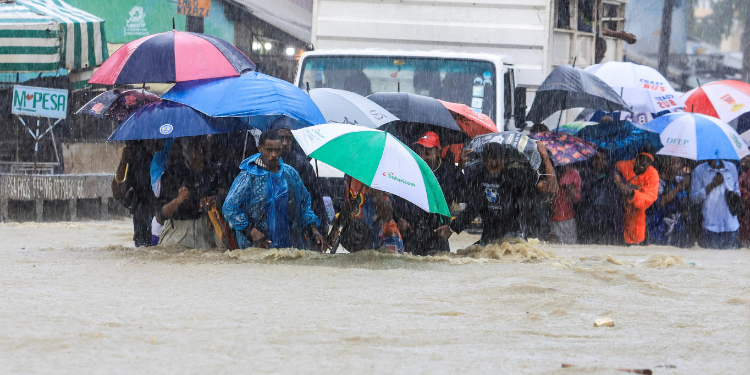
Kenyans across the country continue to experience high temperatures even as the country prepares for the October to December short-rains season, which was forecast to bring above-average rainfall.
The contrasting weather conditions have raised questions about why some areas are experiencing intense heat while others are receiving heavy rainfall, despite forecasts pointing to generally wetter conditions.
Speaking on Spice FM on Wednesday, November 11, Acting Deputy Director of Meteorological Services for the Eastern Region Richard Muita said the situation was linked to different climate systems influencing weather patterns across Kenya and the wider region.
Muita explained that El Niño does not automatically translate into rainfall everywhere, noting that its effects vary depending on geographical conditions and other climate drivers.
“El Niño is just a factor. And therefore, in order for you to attach the interpretation or what it may cause, then you need to tie the science,” Muita said.
Meteorologist Explains Link Between El Niño, Indian Ocean and Kenya’s Extreme Heat
He added that parts of Southern Africa were likely to experience severe drought, showing how the same climate phenomenon can produce different outcomes in different regions.
The meteorologist also pointed to the Indian Ocean Dipole (IOD), describing it as a major driver of rainfall in Kenya and East Africa.
“The Indian Ocean Dipole, for a fact, is the major driver of rainfall in Kenya and East Africa, as opposed to the belief that it is more of El Niño or other factors,” he stated.
Muita explained that the Indian Ocean Dipole played a significant role in the enhanced rainfall experienced between October and December 2018, when several areas, including Nairobi, experienced heavy rains and flooding.
He said rainfall patterns were influenced by a combination of factors, including El Niño, the Indian Ocean Dipole and prevailing ocean temperatures.
Why Some Parts of Kenya Are Hot While Others Receive Heavy Rainfall
Muita said the distribution of rainfall across the country had not been uniform, with some counties recording substantial rainfall while others experienced prolonged dry conditions.
He cited Nyeri and other areas around Mount Kenya, as well as parts of Western Kenya, which had recorded more than 250 millimetres of rainfall by the end of October.
In contrast, residents in Mandera had experienced high temperatures and prolonged dry conditions before flooding was reported in parts of the county.
He explained that the contrasting conditions showed why national weather forecasts should not be interpreted as meaning every county would receive the same amount of rainfall at the same time.
Muita maintained that the Kenya Meteorological Department had remained consistent with its August seasonal forecast, which indicated that most parts of the country would receive above-average rainfall during the October to December season.
November is the peak month of the short-rains season, and Muita said the department was continuing to monitor rainfall patterns as the season progressed.
Also Read: Floods Hit Nairobi: Vehicles Stuck, Roads Cut Off as Questions Over El Niño Preps Emerge
Human Activities Behind Rising Global Temperatures
Beyond the influence of El Niño and the Indian Ocean Dipole, Muita attributed the sustained increase in global temperatures to climate change and human activities.
He identified the burning of fossil fuels, deforestation and changes in land use, including agricultural activities, as some of the factors contributing to rising temperatures.
Muita explained that human activities release greenhouse gases into the atmosphere, trapping heat and contributing to the warming of the planet.
Using an analogy of covering oneself with additional blankets, Muita explained how greenhouse gases contribute to rising temperatures.
“It’s more like what you do when you cover yourself with more blankets. So we increase the layer that actually obstructs the solar intensity from coming in, and therefore we make the world much warmer than it is supposed to be,” he said.
He also dismissed increased solar intensity as the primary explanation for the warming experienced in recent decades.
“From 1978 up to date, the solar intensity has never increased. It has remained constant,” Muita stated.
He added that major volcanic eruptions could influence global temperatures, but maintained that human activities remain a major contributor to the current warming trend.
Muita said the forecast for above-average rainfall remained under monitoring, emphasising that El Niño should not be confused with rainfall itself.
“El Niño is not rain,” he said.
Also Read: El Niño? Heavy Rains and Storm Leave Four Injured as Hotels and Businesses Are Destroyed
Government Preparedness for El Niño Rains
The Kenya Meteorological Department forecasts El Niño conditions and above-average rainfall across much of the country. A national assessment has identified 18 counties and 5,660 health facilities in at-risk areas, and rates overall flood preparedness at 54 per cent. Key structures are in place, but serious gaps remain.
The department warns that November is usually the peak rainfall month of the short rainy season, which normally lasts from October to December.
A regional forecast from the Intergovernmental Authority on Development (IGAD) warned in September that there was “an 81% probability of a very strong El Niño during October–December 2026”.
The UN’s migration body the International Organization for Migration (IOM) has also warned that almost 900,000 people could be forced to leave their homes in Kenya this year, mostly because of the predicted floods.
Ahead of the anticipated El Niño-related rainfall, the government established a response committee headed by the Deputy President, while county governments also undertook preparedness measures.
An El Niño Contingency Plan is in place, the Ministry of Health and the National Disaster Operations Centre have activated joint planning meetings, and counties are being supported to assess their own preparedness.
The Kenya Defence Forces (KDF) has been building an emergency medical team for this kind of crisis, a trained group that deploys during disasters to treat the sick and injured and keep essential care running.
Thirty KDF health professionals completed induction training in 2024, and the team now has a leadership structure and written procedures.
Follow our WhatsApp Channel and X Account for real-time news updates and subscribe to our YouTube Channel for in-depth interviews.