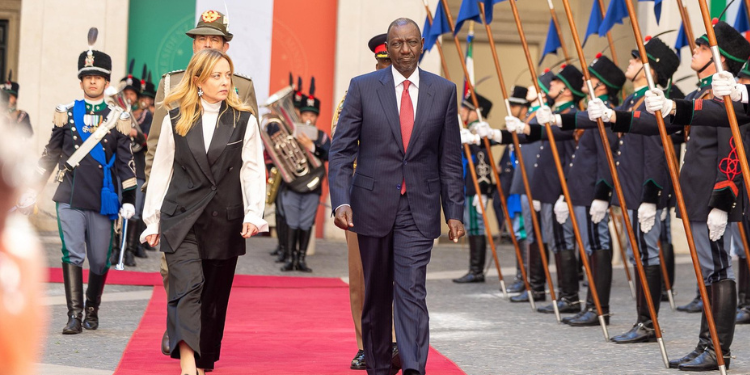
President William Ruto has signed several bilateral agreements between Kenya and Italy during his official visit to Rome, marking a major step in strengthening ties under the Mattei Plan for Africa.
The deals announced on Tuesday, April 21, were sealed following talks with Prime Minister Giorgia Meloni on April 20, 2026, during which both leaders adopted a 2026–2029 Action Plan to deepen cooperation across key sectors.
Under the political dialogue framework, the two leaders welcomed the strong momentum in bilateral relations and agreed to deepen engagement through reciprocal high-level visits and sustained exchanges, including on the sidelines of multilateral events.
Ruto Signs 7 Kenya–Italy Deals Under Mattei Plan for Africa
They committed to holding regular consultations between their respective foreign ministries in line with the existing Memorandum of Understanding on Political Consultations to strengthen coordination on issues of mutual interest.
Both leaders also agreed to reinforce cooperation through multilateral platforms such as the United Nations to jointly address global challenges, including technology, migration, sustainable development, and climate change, while promoting peace, stability, and security in Africa and beyond through diplomatic initiatives and humanitarian support.
In addition, they agreed to explore further cooperation under the Mattei Plan to support inclusive growth, regional integration, and trade across Africa within the framework of the African Continental Free Trade Area (AfCFTA).
Also Read: Ruto Explains Why Fuel Prices Are Higher in Kenya Than in Regional Neighbors
Trade and Investment
On economic cooperation, trade, and investment, the leaders reaffirmed their shared goal of strengthening bilateral economic relations by promoting trade and investment opportunities and encouraging the expansion of commercial ties between Kenyan and Italian enterprises.
This includes continued negotiations on pending agreements and the facilitation of private-sector partnerships, including collaboration in third markets.
The two leaders further welcomed the convening of a bilateral Business Forum held alongside the visit, noting its role in unlocking opportunities in strategic sectors such as infrastructure, sustainable energy, agri-business, and manufacturing.
According to State House, emphasis was placed on developing Kenya’s leather sector into a modern, sustainable, and globally competitive industry by improving quality standards, ensuring environmental compliance, and enhancing market access.
They also underscored the importance of promoting tourism as a driver of cultural exchange, economic growth, and community empowerment through sustainable and inclusive practices.
Further, both sides agreed to advance capacity-building initiatives in foreign service, customs, and trade facilitation, building on training programs supported by Italy’s National School of Administration under the Mattei Plan.
On partnership for sustainable development, both countries committed to strengthening cooperation on food security, sustainable high-value supply chains, and climate resilience.
Focus areas include the coffee sector, the blue economy, and urban development, with a focus on circular bio-economy systems and integrated waste management solutions.
They also reaffirmed support for expanding cooperation in physical and digital infrastructure, including transport and telecommunications, and for promoting joint initiatives in sustainable energy production and access, particularly renewable energy and the energy transition. Water management and environmental protection were also identified as priority areas for enhanced collaboration.
Also Read: Ruto Takes Ksh3.4 Billion Power Project to Eldoret
Science, Education and Defence Cooperation
On science, technology, innovation, and space, the leaders agreed to scale up joint initiatives through research collaborations, institutional partnerships, and knowledge-sharing platforms.
They committed to strengthening cooperation in artificial intelligence and its practical application, particularly within the Mattei Plan AI Hub for Sustainable Development.
The two sides also pledged to support innovation ecosystems, facilitate technology transfer, and expand cooperation in the space sector, including capacity building and the development of the space economy, leveraging the Luigi Broglio Malindi Space Center.
In education, training, and people-to-people exchanges, the leaders prioritized the development of Technical and Vocational Education and Training (TVET) programs to enhance skills development.
They also agreed to promote academic cooperation and exchanges between universities and research institutions, while encouraging stronger people-to-people connections, especially among youth, to deepen cultural ties. Partnerships between local authorities, including twinning arrangements, will also be supported.
Defense
On defence and security cooperation, the two leaders welcomed the signing of a Defence Cooperation Agreement to be implemented in line with the legal frameworks and priorities of both countries.
The agreement provides for collaboration in training, capacity building, and institutional cooperation among defense agencies, guided by mutual consent, transparency, and clearly defined safeguards.
It is expected to support joint efforts to address shared security challenges, including maritime security and counterterrorism, while safeguarding national sovereignty over territory, territorial waters, and airspace.