Banks (Kshs 6.8 trillion in September 2025), like the government (Kshs 4.2 trillion in the FY 2025/26 budget) and the economy (GDP of Kshs 17.5 Trillion in 2025), allocate scarce resources across the various sectors of the economy, as shown in Table 1 below. The key actors in any economy comprise the households, the private sector, governments, and Non-Profit Institutions. Banks manage the assets, liabilities, income, and expenses of all these economic actors in their primary duty of mobilizing national savings from entities with excess funds and allocating loans to those with shortfalls.
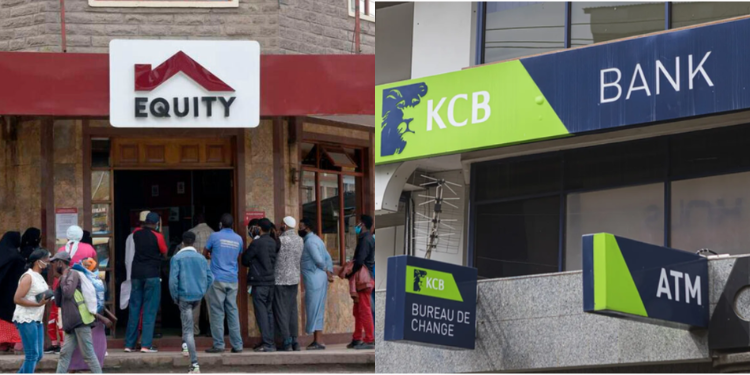
Large homegrown banks like KCB, Equity, Coop, I&M, DTBK, and Family, with combined total assets of Ksh 3.9 trillion in December 2024, account for 52.3% of the banking industry’s Ksh 7.5 trillion in assets. They are best placed to foster pervasive national transformation, especially if they shift from a commercial-bank mentality to a development-bank perspective.
| Table 1- Banks Allocate Scarce Resources to All Economic Actors Just Like the Economy and Government (Kshs Millions) | |||
| Sector of the Economy. | Banking Industry Loans Allocation -Sept 2025. | Government Budget Allocation-2025/26. | Economy’s GDP Allocation – Dec 2025 at Current Prices. |
| Agriculture, forestry and fishing. | 153,500 | 97,012.60 | 4,070,960 |
| Mining and quarrying. | 21,500 | 1,630.59 | 141,696 |
| Manufacturing. | 590,300 | 1,251,981 | |
| Building and construction | 192,500 | 1,141,540 | |
| Trade, Business Services ( Professional & Administrative)- G.E.C.A. | 899,800 | 49,137.60 | 1,822,496 |
| Transportation + Communications (ICT). | 343,400 | 335,290.91 | 2,485,468 |
| Financial and insurance activities | 154,600 | 1,464,998 | |
| Real estate- Housing; community services | 459,700 | 102,634.90 | 1,433,937 |
| Private households final consumption (EXPENDITURE APPROACH) + Other activities | 1,164,500 | 13,411,742 | |
| Government final consumption (EXPENDITURE APPROACH) | 2,881,000 | 3,683,872.85 | 1,970,713 |
| Sources: CBK Quarterly Economic Review Q3 2025, KNBS Economic Survey (2026) | |||
Financing the Dreams and Aspirations of Ordinary Mwananchi
These banks provide savings, credit, payments, insurance, investments, treasury and trade finance services to households. They are key drivers in building a savings culture among Kenyans. They provide households with credit to ensure they maintain their consumption levels. This stood at Kshs 1.16 trillion for private households, consumer durables, and other activities by September 2025.
Also Read: List of 10 Largest Banks in Kenya by Market Share
They digitize citizens by enabling their digital lifestyles through payments. They create jobs directly and indirectly through the businesses they finance, to solve Kenya’s topmost problem: 19% of youths aged 15-34 years are Not in Education, Employment, or Training (NEETs) in December 2022.
They are critical in providing public goods, such as free financial literacy programs for Kenyans, to help them achieve their dreams and aspirations. Equity Bank had trained 2,493,261 women and youths in March 2026. These banks are blue-chip companies at the Nairobi Securities Exchange (NSE), enriching Kenyans through Total Shareholder Returns (TSR), i.e., dividend payments plus rise in their share prices. The combined NSE market capitalization of Equity, KCB, Coop, I&M and DTBK stood at Kshs 761.9 billion in March 2026.
Financing the Dreams and Aspirations of Kenyan Entrepreneurs
Entrepreneurs mobilize factors of production, take well-calculated risks, and create value in the products and services they sell to their end customers.
Banks are critical actors in financing the development of the private sector, which creates the majority of the jobs and incomes and thus solves Kenya’s problem of unemployment and poverty. The total credit to the private sector by banks stood at Kshs 3.9 trillion in September 2025. Their payment solutions are key to digitizing businesses, enabling the formalization of the informal sector, and linking MSMEs to the value chains of ecosystem anchors, i.e., large manufacturing corporates.
They inspire Kenyan businesses by showing that it can be done and that the impossible is possible through their own grass-to-grace success journeys. Their shared prosperity business models integrate MSMEs as agents and merchants to distribute their products to the last mile.
KCB had 1.3 million agents and merchants in 2025. Their capacity builds the entrepreneurship skills of MSMEs through training using curricula such as the ILO Start and Improve Your Business (SIYB) or IFC’s Business Edge.
This means they are key to making Kenya a startup nation. Equity Bank has trained 1,016,134 MSMEs in entrepreneurship and disbursed USD 3.4 billion to the trained businesses by March 2026.
Financing the Dreams and Aspirations of Government
These banks have adopted and mainstreamed the dreams and aspirations of Kenya Vision 2030, Africa Agenda 2063, and the UN Sustainable Development Goals (SDGs) into their social purposes and strategic plans. These banks are among the largest taxpayers of Corporate Income Tax (CIT), VAT, excise duties, and collect withholding tax for the government. KCB paid Kshs 22.6 billion and KCB Kshs 16.6 billion in CIT in 2025. They are the top buyers of government development finance papers, i.e., treasury bills, treasury bonds, and infrastructure bonds (IFBs), with Equity Bank leading at Kshs 577.8 billion and KCB with Kshs 453.7 billion in 2025.
Serial Innovation and Business Sophistication
These banks are amongst the fastest adopters, scalers, and spenders on 4th Industrial Revolution technologies. They are thus amongst the most innovative companies in Kenya, offering a range of solutions, including mobile apps, digital wallets, web portals, and software.
Also Read: CBK Reveals Latest 2026 Loan and Savings Rates for 38 Kenyan Banks
They have adopted Group Holding Company organization structures. Most of them are evolving into technology companies. They are adept at mergers and acquisitions (M&As). Between 2015 and 2023, Equity Group acquired Procredit-DRC, BCDC-DRC, and Cogebanque-Rwanda, while KCB acquired BPR-Rwanda, Trust Merchant Bank-DRC, and Riverbank Solutions.
Connecting the Country to Africa, Global Financial Systems and Ecosystems
Many of these banks are exporting financial innovations in Kenya like agency banking, mobile banking, and digital wallets to other countries in Africa, following the footsteps of West African (UBA, Access, GTB, EcoBank), South African (Stanbic, ABSA, Nedbank) and North African (BOA, CIB ) banks.
They connect Kenya to the world through trade finance, treasury training and payment settlement systems (e.g. SWIFT). They anchor the foreign exchange reserves through the mobilization of diaspora remittances, which stood at Kshs 661.2 billion in 2025; Foreign Direct Investments (FDI, Kshs 143.6 billion); exports (Kshs 2.7 trillion); tourism receipts (Kshs 500 billion); and facilitate the financing of imports (Kshs 1.1 trillion). They mobilize foreign currency loans from Development Finance Institutions (DFIs) like IFC, EIB, Proparco, KFW, BII, and FMO, plus Sovereign Wealth Funds (SWFs) like Norfund, to finance MSMEs to import, repay loans, or for the government to repay foreign-currency public debt. Equity Bank had Kshs 105 billion in borrowed funds, and KCB had Kshs 72.4 billion in March 2026.
Tips on Getting Maximum Benefits from Large Homegrown Kenyan Banks
- Get their free financial literacy training.
- Get their free entrepreneurship education.
- Get digitized by subscribing to their payments systems.
- Become their partner in their distribution value chain as an agent or merchant.
- Consume their products to benefit from their one-stop business model.
- Invest in their NSE shares to receive dividends and benefit from a rise in the stock price.
- Partner with their Corporate Foundations to benefit from their Impact Investments.
- Bank with them to benefit from their ability to protect you from financial crimes.
- Join their trade and investment missions abroad to expand your business.
Follow our WhatsApp Channel and X Account for real-time news updates.