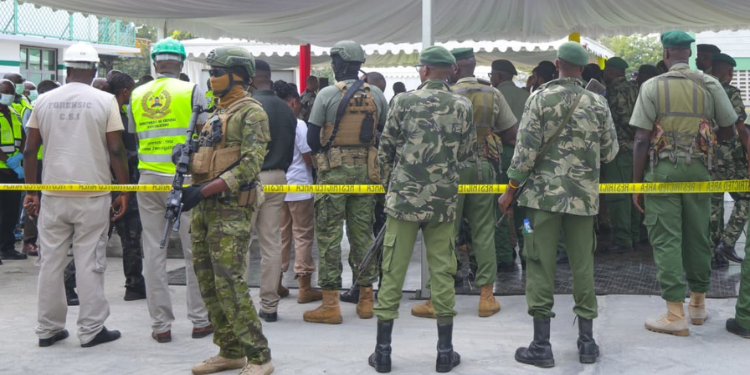
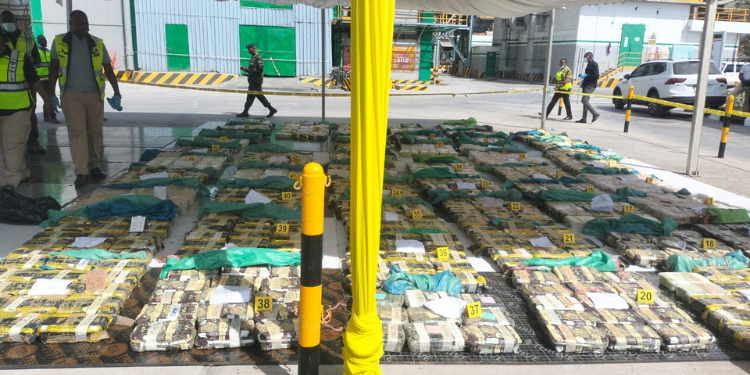
The government is set to destroy Methamphetamine valued at KSh8.2 billion in Mombasa after authorities completed legal processes surrounding one of the largest narcotics seizures ever recorded in East Africa.
The drugs were intercepted in the Indian Ocean in October 2025 in an operation involving the Kenya Navy, Directorate of Criminal Investigations (DCI), the Kenya Coast Guard, and National Authority for the Campaign Against Alcohol and Drug Abuse (NACADA).
Drugs Worth KSh8.2 billion to be Destroyed
Methamphetamine was discovered aboard a stateless vessel intercepted 630 kilometers east of Mombasa following intelligence shared by regional and international security partners.
During the operation, six Iranian nationals, Jaseem Darzadeh Nia, Nadeem Jadgal, Hassan Baloch, Raheem Baksh, Imran Baloch and Imtiyaz Daryay, are charged with trafficking 1,036.044 kilograms of methamphetamine.
Also Read: DCI Reveals What Happened to Viral Man Who Died in Police Custody
Investigators tracked, intercepted, and escorted a vessel identified in court documents as MV Mashallaah to the Port of Mombasa for inspection.
According to DCI Director Mohamed Amin, investigators recovered hundreds of packages containing crystalline substances that laboratory analysis confirmed to be methamphetamine.
Narcotics weighed 1,024 kilograms and were found to have a purity level of about 98 percent, making the haul one of the largest ever seized in the region.
The National Police Service estimated the street value of the drugs to be worth KSh8.2 billion, and the shipment was linked to international trafficking networks operating across the Indian Ocean.
Law Provision for Disposal of Seized Narcotics
The planned destruction of the methamphetamine is anchored in Kenya’s Narcotic Drugs and Psychotropic Substances (Control) Act, 1994 (Cap. 245).
The law criminalizes the possession and trafficking of narcotic drugs and psychotropic substances and provides legal mechanisms for the handling and disposal of seized contraband.
Also Read: DCI Arrests 12 for Blocking Rachel Ruto’s Motorcade
“An Act of Parliament to make provision with respect to the control of the possession of, and trafficking in, narcotic drugs and psychotropic substances and cultivation of certain plants; to provide for the forfeiture of property derived from, or used in, illicit traffic in narcotic drugs and psychotropic substances and for connected purposes,” reads the law.
Under the law, victims of trafficking in narcotic drugs are subjected to fines and life imprisonment upon conviction.
Under Section 4 of the Act, any person convicted of trafficking narcotic drugs is liable to a fine of KSh1 million or three times the market value of the drugs, whichever is greater, in addition to life imprisonment.
The Act also provides that a person who traffics a substance that is not a narcotic drug or psychotropic substance, but falsely represents or holds it out as one, is liable to a fine of KSh500,000 and imprisonment for a term not exceeding 20 years.
The state also has the power to seize drugs connected to criminal activity and retain them as evidence during investigations.
Under the legislation, the police dispose of seized narcotics after meeting evidence and judicial requirements. This process is intended to ensure that illegal drugs do not re-enter circulation while in government custody.
Only samples needed for evidence are retained, while the bulk of the seized substances are destroyed once the courts authorize their disposal.
Follow our WhatsApp Channel and X Account for real-time news updates.