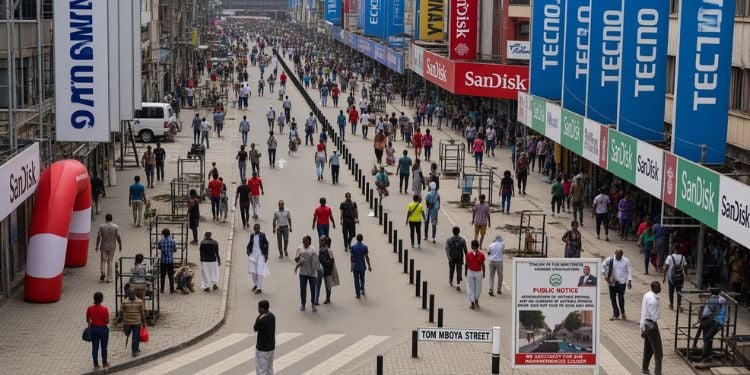
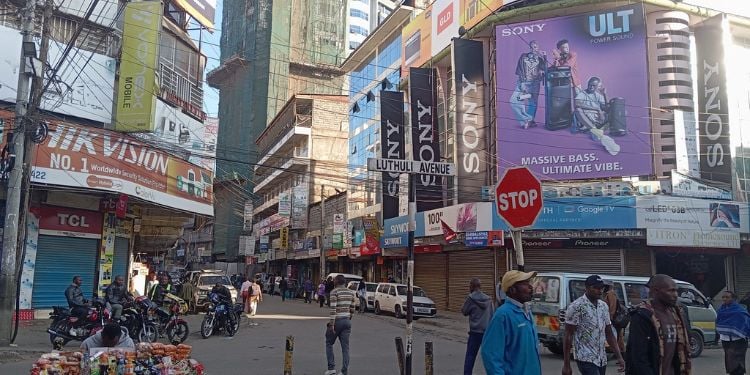
Luthuli Avenue is a short but commercially important street in Nairobi’s CBD, running from Tom Mboya Street to River Road.
It has evolved from a colonial-era road into one of East Africa’s busiest hubs for electronics and mobile-phone trading.
The street was renamed after South African anti-apartheid leader Chief Albert Luthuli during the post-independence period.
Before Kenya gained independence, the street was known as Campos Ribeiro Avenue, named after a Portuguese figure associated with colonial-era Nairobi.
Between 1964 and 1970, it was renamed as Nairobi replaced colonial street names with identities reflecting African history and the independence era.
The new name honoured Chief Albert John Luthuli, who served as president-general of the African National Congress (ANC) from 1952 to 1967.
He was recognised for his nonviolent resistance to apartheid, South Africa’s system of racial segregation and discrimination.
In 1960, Luthuli received the Nobel Peace Prize for his efforts against apartheid, making him an internationally recognised figure in the struggle for racial equality.
Albert Luthuli died in 1967.
Also Read: Story Behind Nation Centre’s 17-Storey Landmark and the New Structure Beside It
From a Congested Street to an Electronics Hub
For much of its later history, Luthuli Avenue was a congested commercial street in Nairobi’s Central Business District. By the 2000s, it had become widely known for mobile phone sales, with Nokia handsets initially dominating the market because they were durable and easy to repair.
Samsung products later gained prominence, followed by Chinese brands such as Tecno, Huawei, Itel, Oppo, Xiaomi and Oraimo. The growing presence of these brands helped strengthen the avenue’s reputation as a destination for mobile phones and electronic devices.
By 2020, the Nation had described Luthuli Avenue as Nairobi’s “technology centre.” Hundreds of shops sold mobile phones, televisions, cameras, memory cards, flash disks, and electronic accessories, attracting customers seeking a wide range of products and repair services.
The avenue also became a regional trading hub, drawing customers and suppliers from across East Africa and beyond. Its commercial growth was supported by the concentration of small traders, importers, repair technicians and refurbishers operating within a relatively short stretch of the street.
Research on Nairobi’s digital economy described Luthuli Avenue as the “pulsating heart” of China’s digital presence in Kenya. Affordable Chinese mobile phones, locally known as chinku, became part of the street’s trade, with businesses selling, repairing and repurposing the devices.
Area and Location
Luthuli Avenue runs through Nairobi’s Central Business District (CBD), within the city’s busy downtown commercial zone, and the short east–west street begins at its junction with Tom Mboya Street, near the Kenya National Archives, and runs east to River Road, passing near Munyu Road and Ronald Ngala Street.
The avenue sits between two of Nairobi’s busiest commercial corridors, with Tom Mboya Street to the west and River Road to the east.
Its location places it near key landmarks and commercial areas, including the Kenya National Archives, OTC, Afya Centre and the wider downtown electronics market.
Despite its short length, Luthuli Avenue is a key commercial area, characterised by heavy pedestrian traffic, matatu stages, arcades, wholesale shops, and transport connections.
2019–2020 Redevelopment
In 2019, Nairobi County, working with UN-Habitat, undertook a KSh 24 million refurbishment of Luthuli Avenue under then-Governor Mike Sonko.
The project aimed to improve movement along the busy commercial street by changing traffic flow and pedestrian infrastructure.
As part of the redesign, the avenue was converted into a one-way route, matatu terminus activities were removed, pedestrian walkways were widened, and benches were installed.
Under the new traffic arrangement, motorists were directed to enter the street from Tom Mboya Street and exit onto River Road.
The changes were intended to ease congestion, improve pedestrian movement and make the avenue more suitable for shoppers, traders and other members of the public.
Follow our WhatsApp Channel and X Account for real-time news updates.